
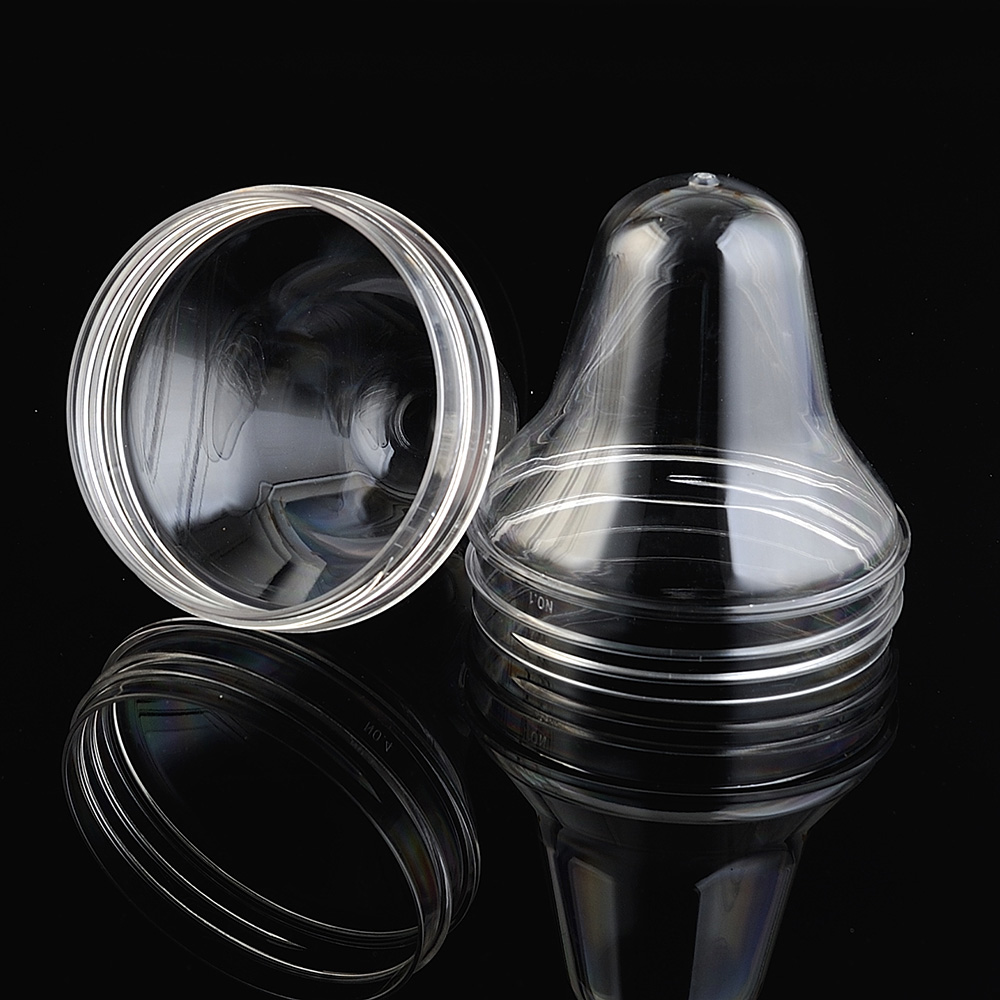
Why Mold Steel Selection Matters: S136 vs P20 for PET Preform Molds
A Technical Metallurgical Guide for Beverage Packaging Converters and Injection Molders by GTWMOULD
Introduction: Metallurgy as the Foundation of Mold Longevity and Performance
In high-speed Polyethylene Terephthalate (PET) preform manufacturing, selecting the appropriate tool steel for mold core, cavity, and neck finish components is a decision that dictates long-term return on investment (ROI), maintenance overhead, and preform optical quality. PET molding presents a challenging mechanical and chemical environment: continuous high hydraulic injection pressures ($1000\text{--}1500 \text{ bar}$), rapid thermal cycling, and corrosive chemical outgassing during resin melting.
Choosing an inappropriate steel grade leads to premature surface pitting, cooling line oxidation, parting line wear, and core pin bending—resulting in costly un-scheduled downtime and high scrap rates. As an industry-leading Chinese manufacturer and specialized solution provider, GTWMOULD manufactures high-precision PET preform molds designed for multi-million cycle operation. This technical guide delivers an in-depth comparative analysis of S136 stainless steel versus P20 tool steel, outlining why strategic metallurgical selection is essential for modern packaging plants.
1. Chemical Composition and Metallurgical Comparison
The operational capabilities of S136 (ESR Grade AISI 420 Stainless) and P20 (AISI P20 / 1.2311 Low-Alloy Tool Steel) stem directly from their underlying chemical compositions and heat treatment profiles.
| Metallurgical Property | S136 Stainless Steel (ESR Grade) | P20 Tool Steel (Pre-Hardened) | Impact on PET Preform Molding |
|---|---|---|---|
| Chromium (Cr) Content | $12.5\% \text{--} 14.5\%$ | $1.40\% \text{--} 2.00\%$ | High Chromium creates a passive oxide layer that resists acidic polymer outgassing and chilled water line corrosion. |
| Achievable Hardness | $48 \text{--} 52 \text{ HRC}$ (Through-Hardened) | $28 \text{--} 32 \text{ HRC}$ (Pre-Hardened) | Higher hardness prevents parting line deformation, core bending, and scratches from dust or resin inclusions. |
| Corrosion Resistance | Exceptional (Resists moisture oxidation & PET gas) | Low to Moderate (Prone to rusting without plating) | S136 prevents internal water-channel rust scaling, maintaining high heat transfer rates over years of service. |
| Polishability & Clarity | Super-mirror polish (ESR electro-slag remelted) | Standard technical polish | Mirror surface finish is essential to achieve 100% crystal-clear, scratch-free preform surfaces without optical distortion. |
| Wear Resistance | Extreme wear resistance under abrasive friction | Moderate wear resistance | High resistance ensures neck split thread profiles retain precise dimensions across millions of demolding cycles. |
2. Structural Impact on Mold Sub-Systems
Core Pins, Cavity Inserts, and Neck Split Rings (S136 Recommended)
Core pins, cavity inserts, and neck splits come into direct contact with molten PET at temperatures between $270^\circ\text{C}$ and $290^\circ\text{C}$. During melt processing, small amounts of acidic gases (such as acetaldehyde and volatile organic acids) are released. Standard P20 steel reacts with these compounds, leading to microscopic pitting over time. Once pitted, preforms lose optical clarity and become difficult to eject.
GTWMOULD utilizes electro-slag remelted (ESR) certified Swedish S136 stainless steel vacuum-hardened to $48\text{--}52 \text{ HRC}$ for all moulding inserts. This guarantees:
- Zero Chemical Pitting: Resistance to PET outgassing degradation ensures pristine preform surface finish.
- Sub-Micron Concentricity Retention: High tensile yield strength prevents core pin deflection under $1200 \text{ bar}$ injection pressures, maintaining strict concentricity limits:
$$\Delta \le 0.015 \text{ mm}$$
- Mirror Polish Longevity: Maintains SPI A1 / Ra 0.02 $\mu\text{m}$ surface finishes without requiring frequent re-polishing.
Structural Mold Bases and Plates (P20 / AISI 420 Hybrid Design)
While S136 is superior for moulding inserts, utilizing solid S136 for massive external structural plates significantly increases mold cost without proportional performance gains. P20 steel (or nickel-plated AISI 420) is an ideal, cost-effective choice for structural mold bases, clamping plates, and ejector frames where direct resin contact does not occur.
GTWMOULD applies pre-hardened P20 or nickel-plated steel for main mold frames, providing excellent shock absorption, structural stability, and resistance to clamping force distortion.
3. Thermodynamic and Financial ROI Analysis
Preventing Cooling Line Scale and Thermal Efficiency Degradation
PET preform molds utilize high-velocity chilled water lines ($6\text{--}10^\circ\text{C}$) to quench preforms rapidly below $T_g \approx 75\text{--}80^\circ\text{C}$. When internal cooling channels are drilled into non-stainless P20 steel, moisture and dissolved oxygen cause internal rust scaling. Rust acts as a thermal insulator, dropping heat transfer efficiency by up to 30% after 12 to 18 months of operation.
By specifying S136 stainless inserts integrated with GTWMOULD's high-pitch spiral cooling channels and Beryllium-Copper (BeCu) thermal inserts, cooling efficiency remains constant over millions of cycles, protecting total cycle times and output.
Long-Term Total Cost of Ownership (TCO) Comparison
While an S136 stainless steel tool carries a $20\%\text{--}30\%$ higher initial capital purchase price compared to an all-P20 tool, the total life-cycle economics favor S136 for medium and high-volume production:
- Maintenance Frequency: S136 tools require 70% fewer mold teardowns for re-polishing and rust removal.
- Tool Lifespan: GTWMOULD S136 cavity stacks are warranted for over 5 to 8 million shots, compared to 1 to 2 million shots for P20 tooling.
- Scrap Rate Reduction: Eliminates wall eccentricity and surface scratch defects, keeping long-term production scrap below 0.15%.
4. GTWMOULD Precision Manufacturing Integration
Combining world-class steel alloys with sub-micron CNC machining ensures that every GTWMOULD tool operates at peak efficiency:
- Vacuum Heat Treatment: All S136 inserts undergo computer-controlled vacuum hardening and triple tempering to eliminate internal stress and guarantee uniform hardness throughout the component.
- Triple-Taper Component Alignment: Locks core pins, cavity inserts, and neck splits along three independent mechanical tapers, ensuring wall thickness variations stay strictly under $0.03 \text{ mm}$.
- DLC Slide Coatings: Diamond-Like Carbon (DLC) surface treatments applied to neck split slides allow smooth, oil-free mechanical movement without lubricant contamination on preform thread finishes.
Conclusion: Making the Strategic Steel Choice with GTWMOULD
Selecting the right steel grade is a strategic decision that balances upfront Capital Expenditure (CapEx) against long-term Operational Expenditure (OpEx). While P20 steel serves as a viable cost-effective choice for prototype or short-run structural plates, Swedish S136 stainless steel is the undisputed industry standard for high-volume, high-precision PET preform cores, cavities, and neck rings.
Partnering with **GTWMOULD** guarantees access to certified premium metallurgy, advanced thermodynamic cooling, and sub-micron core alignment—delivering preform tooling systems optimized for maximum output and lowest unit manufacturing cost.
Contact GTWMOULD's technical engineering team today to evaluate your material specifications and receive a tailored tooling proposal for your injection moulding operations.