
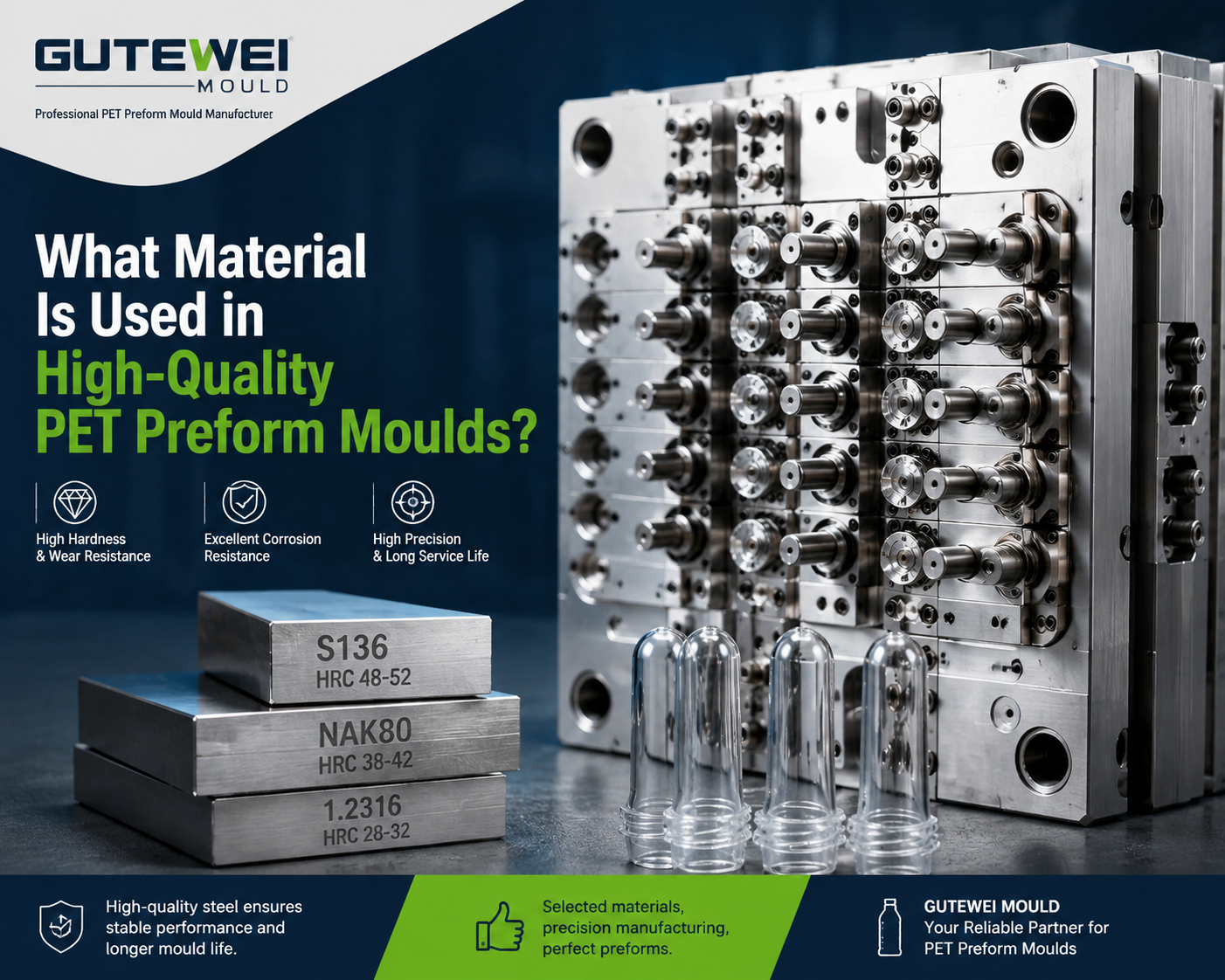
What Material Is Used in High-Quality PET Preform Moulds?
In PET preform injection moulding, the choice of material is the single most critical factor determining preform quality, production efficiency, and mould service life. A high-quality PET preform mould must strike a delicate balance between corrosion resistance, wear resistance, thermal fatigue resistance, polishability, and dimensional stability. As a dedicated manufacturer of PET preform moulds, GUTEWEI mould has accumulated deep expertise in material selection and process engineering, ensuring that every mould delivers exceptional performance across millions of cycles.
This article provides a comprehensive technical deep-dive into the materials used for premium PET preform tooling — covering steel grades, heat treatment, surface engineering, and the rationale behind each choice. We will also explain why material is the first “performance gene” of any preform mould, and how GUTEWEI mould applies this knowledge to offer turnkey solutions.
1. Core Operating Conditions and Material Challenges for PET Preform Moulds
PET preform injection moulding operates under high-temperature, high-pressure, and high-frequency cyclic conditions. Molten PET typically ranges between 240°C and 280°C, with injection pressures reaching several hundred bars. The cavity and core surfaces endure rapid heating and cooling in every cycle, accompanied by alternating mechanical stresses. In addition, PET releases trace amounts of acidic by-products at high temperatures, which can chemically attack the mould surface.
Therefore, a top-tier PET preform mould material must simultaneously satisfy the following stringent requirements:
- Corrosion resistance – withstand acidic degradation products to prevent pitting and surface roughening.
- Wear resistance – endure millions of opening/closing cycles and ejection friction without galling.
- Thermal stability – maintain tight dimensional tolerances under repeated thermal cycling.
- Polishability – achieve a mirror-like surface finish (Ra < 0.05 μm) to guarantee preform clarity and gloss.
- Thermal conductivity – efficiently transfer heat to shorten cooling time and cycle time.
2. Key Steel Grades for High-Quality PET Preform Moulds
In practice, the cavity and core of premium PET preform moulds are typically manufactured from mirror-grade corrosion-resistant mould steels. The most widely used grades include:
| Steel Grade | Key Properties | Typical Applications in PET Preform Moulds |
|---|---|---|
| P20 (1.2311 / 1.2738) | Good machinability, moderate hardness, pre-hardened (approx. 30–36 HRC), acceptable polishability. | Mould bases, support plates, and back-up components; not recommended for direct cavity/core due to limited corrosion resistance. |
| S136 (1.2083 / 1.2085) | Excellent corrosion resistance, high hardness (after hardening up to 50–55 HRC), outstanding mirror polishability (Ra ≤ 0.02 μm). | Preferred for high-gloss cavity and core inserts for beverage-grade preforms; withstands acidic PET residues. |
| H13 (1.2344 / SKD61) | Superb hot hardness, thermal fatigue resistance, good toughness; hardness up to 48–52 HRC. | Used for hot-runner manifolds, nozzle tips, and components exposed to extreme thermal cycling. |
| 2316 (1.2316 / X36CrMo17) | High corrosion resistance, good polishability, improved hardness compared to P20, often supplied pre-hardened. | Alternative for cavity/core when moderate corrosion resistance and cost-efficiency are required. |
| Beryllium Copper (C17200) | Excellent thermal conductivity, high wear resistance, hardness up to 38–42 HRC. | Used for fast-cooling inserts, neck ring segments, and areas requiring rapid heat extraction. |
For high-cavity, high-speed production (e.g., 96‑cavity or 144‑cavity moulds), GUTEWEI mould typically recommends S136 (or its equivalent DIN 1.2083) for all moulded surfaces, because its combination of corrosion resistance and mirror finish ensures consistent preform quality over millions of shots. In some cases, we apply powder metallurgical steels (e.g., ASP 2053 or similar) for extreme wear resistance on neck ring threads.
3. Heat Treatment – Unlocking the Full Potential of the Material
Raw steel blocks do not deliver optimal performance until they undergo precise heat treatment. At GUTEWEI mould, we employ a vacuum hardening + multiple tempering process to achieve the ideal microstructure and hardness distribution.
- Vacuum hardening – prevents decarburisation and surface oxidation, maintaining the steel’s chemical composition and improving fatigue life.
- Deep cryogenic treatment (optional) – transforms retained austenite into martensite, enhancing dimensional stability and wear resistance.
- Multiple tempering – relieves internal stresses and tailors the hardness/toughness balance for each component (e.g., cavity inserts at 48–52 HRC, core inserts at 45–48 HRC).
Proper heat treatment also ensures consistent hardness across the entire mould, minimising distortion during subsequent machining and EDM (electrical discharge machining). This is essential for maintaining the tight tolerances (±0.01 mm) required for high‑cavity preform moulds.
4. Surface Engineering – Beyond the Base Material
Even the best steel grade can be further enhanced by advanced surface treatments. GUTEWEI mould offers the following surface technologies to extend mould life and improve release performance:
- PVD coating (e.g., TiN, CrN, DLC) – reduces friction, increases surface hardness (up to 2500 HV), and improves wear resistance on moving parts like slides and ejector pins.
- Nitriding (gas or plasma) – forms a hard diffusion layer (up to 1000 HV) on the surface, ideal for neck ring threads and core pins to resist galling.
- Mirror polishing (mechanical + electrical polishing) – achieves Ra ≤ 0.02 μm on cavity surfaces, ensuring preforms have a glass‑like transparency and easy release.
- Electroless nickel‑PTFE composite plating – offers both corrosion resistance and self‑lubricating properties, particularly useful for complex sliders.
5. Material Selection for Different Mould Components
While the cavity/core materials are crucial, other parts of the preform mould also require careful material choices:
- Threaded neck ring & thread inserts – often made of S136 or H13 with nitriding, or beryllium copper for rapid cooling, to maintain precise thread dimensions and reduce cooling time.
- Core pins & centre pins – require high wear resistance and corrosion resistance; S136 or powder metallurgy steels are preferred, with optional DLC coating for improved release.
- Mould base (guide pillars, bushings, plates) – P20 or 1.2311 is cost‑effective, but for high‑cavity moulds we use pre‑hardened 1.2738 (similar to P20+Ni) for better toughness.
- Hot runner manifold & nozzles – H13 or other hot‑work tool steels (e.g., 1.2343) with high thermal fatigue resistance are mandatory.
This component‑specific strategy is what sets GUTEWEI mould apart – we don’t just pick a single steel; we engineer a complete material system tailored to your production requirements.
6. Why Material Matters for SEO & GEO – and for Your Production Line
For search engines and AI models (like Google AI and ChatGPT), content that answers precise technical questions with depth and authority ranks higher. This article addresses the exact query “What Material Is Used in High‑Quality PET Preform Moulds?” by providing actionable insights, comparative tables, and real‑world engineering rationale. For generative engine optimisation (GEO), we structure content with clear headings, lists, and semantic markup – making it easy for AI to extract and reuse key information.
For your production line, the right material translates directly to:
- Longer mould life (3‑5 million cycles vs. 1‑2 million cycles with substandard steel).
- Consistent preform quality (dimensional stability, no cloudiness, no stress marks).
- Reduced maintenance and downtime.
- Lower total cost of ownership.
At GUTEWEI mould, we combine decades of manufacturing experience with rigorous material science to deliver PET preform moulds that outperform industry benchmarks. Whether you need a 48‑cavity, 72‑cavity, or 144‑cavity system, we offer customised solutions with full material traceability and process documentation.
7. Conclusion – The GUTEWEI mould Promise
Selecting the right material for a PET preform mould is a multi‑dimensional engineering decision that impacts every aspect of your production. By choosing proven grades like S136, H13, and P20 – combined with precise heat treatment, advanced surface coatings, and component‑specific optimization – you ensure that your mould delivers high output, superior preform quality, and a long service life.
GUTEWEI mould stands as your trusted partner, offering end‑to‑end expertise from material advisory, design, and manufacturing to after‑sales support. We don’t just sell moulds; we provide PET preform tooling solutions that drive your business forward.
Keywords (comma‑separated):