
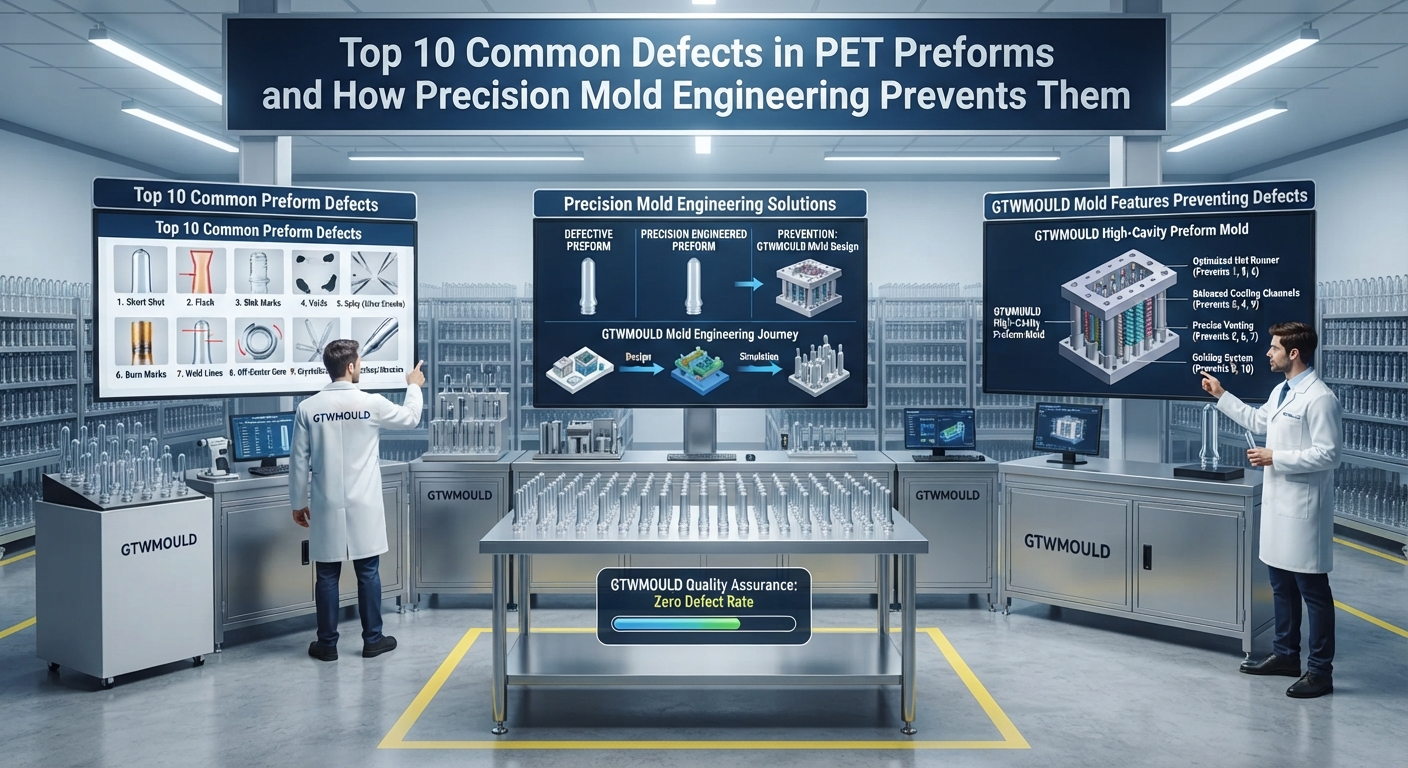
Top 10 Common Defects in PET Preforms and How Precision Mold Engineering Prevents Them
A Definitive Technical & Diagnostic Blueprint for Eliminating Injection Flaws Through Advanced Tooling Design by GTWMOULD
Introduction: Zero-Defect Manufacturing in High-Speed PET Injection Lines
In high-cavitation Polyethylene Terephthalate (PET) preform injection molding, minor processing deviations or mechanical tool misalignments quickly cascade into high scrap rates, unscheduled machine downtime, and compromised container structural integrity. Because PET preforms undergo downstream two-stage stretch blow molding, any physical imperfection, thermal stress zone, or volumetric variation in the preform is drastically amplified in the final blown bottle.
While basic processing tweaks can temporarily mask certain visual flaws, achieving permanent, zero-defect yield requires engineering precision directly into the mold architecture. As a world-class authority in high-precision PET preform mold manufacturing, GTWMOULD designs and builds tooling systems that systematically prevent production flaws. This technical diagnostic manual explores the Top 10 Common Defects in PET Preforms and How Precision Mold Engineering Prevents Them.
1. Wall Thickness Eccentricity (Uneven Wall Distribution)
Uneven wall thickness around the preform circumference causes uneven thermal absorption during infrared reheating in stretch blow molding, leading to localized bottle blowouts or structural wall failure.
- Root Cause: Core pin displacement or bending caused by unbalanced injection forces during the high-pressure filling phase ($1000\text{--}1500 \text{ bar}$).
- GTWMOULD Engineering Prevention: We implement a proprietary triple-taper self-locking component alignment system across every individual cavity stack. By locking the core pin, cavity insert, and neck split along three precise mechanical tapers, core-to-cavity concentricity is locked within:
$$\Delta \le 0.015 \text{ mm}$$
This restricts total wall-thickness variation strictly under 0.03mm, completely neutralizing core deflection under extreme injection pressure.
2. Body Hazing (Thermal Crystallization)
Milky or cloudy appearance across the main body of the preform that destroys optical clarity and prevents proper biaxial orientation during blowing.
- Root Cause: Slow cooling rates allowing polymer chains to organize into crystalline spherulites before the material freezes below its glass transition temperature ($T_g \approx 75\text{--}80^\circ\text{C}$).
- GTWMOULD Engineering Prevention: GTWMOULD incorporates high-pitch spiral-wound cavity cooling channels wrapping closely around individual cavity inserts, combined with high-velocity internal turbulent core bubblers. Rapid, uniform thermal quenching traps the polymer in a crystal-clear, 100% amorphous state.
3. Gate Hazing and Gate Crystallization
A cloudy white ring or spot surrounding the injection gate base at the bottom of the preform.
- Root Cause: Excessive thermal accumulation around the injection nozzle tip or insufficient heat extraction at the gate insert.
- GTWMOULD Engineering Prevention: Press-fitted Beryllium-Copper (BeCu) gate inserts are integrated directly into the gate zone. BeCu conducts thermal energy up to 10x faster than standard stainless steel, dissipating localized heat instantly and eliminating gate-zone crystallization.
4. Gate Tailing, Stringing, and Uncut Vestiges
Protruding stringy tails or long gate vestiges that interfere with automated robot transfer, jam downstream stretch rods, or puncture bottle bases.
- Root Cause: Thermal drooling at open hot runner gates or worn mechanical valve pins.
- GTWMOULD Engineering Prevention: Integration of a custom pneumatically actuated valve gate hot runner system featuring individually guided shut-off pins. Mechanical pin closure delivers a completely smooth, flush gate base with zero stringing or tailing.
5. High Acetaldehyde (AA) Levels
Elevated levels of Acetaldehyde (AA)—a thermal breakdown byproduct of PET—which imparts a sweet, off-flavor taste to bottled still water.
- Root Cause: High polymer shear stress and excessive residence time in restricted or uneven hot runner channels.
- GTWMOULD Engineering Prevention: Our hot runners feature FEA-calculated, naturally balanced flow pathways with micro-polished interior channel walls. This low-shear, uniform-velocity design prevents localized material overheating and keeps AA generation below strict industry limits ($< 2.0 \text{ ppm}$).
6. Neck Finish Distortion and Thread Ovality
Deformed, out-of-round thread finishes or parting line flash on the neck ring that compromise bottle cap sealing integrity.
- Root Cause: Ejection of the preform while the thick neck finish section is still soft, or mechanical wear on slide split surfaces.
- GTWMOULD Engineering Prevention: Neck split inserts feature independent water cooling circuits equipped with BeCu cooling blocks for immediate thread solidification. Furthermore, Diamond-Like Carbon (DLC) low-friction coatings on sliding components ensure smooth, wear-free mechanical stripping.
7. Comprehensive Defect Prevention Matrix
The following technical matrix outlines the additional four major preform defects along with GTWMOULD's specialized tooling prevention mechanisms:
| Defect Category | Observed Defect & Impact | Primary Root Cause | GTWMOULD Tooling Prevention Solution |
|---|---|---|---|
| 8. Silver Streaks / Moisture Marks | Silver-colored splay streaks along the preform body causing structural weakness. | Hydrolytic degradation caused by improper resin drying or condensation on mold surfaces. | Optimized internal mold insulation plates and isolated cooling channels that eliminate surface sweat in humid plant environments. |
| 9. Burn Marks / Black Spots | Charred degradation specks embedded in the preform wall or gate area. | Trapped air pockets experiencing diesel effect compression, or thermal dead spots in hot runner channels. | Micro-venting channels along cavity parting lines and polished, dead-spot-free hot runner manifold channels. |
| 10. Shot-to-Shot Weight Fluctuation | Inconsistent volumetric filling weight across different cavities or cycle runs. | Unbalanced hot runner heating zones or irregular valve gate actuation timing. | Multi-zone PID thermal controllers paired with pneumatic valve pin manifold linkages for synchronized, identical multi-cavity filling. |
| 10. Short Shots (Incomplete Fill) | Unfilled preform rims or missing material near top thread sections. | Insufficient injection pressure, narrow gate orifices, or restricted venting paths. | Precision-calculated gate sizing and sub-micron venting gaps designed specifically for high-speed filling without flash. |
8. Premium Metallurgy for Multi-Million Cycle Reliability
Sustaining defect-free production over millions of continuous 24/7 injection cycles requires strict metallurgical standards:
- Swedish S136 Tool Steel: All core pins, cavity inserts, and neck rings are machined from genuine Swedish S136 stainless steel, vacuum-hardened to $48\text{--}52 \text{ HRC}$ for ultimate resistance against mechanical friction and corrosive polymer outgassing.
- DLC Low-Friction Coatings: Sliding neck ring split components feature Diamond-Like Carbon (DLC) surface treatments, enabling clean, oil-free mechanical movement that eliminates grease contamination on preform necks.
- Corrosion-Proof AISI 420 Base Frame: Structural mold plates built from AISI 420 stainless steel prevent rust and scale buildup inside internal cooling loops, preserving heat exchange efficiency year after year.
Conclusion: Partnering with GTWMOULD for Zero-Defect Manufacturing
Understanding the **Top 10 Common Defects in PET Preforms and How Precision Mold Engineering Prevents Them** makes it clear that defect elimination is achieved through superior tool engineering rather than trial-and-error processing adjustments. **GTWMOULD** translates decades of specialized engineering experience into high-performance preform molds designed to eliminate injection flaws, lower cycle times, and maximize long-term operational ROI.
Partner with GTWMOULD today to elevate your injection molding operations with world-class, high-precision preform tooling solutions.