
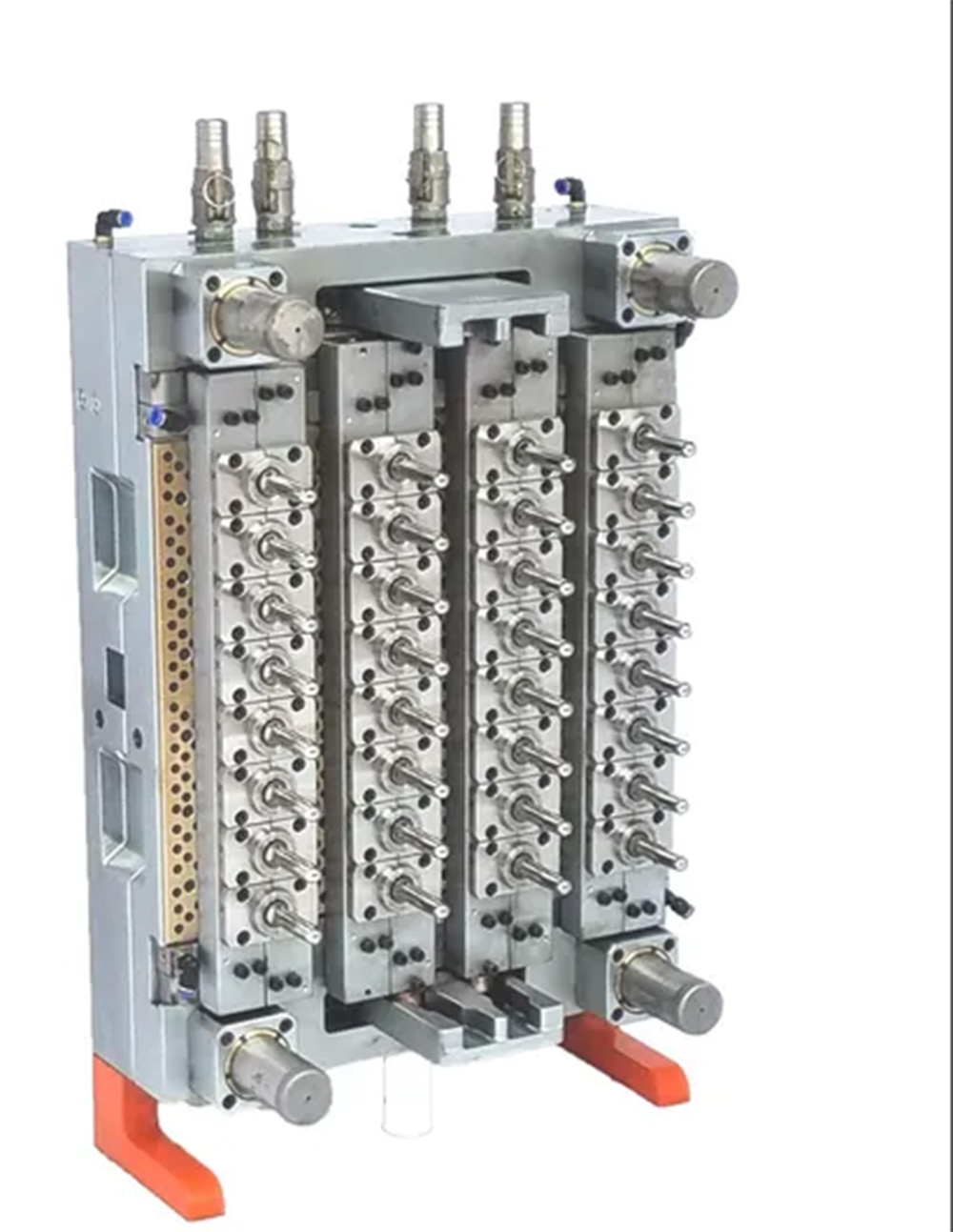
PET Resin Drying and Processing: Critical Steps for Defect-Free Preform Molding
A Technical Engineering Guide on Polymer Chemistry, Moisture Control, Thermal Processing, and Tooling Synergy by GTWMOULD
Introduction: Polymer Degradation Dynamics in PET Injection Molding
In high-cavitation Polyethylene Terephthalate (PET) preform injection molding, resin preparation before plasticization is just as vital as mechanical tool design. PET is a hygroscopic polyester resin that readily absorbs moisture from atmospheric air. Processing PET resin without adequate dehumidification triggers rapid hydrolytic degradation inside the injection barrel, breaking down polymer chains and permanently lowering Intrinsic Viscosity (IV).
Lower IV compromises preform tensile strength, leading to severe downstream failures during stretch blow molding, such as stress cracking, sidewall blowouts, and poor top-load performance. While proper resin drying is essential, achieving zero-defect preform yield requires total synergy between auxiliary drying systems, melt processing parameters, and precision mold architecture. As an industry-leading Chinese manufacturer and high-precision PET preform tooling specialist, GTWMOULD engineers molds designed to handle sensitive polymer melts perfectly. This technical manual explores the critical steps of PET resin drying and thermal processing for defect-free preform manufacturing.
1. The Science of PET Drying: Moisture Control & Hydrolysis Prevention
Virginal virgin PET resin typically contains environmental moisture levels between 0.15% and 0.40% by weight (1,500 to 4,000 ppm). To prevent hydrolytic chain scission during melting at temperatures above $260^\circ\text{C}$, resin moisture levels must be reduced to strictly below 0.005% (50 ppm) before entering the injection barrel.
The Four Universal Rules of Dehumidification
- Temperature: Desiccant dry air hovers between $160^\circ\text{C}$ and $180^\circ\text{C}$. Operating below $160^\circ\text{C}$ results in incomplete drying, while temperatures exceeding $185^\circ\text{C}$ induce thermal degradation and resin yellowing before plasticization.
- Dew Point: The drying hopper air supply must maintain a continuous dew point of $-40^\circ\text{C}$ or lower to pull moisture from the core of the PET pellets.
- Drying Time: Residence time inside the insulated drying hopper must range strictly between 4 to 6 hours. Short residence times result in wet core pellets, whereas over-drying ($> 8 \text{ hours}$) degrades polymer IV.
- Air Flow Rate: High-volume airflow ($\ge 3.5 \text{ m}^3/\text{hr}$ per kg/hr of resin throughput) ensures consistent thermal heat transfer across all hopper pellet layers.
2. Polymer Thermal Processing & Processing Defect Diagnostics
Improper drying and thermal processing directly manifest as visible physical defects in molded preforms. The matrix below outlines common resin-related defect modes, their root processing causes, and GTWMOULD's precision tooling remedies:
| Defect Mode | Physical Characteristics & Downstream Impact | Root Processing / Drying Cause | GTWMOULD Tooling Prevention Solution |
|---|---|---|---|
| Silver Streaks / Splay Marks | Silver-colored fan-shaped streaks along the preform body causing structural weakness. | Hydrolytic degradation from moisture levels exceeding $50 \text{ ppm}$, or mold surface sweating. | Integrated mold insulation plates and anti-sweat dehumidified enclosure interfaces. |
| Intrinsic Viscosity (IV) Drop | Preform becomes brittle; blown bottles suffer low top-load and stress cracking. | Excessive moisture in melt causing chain cleavage, or excessive shear in hot runner. | Naturally balanced, FEA-designed hot runners with micro-polished low-shear flow channels. |
| Acetaldehyde (AA) Spikes | Off-flavor taste in bottled water due to thermal breakdown of polymer chains ($> 3.0 \text{ ppm}$). | Barrel melt temperature too high ($> 290^\circ\text{C}$) or high shear rates in runner gates. | Low-shear pneumatic valve gate nozzles and hyper-conductive Beryllium-Copper (BeCu) gate inserts. |
| Body & Gate Hazing | Milky, cloudy appearance across body wall or gate base destroying optical clarity. | Spherulitic crystallization caused by slow thermal quenching below $T_g \approx 75\text{--}80^\circ\text{C}$. | High-pitch spiral cavity cooling loops and turbulent core bubblers driving rapid heat extraction. |
3. Tooling Architecture Synergy: GTWMOULD Precision Solutions
Even perfectly dried PET resin will fail to yield pristine preforms if the injection mold introduces uneven stress, thermal dead zones, or mechanical concentricity shifts. GTWMOULD incorporates specific design sub-systems to preserve polymer IV and maintain crystal clarity:
1. FEA-Balanced Low-Shear Valve Gate Hot Runner Systems
GTWMOULD designs hot runner manifolds using Finite Element Analysis (FEA) polymer flow modeling. By micro-polishing internal runner channels and maintaining identical flow path lengths across all drops, shear stress is minimized. This maintains resin IV and keeps Acetaldehyde levels strictly below $1.8 \text{ ppm}$, fulfilling stringent beverage brand requirements.
2. Sub-Micron Triple-Taper Core Alignment
Uneven material flow during high-pressure injection causes core pin deflection, resulting in wall thickness variation. GTWMOULD utilizes an independent triple-taper self-locking component alignment system across every cavity stack, maintaining core-to-cavity concentricity strictly within:
$$\Delta \le 0.015 \text{ mm}$$
This restricts total preform wall variation under $0.025 \text{ mm}$, ensuring even thermal absorption during downstream stretch blow molding reheating.
3. Hyper-Conductive Metallurgy & Rapid Quenching
- Certified Swedish S136 Stainless Steel: Vacuum-hardened to $48\text{--}52 \text{ HRC}$, providing complete corrosion resistance against acidic PET outgassing and cooling line scale.
- Press-Fitted Beryllium-Copper (BeCu) Inserts: Placed in high-heat zones at the gate base and neck finish to dissipate heat up to 10x faster than standard steel, completely eliminating gate hazing.
- Diamond-Like Carbon (DLC) Slide Coatings: Enables oil-free, dry mechanical movement on neck splits, preventing lubricant contamination on preform threads.
Conclusion: Achieving Zero-Defect PET Preform Manufacturing
Understanding **PET Resin Drying and Processing: Critical Steps for Defect-Free Preform Molding** confirms that preform quality relies on a seamless balance between scientific material drying, precise melt processing, and high-performance mold design. By controlling resin moisture, minimizing hot runner shear stress, and utilizing sub-micron core alignment with hyper-conductive thermal cooling, **GTWMOULD** delivers industry-leading PET preform molds engineered for maximum yield, optical clarity, and lowest unit production cost.
Contact GTWMOULD's technical engineering team today to optimize your resin processing and receive a tailored tooling proposal for your PET injection lines.