
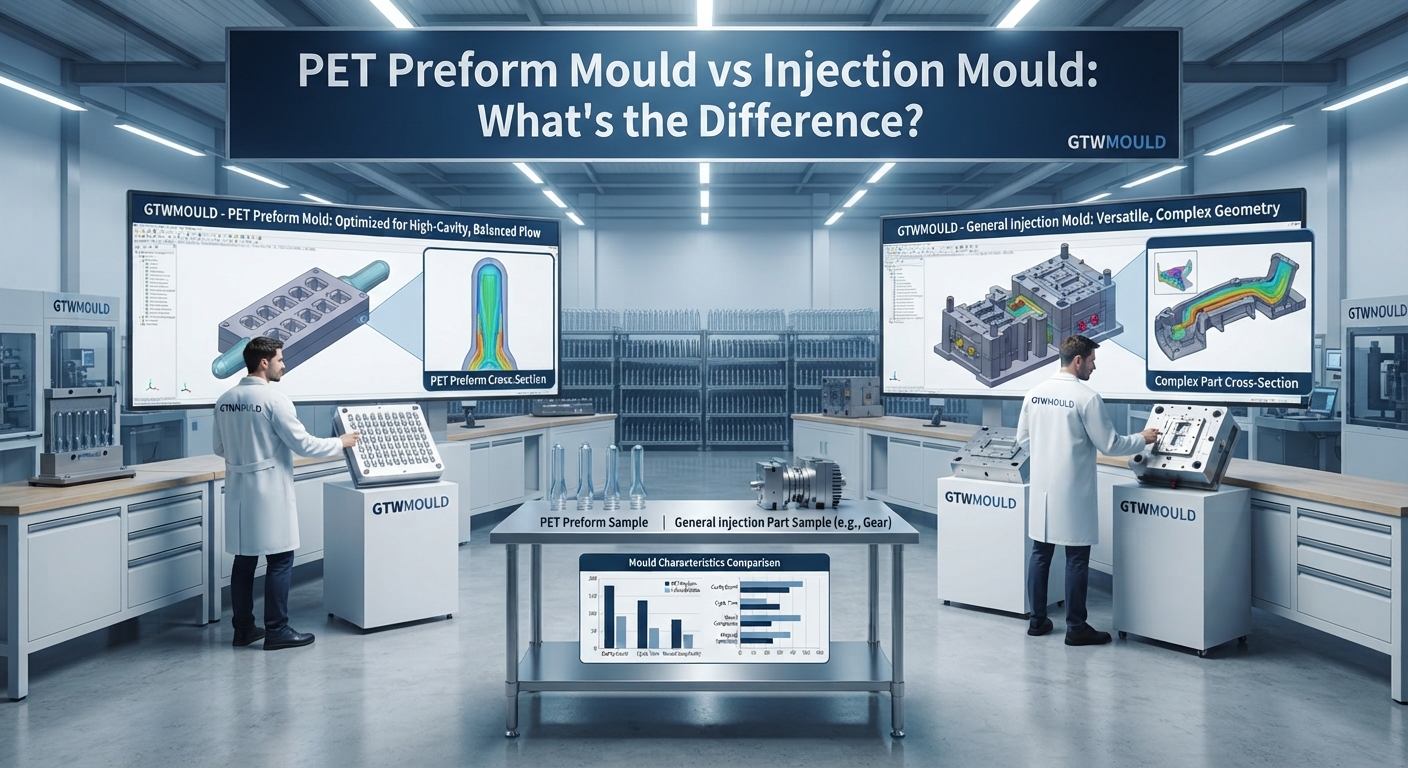
PET Preform Mould vs Injection Mould: What's the Difference?
A Deep Technical Comparison on Tooling Architecture, Thermodynamic Design, and Polymer Rheology by GTWMOULD
Introduction: Defining General Injection Molds vs. Specialized PET Preform Tooling
In the global plastic processing industry, the term injection mold encompasses a vast array of tooling engineered to produce everything from automotive dashboards and electronic housings to thin-wall food containers. However, a PET preform mould represents an ultra-specialized subset of injection tooling dedicated exclusively to producing Polyethylene Terephthalate (PET) bottle preforms for the beverage, edible oil, cosmetic, and pharmaceutical sectors.
While both tooling types share fundamental injection molding principles, their mechanical configurations, thermal dynamics, material selections, and rheological designs differ drastically. As an industry-leading manufacturer of high-precision injection tooling in China, GTWMOULD has crafted this technical comparison to analyze PET Preform Mould vs Injection Mould: What's the Difference? and explain why specialized engineering is essential for high-cavitation PET container manufacturing.
1. Structural and Mechanical Architectural Differences
General injection molds are designed to produce final plastic parts with complex geometries, undercuts, slides, and side-action cores. In contrast, PET preform molds produce intermediate thick-walled tubular precursor parts that undergo subsequent biaxial stretch blow molding.
Core-to-Cavity Alignment and Concentricity Engineering
Because general injection molded parts usually feature varied wall thicknesses, slight core deflection under injection pressure is often acceptable. However, in a PET preform mold, any core shifting creates wall-thickness variation (eccentricity). Thin spots lead directly to uneven reheating in stretch blow molding, resulting in bottle wall blowouts or structural panel failures.
To eliminate core displacement under immense injection pressures ($1000\text{--}1500 \text{ bar}$), GTWMOULD utilizes a proprietary triple-taper self-locking component alignment system across every individual cavity stack:
- Sub-Micron Tolerance Control: Concentricity between core pin and cavity insert is held within:
$$\Delta \le 0.015 \text{ mm}$$
- Strict Wall Thickness Security: Total preform wall-thickness variation is restricted to under 0.03mm, a level of precision unnecessary in standard general injection tooling.
2. Thermal Management and Thermodynamic Cooling Velocity
Cooling requirements represent one of the starkest technical divergences between general injection molds and PET preform tooling.
| Technical Engineering Aspect | Standard General Injection Mould | GTWMOULD Specialized PET Preform Mould |
|---|---|---|
| Polymer Crystallization Target | Allows standard semi-crystalline or amorphous polymers to solidify without strict optical mandates. | Must quench molten PET instantly below its glass transition temperature ($T_g \approx 75\text{--}80^\circ\text{C}$) to prevent crystallization hazing. |
| Cavity Cooling Design | Standard drilled cooling channels or simple baffled water circuits. | High-pitch spiral-wound cavity cooling channels wrapping closely around every individual cavity insert. |
| Internal Core Heat Extraction | Standard core cooling loops or simple copper pins. | High-velocity internal turbulent bubblers with micro-polished interior flow paths for rapid internal quenching. |
| High-Conductivity Metallurgy | Rarely required except for localized hot spots in complex part features. | Press-fitted Beryllium-Copper (BeCu) inserts at neck splits and gate zones, dissipating heat up to 10x faster than steel. |
3. Hot Runner System Integration and Polymer Rheology
While general injection molds often utilize cold runners, insulated runners, or basic thermal gate hot runners, high-cavitation PET preform molds strictly require specialized low-shear hot runner systems.
Hot Runner Requirements for PET Processing
- Acetaldehyde (AA) Control: PET polymer is sensitive to thermal degradation and shear stress. High shear levels generate Acetaldehyde (AA), which imparts an off-taste to bottled water. GTWMOULD hot runners feature FEA-optimized, naturally balanced channels with micro-polished interior pathways to ensure low-shear, uniform melt delivery.
- Pneumatic Valve Gate Shut-Off: Unlike open thermal gates that leave long vestiges or stringing tails, GTWMOULD preform molds incorporate pneumatically actuated valve gate systems. Individual valve pins mechanically shut off the gate, delivering a smooth, flush base required for downstream stretch blow molding and automated handling.
4. Metallurgy and Tool Lifespan Standards
General injection molds may use P20 or pre-hardened tool steels when production volumes are low to moderate. In contrast, high-speed PET preform tooling operates continuously in 24/7 high-volume production, requiring premium metallurgical compositions:
- Swedish S136 Stainless Steel: All active molding inserts (cores, cavities, neck splits) in GTWMOULD tools are manufactured from vacuum-hardened Swedish S136 steel ($48\text{--}52 \text{ HRC}$) to resist mechanical wear and corrosive PET polymer outgassing.
- Diamond-Like Carbon (DLC) Coatings: High-wear sliding neck ring components feature DLC surface treatments, enabling dry, grease-free mechanical operation for cleanroom compliance.
- Corrosion-Proof AISI 420 Mold Base: Main structural plates are constructed from AISI 420 stainless steel to prevent rust and scaling inside internal chilled water lines, preserving cooling efficiency over millions of cycles.
Conclusion: Partnering with China's Premier Preform Tooling Specialist
Understanding **PET Preform Mould vs Injection Mould: What's the Difference?** makes it clear that high-cavitation preform manufacturing demands specialized engineering solutions. Standard general injection mold designs cannot deliver the sub-micron alignment, hyper-conductive thermal quenching, and low-shear valve gate control required for profitable PET preform production.
**GTWMOULD** brings decades of specialized engineering expertise to the design and manufacture of high-speed PET preform molds that lower cycle times, eliminate defects, and maximize operational profitability.
Partner with GTWMOULD today to upgrade your bottling and plastic packaging lines with world-class preform tooling solutions.