
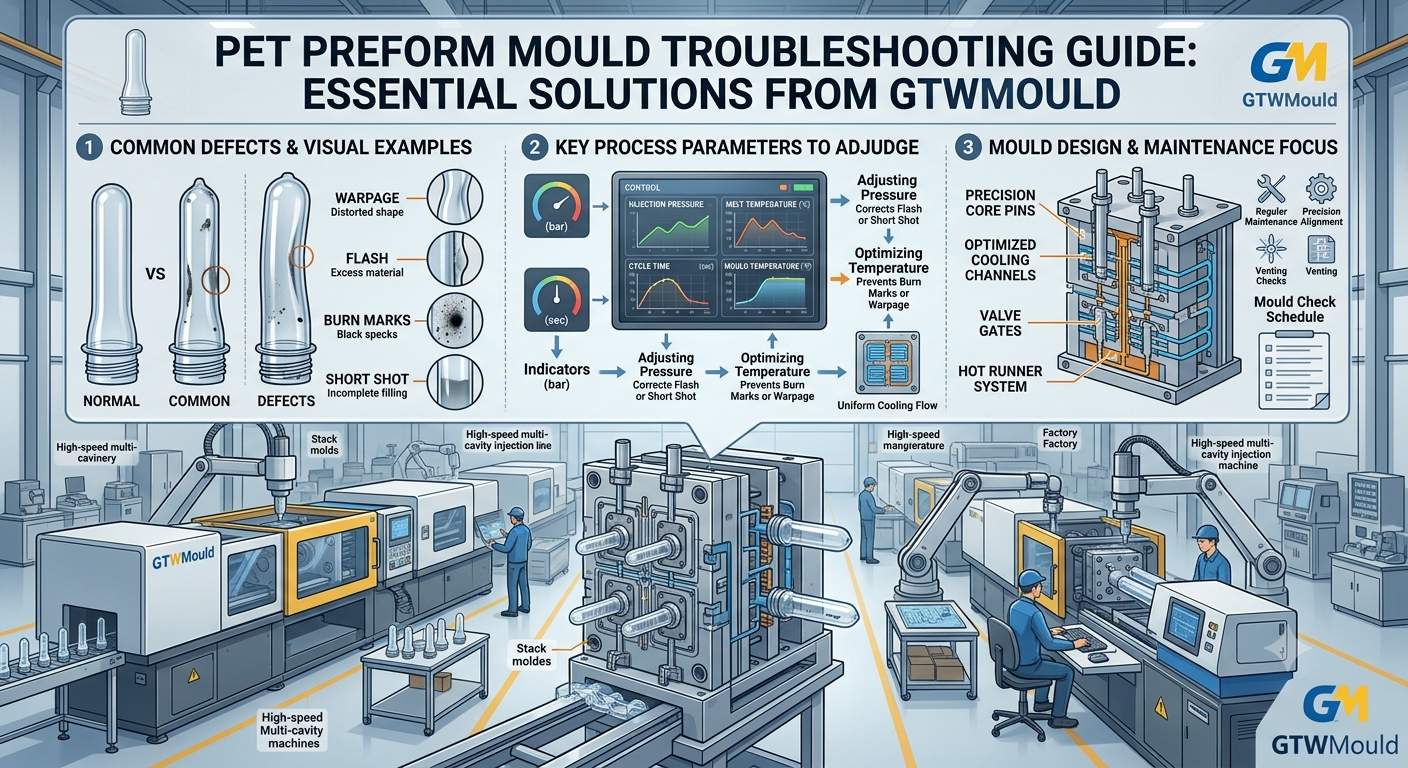
PET Preform Mould Troubleshooting Guide
An Advanced Technical Diagnostic & Preventive Maintenance Blueprint by GTWMOULD
Introduction: Industrial Maintenance Principles for High-Cavitation PET Injection Lines
In high-speed PET container manufacturing, unscheduled machine downtime, high scrap rates, and inconsistent preform quality severely erode profit margins. Systemic troubleshooting requires moving beyond temporary operational patches to diagnose root causes across melt rheology, mechanical alignment, pneumatic timing, and thermodynamic heat exchange.
As a leading global authority in precision injection mold engineering, GTWMOULD designs robust tooling systems built for continuous 24/7 production efficiency. This comprehensive PET Preform Mould Troubleshooting Guide provides plant engineers, quality managers, and processing technicians with a scientific framework to diagnose, resolve, and prevent the most challenging PET injection molding issues.
1. Comprehensive Visual and Thermal Defect Diagnostics
Thermal defects stem directly from unbalanced heat dissipation, incorrect melt processing temperatures, or inadequate cooling circuit mechanics during the injection cycle.
| Defect Category | Observed Physical Symptom | Primary Root Cause | Corrective Action & GTWMOULD Engineering Solution |
|---|---|---|---|
| Body Hazing / Crystallization | Milky or cloudy appearance across the main body of the preform. | Insufficient cooling rate allowing polymer chains to form crystalline structures in thick walls. | Increase chilled water flow rate ($6\text{--}10^\circ\text{C}$). GTWMOULD utilizes spiral-wound cavity cooling and high-velocity internal core bubblers for rapid thermal extraction. |
| Gate Hazing / White Gate | Crystallized white ring surrounding the injection gate base. | Excessive localized heat buildup at the nozzle tip or slow heat removal from the gate insert. | Reduce hot runner nozzle tip temperature; optimize hold time. GTWMOULD integrates press-fitted Beryllium-Copper (BeCu) gate inserts that conduct heat 10x faster than steel. |
| Neck Finish Deformation | Distorted threads or cloudiness on the neck split parting line. | Premature ejection before the thread region completely solidifies. | Lower neck ring water circuit temperature. GTWMOULD incorporates dedicated BeCu neck split inserts with independent water loops for immediate thread solidification. |
| High Acetaldehyde (AA) | Off-taste or odor in bottled still water. | Thermal degradation of PET resin caused by high shear stress or excessive melt temperatures. | Lower barrel temperatures; optimize screw speed. GTWMOULD engineers naturally balanced, micro-polished hot runner channels to eliminate high-shear restriction zones. |
2. Mechanical Defect Diagnostics: Concentricity, Gate Quality, and Parting Lines
Mechanical flaws weaken structural integrity, create uneven wall thickness distribution, and cause downstream bottle failure during stretch blow molding.
Uneven Wall Thickness (Preform Eccentricity)
When preform wall thickness varies around its circumference, the thinner section reheats faster in stretch blow molding, leading to uneven bottle wall distribution or blowouts.
- Root Cause Analysis: Core shifting under extreme injection pressure ($1000\text{--}1500 \text{ bar}$), worn taper alignment surfaces, or non-uniform clamping force across the mold base.
- GTWMOULD Alignment Solution: We implement a proprietary triple-taper self-locking alignment design for every individual cavity stack. By maintaining sub-micron machining tolerances:
$$\Delta \le 0.015 \text{ mm}$$
This system restricts total wall-thickness variation strictly under 0.03mm, completely preventing core displacement during high-speed fill cycles.
Gate Tailing, Stringing, and Valve Pin Wear
Protruding gate vestiges or fine stringing tails jam automated robot handling arms, damage stretch rods, and disrupt stable upright bottle positioning.
- Root Cause Analysis: Worn mechanical valve pins, incorrect pneumatic shut-off pressure, or thermal drooling caused by overheating at the gate tip.
- GTWMOULD Tooling Solution: Integration of a pneumatically actuated valve gate hot runner system featuring individually guided shut-off pins. Mechanical pin closure delivers a completely flush gate base with zero stringing or tailing defects.
3. Systematic Preventative Maintenance Matrix
To ensure long-term equipment stability, minimize unexpected breakdowns, and preserve sub-micron component tolerances, plant technicians should follow a standardized preventative maintenance protocol.
Daily Production Checks (Every 24 Hours)
- Inspect preform gate vestiges for stringing, trailing, or uneven mechanical shut-off marks.
- Verify chilled water supply flow rate, pressure differential ($\Delta P \ge 3.5 \text{ bar}$), and temperature ($6\text{--}10^\circ\text{C}$).
- Check pneumatic pressure manifolds supplying the valve gate actuator cylinders.
Monthly Preventive Inspection
- Clean and inspect all neck split sliders and guide pillars. Verify that Diamond-Like Carbon (DLC) low-friction coatings remain intact.
- Check parting line contact faces for flash buildup or plastic debris embedment.
- Inspect internal cooling line connections for scaling, rust, or mineral buildup.
Annual Overhaul and Refurbishment
- Remove and disassemble core, cavity, and neck ring stacks for complete CMM dimensional verification.
- Replace internal seals, O-rings, and pneumatic valve pin guide bushings.
- Inspect hot runner manifold heater bands and thermocouple response profiles across all PID heating zones.
4. Premium Tool Metallurgy and Long-Term Reliability
Effective defect prevention relies heavily on the quality of underlying tooling materials. GTWMOULD selects premium alloys designed to withstand continuous production stress without dimensional drift:
- Swedish S136 Stainless Steel: Cores, cavities, and neck rings are manufactured from vacuum-hardened S136 stainless steel ($48\text{--}52 \text{ HRC}$), providing maximum resistance to mechanical friction and corrosive polymer outgassing.
- Dry-Running DLC Coatings: Friction parts, including neck split sliders and alignment guides, feature Diamond-Like Carbon (DLC) surface treatments. This enables oil-free, dry mechanical movement, eliminating lubricant contamination on preforms.
- Corrosion-Proof AISI 420 Mold Base: Structural plates are crafted from pre-hardened AISI 420 stainless steel, preventing rust and calcification inside internal water lines to maintain heat transfer efficiency over millions of cycles.
Conclusion: Partnering with China's Premier Preform Tooling Expert
Mastering **PET Preform Mould Troubleshooting** requires combining systematic diagnostic protocols, precise process control, and sub-micron tool engineering. **GTWMOULD** builds high-performance, high-cavitation PET preform molds designed to eliminate injection defects, lower cycle times, and maximize long-term manufacturing yield.
Partner with GTWMOULD to upgrade your bottling and packaging operations with preform tooling engineered for absolute precision, durability, and processing efficiency.