
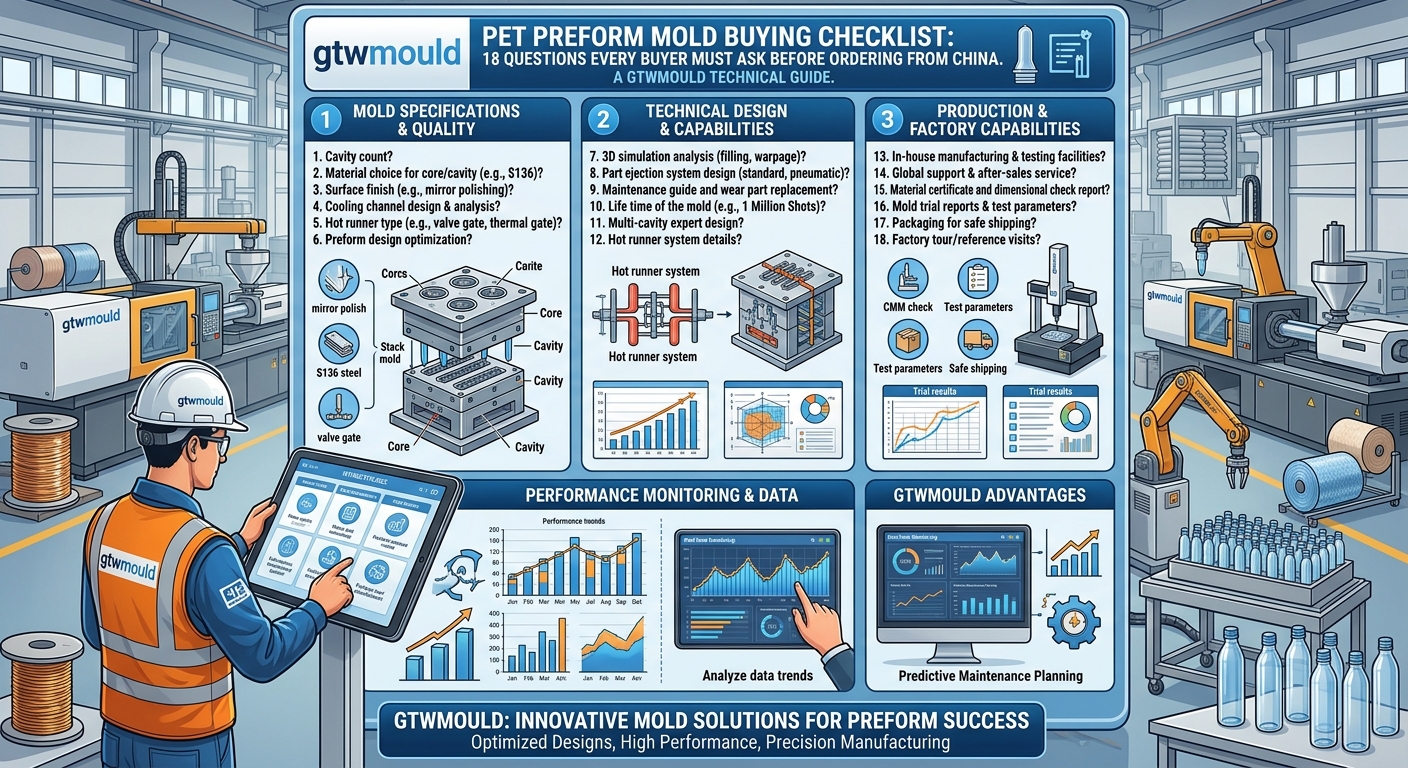
PET Preform Mold Buying Checklist: 18 Questions Every Buyer Must Ask Before Ordering from China
An Essential Technical Evaluation Blueprint for Sourcing High-Precision, High-Cavitation PET Tooling from GTWMOULD
Introduction: Navigating High-Capital Preform Tooling Investments
Sourcing high-cavitation PET preform molds from Chinese manufacturers offers global beverage brands, packaging converters, and injection molding processors an exceptional balance of cost efficiency and cutting-edge engineering. However, given the technical complexity of high-speed PET processing—where cycle time, wall-thickness consistency, and Acetaldehyde (AA) control dictate profitability—selecting the right tooling partner requires strict due diligence.
As a leading Chinese manufacturer and global solution provider, GTWMOULD specializes in designing and building high-precision PET preform molds that operate continuously in 24/7 manufacturing plants. To help global procurement directors, packaging engineers, and plant managers make informed sourcing decisions, GTWMOULD has compiled this comprehensive PET Preform Mold Buying Checklist: 18 Questions Every Buyer Must Ask Before Ordering from China.
Category 1: Mechanical Alignment and Centering Precision
1. What alignment architecture is used to guarantee core-to-cavity concentricity under high pressure?
High injection pressures ($1000\text{--}1500 \text{ bar}$) cause core deflection if a tool lacks rigid mechanical interlocking. GTWMOULD utilizes a proprietary triple-taper self-locking component alignment system across every cavity stack, ensuring core-to-cavity concentricity is held within a strict tolerance threshold:
$$\Delta \le 0.015 \text{ mm}$$
2. What is the guaranteed preform wall-thickness eccentricity limit?
Uneven preform wall thickness causes uneven reheating during stretch blow molding, leading to bottle wall blowouts and structural panel failure. GTWMOULD guarantees total wall-thickness variation remains strictly under 0.03mm.
3. Are cavity stacks modular and fully interchangeable on-machine?
Individual stack components (core pins, cavity inserts, and neck rings) in GTWMOULD tools are manufactured with sub-micron CNC precision, allowing quick single-cavity replacements directly on the machine without removing the entire mold frame.
4. How is neck ring wear prevented during high-speed stripping operations?
Neck split components in GTWMOULD molds feature specialized wear plates and precision slide alignments designed to absorb mechanical friction during high-speed ejection cycles.
Category 2: Hot Runner Engineering and Polymer Rheology
| Key Technical Evaluation Question | Risk of Substandard Engineering | GTWMOULD Specialized Solution | Buyer Advantage |
|---|---|---|---|
| 5. Is the hot runner naturally balanced via FEA simulation? | Uneven flow paths cause thermal shear spikes, Intrinsic Viscosity (IV) drops, and elevated Acetaldehyde (AA) levels. | FEA-optimized, naturally balanced runner pathways with micro-polished interior flow channels. | Uniform resin melt delivery across all drops (24 to 144 cavities) preserving original water/beverage taste. |
| 6. What type of gate shut-off system is implemented? | Open thermal gates leave long vestiges, stringing tails, and cause robot transfer jam-ups. | Pneumatically actuated individual valve gate system with hardened needle shut-off pins. | Clean, completely flush gate vestige with zero stringing defects. |
| 7. How is thermal control zoned across the manifold? | Single-zone heating causes temperature gradients, leading to shot-to-shot weight variations. | Multi-zone PID thermal regulation with independent heating elements per nozzle tip and manifold drop. | Absolute thermal stability and shot-to-shot weight consistency across all cavities. |
| 8. How are hot runner leakage risks mitigated? | Thermal expansion misalignment causes molten plastic leakage behind nozzle stacks. | Precision calculated thermal expansion gaps and double-O-ring sealing interfaces. | Zero-leakage operation and extended hot runner maintenance intervals. |
Category 3: Thermodynamic Cooling Design and Cycle Efficiency
9. What cooling circuit layout is used inside cavity inserts?
Standard straight-drilled channels fail to extract heat rapidly. GTWMOULD incorporates high-pitch spiral-wound cavity cooling channels that wrap closely around every individual cavity insert for maximum thermal contact area.
10. How is heat extracted from the internal core pin tip?
GTWMOULD core pins incorporate high-velocity internal turbulent bubbler tubes that continuously flush chilled water directly against the interior core apex, preventing internal preform sticking.
11. Are high-conductivity alloys used in critical heat-concentration zones?
Yes. GTWMOULD press-fits high-purity Beryllium-Copper (BeCu) inserts into neck split sections and gate zones. BeCu dissipates thermal energy up to 10x faster than stainless steel, rapidly quenching molten PET below its glass transition temperature ($T_g \approx 75\text{--}80^\circ\text{C}$) to eliminate white crystalline hazing.
12. What is the expected cycle time reduction for a target preform weight?
By combining spiral cavity cooling, core bubblers, and BeCu heat sink inserts, GTWMOULD tooling compresses overall cooling time by 15% to 25% compared to conventional mold designs.
Category 4: Metallurgy, Coatings, and Quality Assurance
13. What exact grade of tool steel is used for core, cavity, and neck ring inserts?
All active molding inserts in GTWMOULD tools are crafted from genuine Swedish S136 stainless steel, vacuum-heat-treated to a hardness of $48\text{--}52 \text{ HRC}$ to resist mechanical wear and corrosive PET outgassing.
14. What surface coatings are applied to sliding mechanisms?
GTWMOULD applies Diamond-Like Carbon (DLC) surface coatings to sliding neck splits. DLC provides an ultra-low friction coefficient, enabling dry, oil-free mechanical movement that prevents lubricant contamination on bottle neck finishes.
15. Is the mold base constructed from corrosion-resistant steel?
GTWMOULD structural mold plates are built from AISI 420 stainless steel, preventing internal rust scaling within chilled water lines and maintaining baseline thermal heat transfer over millions of cycles.
16. What factory acceptance testing (FAT) protocol is conducted before shipping?
Every GTWMOULD tool undergoes rigorous FAT trial runs on dedicated PET injection molding machinery. Complete dry-cycle testing, full CMM dimensional validation, water flow differential pressure checks, and preform optical clarity inspections are completed prior to dispatch.
17. What spare parts package is included with the tool?
Each mold shipment includes a comprehensive spare parts kit containing extra core pins, cavity inserts, neck rings, valve gate pins, seal kits, heater bands, and thermocouples for immediate operational support.
18. What technical support and warranty coverage are provided post-delivery?
GTWMOULD provides comprehensive remote engineering installation support, full 3D CAD step files, preventive maintenance manuals, and a standard long-term structural warranty on mold plates and active inserts.
Conclusion: GTWMOULD — Your Trusted PET Preform Solution Partner
Using this **PET Preform Mold Buying Checklist** equips procurement managers and packaging engineers to evaluate Chinese tooling suppliers on genuine technical merit rather than price alone. High-cavitation PET preform manufacturing demands sub-micron alignment, hyper-conductive cooling, low-shear valve gate technology, and premium metallurgical selection.
**GTWMOULD** combines decades of specialized engineering experience with state-of-the-art European CNC machining infrastructure to produce world-class PET preform molds that lower cycle times, eliminate scrap, and maximize lifetime ROI.
Contact GTWMOULD today to submit your preform drawings and receive a detailed engineering proposal tailored to your production goals.