
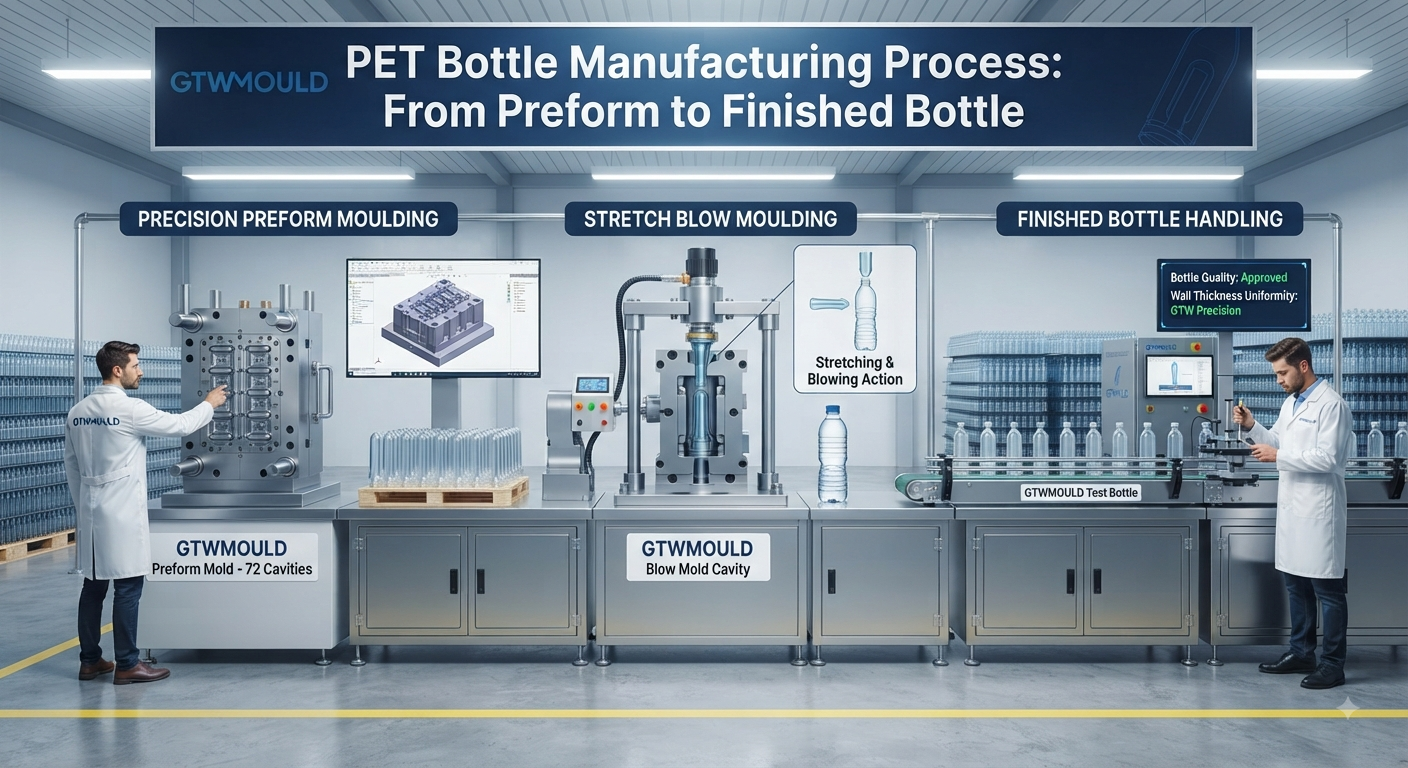
PET Bottle Manufacturing Process: From Preform to Finished Bottle
A Deep Technical Guide on Two-Stage Injection Stretch Blow Molding (ISBM) Engineering by GTWMOULD
Introduction: The Two-Stage PET Manufacturing Architecture
The global production of Polyethylene Terephthalate (PET) containers for beverages, edible oils, cosmetics, and pharmaceuticals relies overwhelmingly on the two-stage Injection Stretch Blow Molding (ISBM) process. Unlike single-stage processing, the two-stage approach decouples preform injection molding from stretch blow molding. This division enables maximum cavitation density, optimized cycle speeds, and total volumetric control at the initial tooling stage.
As a leading global specialist in high-precision PET mold engineering, GTWMOULD manufactures high-performance preform tooling that serves as the precise structural foundation for this process. This technical analysis provides an end-to-end breakdown of the PET Bottle Manufacturing Process: From Preform to Finished Bottle, illustrating how upstream preform mold engineering dictates final container strength, optical clarity, and production yield.
Stage 1: Upstream PET Preform Injection Molding Operations
The quality of a finished PET bottle is fundamentally locked in during the preform injection phase. Any dimensional imperfection, thermal stress, or wall thickness variation in the preform will be magnified during downstream stretching and blowing.
1. Resin Preparation and Dehumidification
PET resin is highly hygroscopic and absorbs ambient atmospheric moisture. Prior to processing, raw PET pellets must be dried in desiccant hopper systems to achieve a moisture level below 0.005% (50 ppm). Processing moist resin induces hydrolytic degradation, severely lowering intrinsic viscosity (IV), weakening final bottle wall strength, and generating aesthetic silver streaks.
2. Low-Shear Plasticization and Valve Gate Injection
Dried resin is melted in the injection cylinder under carefully controlled thermal zones ($260\text{--}290^\circ\text{C}$). The molten polymer is transferred through an advanced hot runner manifold into precision cavity stacks. GTWMOULD utilizes a custom pneumatically actuated valve gate hot runner system with micro-polished interior channels. This configuration minimizes shear stress, prevents Acetaldehyde (AA) formation, and seals each gate with a clean, flush vestige.
3. Sub-Micron Core Alignment and Concentricity Security
To ensure uniform wall thickness across every cavity drop, GTWMOULD implements a proprietary triple-taper self-locking alignment design. By holding core-to-cavity concentricity within:
$$\Delta \le 0.015 \text{ mm}$$
Total preform wall variation is kept strictly under 0.03mm. This extreme mechanical precision prevents thin spots from forming during subsequent biaxial orientation.
4. Hyper-Conductive Thermal Quenching
To prevent PET from crystallizing and turning opaque white, the molten polymer must be rapidly cooled below its glass transition temperature ($T_g \approx 75\text{--}80^\circ\text{C}$). GTWMOULD integrates spiral-wound cavity cooling channels, high-velocity core bubblers, and press-fitted Beryllium-Copper (BeCu) neck and gate inserts to achieve ultra-fast heat dissipation and glass-like optical transparency.
Stage 2: Downstream Stretch Blow Molding (SBM) Operations
Once cooled and stabilized, injection-molded preforms are transferred to high-speed stretch blow molding machines to be transformed into final containers.
| Blow Molding Phase | Physical Mechanism | Preform Engineering Requirement | GTWMOULD Tooling Solution |
|---|---|---|---|
| Infrared Reheating | Preforms pass through NIR/IR oven banks to reach optimal stretch temperature ($90\text{--}115^\circ\text{C}$). | Uniform wall thickness across circumferential and longitudinal cross-sections. | Triple-taper cavity interlocking ensuring zero core shift or wall variation. |
| Axial Stretching | A mechanical stretch rod extends internally to elongate the preform along its vertical axis. | Concentric gate alignment and strain-hardening readiness without thermal crystallization. | Flush valve gate shut-off and amorphous polymer structure achieved via hyper-conductive BeCu cooling. |
| High-Pressure Blowing | High-pressure compressed air ($30\text{--}40 \text{ bar}$) expands the preform outward against the aluminum bottle mold walls. | Balanced resin distribution to ensure uniform wall strength and panel rigidity. | Volumetric weight consistency holding shot mass tolerances within strict sub-gram parameters. |
Metallurgical Integrity for Continuous Multi-Million Cycle Yield
High-cavitation preform tools operating in 24/7 production environments demand robust material selections to maintain structural accuracy over years of continuous operation:
- Swedish S136 Stainless Steel: All active core, cavity, and neck ring inserts are crafted from vacuum-hardened S136 tool steel ($48\text{--}52 \text{ HRC}$) for ultimate resistance against mechanical wear and polymer outgassing.
- Diamond-Like Carbon (DLC) Coatings: Sliding neck ring components feature low-friction DLC surface treatments, enabling oil-free, dry mechanical movement that eliminates grease contamination in cleanroom bottling facilities.
- AISI 420 Stainless Steel Mold Base: Mold frames are built from pre-hardened AISI 420 steel to prevent oxidation and scale buildup inside internal cooling loops.
Conclusion: Partnering with China's Premier Preform Tooling Expert
Mastering the complete **PET Bottle Manufacturing Process: From Preform to Finished Bottle** requires understanding the critical thermodynamic and mechanical linkage between upstream preform injection and downstream blow molding. **GTWMOULD** applies decades of specialized engineering experience to build high-cavitation preform molds that deliver absolute volumetric repeatability, compressed cycle times, and maximized production efficiency.
Partner with GTWMOULD to upgrade your bottling lines with high-performance preform tooling engineered for extreme precision, durability, and operational excellence.