
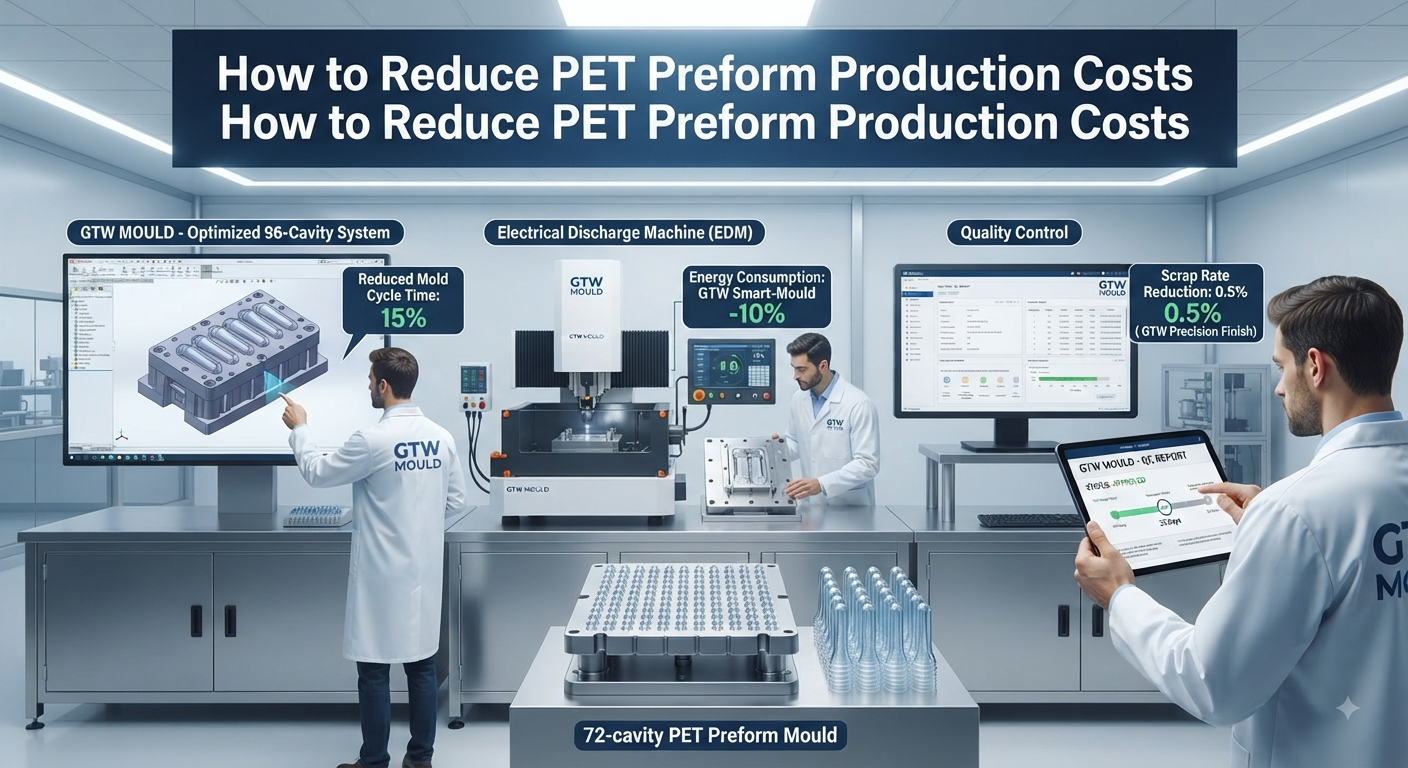
How to Reduce PET Preform Production Costs
A Strategic Engineering Analysis on Cycle Time Optimization, Resin Savings, and Energy Efficiency by GTWMOULD
Introduction: Managing Cost Pressures in High-Volume PET Injection Molding
In global beverage packaging and PET preform manufacturing, operational margins are under continuous pressure from rising raw resin prices, increasing energy tariffs, and aggressive market pricing. Because raw materials and energy consume up to 80% of total manufacturing expenditure in high-speed injection molding lines, reducing unit costs requires looking beyond simple processing adjustments.
True cost optimization is achieved at the tooling level. As a world-class specialist in high-precision PET preform mold engineering, GTWMOULD develops advanced tooling solutions designed to drive down Total Cost of Ownership (TCO). This technical guide provides an engineering-driven breakdown on How to Reduce PET Preform Production Costs through lightweighting, thermodynamic acceleration, resin loss prevention, and extended tool lifespan.
1. Resin Optimization: Precision Lightweighting without Structural Compromise
PET resin represents the single largest recurring cost in preform production. Trimming even 0.5 grams off a standard 28mm preform running across a 48-cavity line operating 24/7 saves tens of tons of resin annually, yielding massive financial returns.
Core-to-Cavity Concentricity and Wall Uniformity
Extreme lightweighting shrinks preform wall thickness to absolute physical limits. If the mold exhibits core deflection under high injection pressures ($1000\text{--}1500 \text{ bar}$), thin spots form, causing bottle blowouts during stretch blow molding. To compensate for poor concentricity, plants are forced to increase part weight.
GTWMOULD eliminates this extra weight penalty using a proprietary triple-taper self-locking component alignment system:
- Sub-Micron Alignment Calibration: Each cavity stack interlocks independently, maintaining core-to-cavity concentricity within:
$$\Delta \le 0.015 \text{ mm}$$
- Guaranteed Resin Savings: Wall thickness variation is strictly limited to under 0.03mm, allowing manufacturers to aggressive lightweight preform profiles without risking structural failure or paneling.
2. Cycle Time Compression: Thermodynamic Engineering and Heat Extraction
In high-cavitation molding, time is money. Because cooling represents over 60% of total cycle duration, accelerating heat removal from the mold cavity directly reduces unit production costs by increasing hourly output.
| Tooling Thermal Element | Standard Tooling Disadvantage | GTWMOULD Engineering Solution | Direct Production Cost Benefit |
|---|---|---|---|
| Cavity Cooling Loop | Standard straight cooling drillings leave thermal hot spots, slowing solidification. | High-pitch, spiral-wound cavity cooling channels wrapping directly around the insert. | Uniform outer cooling, reducing cycle hold time by up to 15%. |
| Core Pin Heat Transfer | Internal heat buildup causes inner wall hazing and extended cooling delays. | High-velocity turbulent bubbler systems with micro-polished interior flow paths. | Rapid internal temperature extraction, preventing crystallization at high speeds. |
| Neck and Gate Zones | Thick thread profiles and injection gates retain heat, risking thread deformation during stripping. | Press-fitted Beryllium-Copper (BeCu) inserts with independent water cooling loops. | Instantaneous thread and gate solidification, enabling fast mechanical ejection. |
3. Zero-Waste Valve Gate Technology: Eliminating Scrap and Material Degradation
Scrap preforms, long gate vestiges, and thermal degradation (Acetaldehyde buildup) create material waste and increase regrind processing costs.
Low-Shear Valve Gate Hot Runner Systems
GTWMOULD integrates custom-designed pneumatic valve gate hot runner systems to maximize material efficiency:
- Flush Mechanical Pin Shut-Off: Individually driven pneumatic pins seal the injection gate flush with the preform base. This eliminates gate tailing or stringing defects that jam downstream handling equipment.
- Naturally Balanced Rheology: FEA-calculated, highly polished runner channels ensure uniform melt velocity and pressure across all drops (from 24 to 144 cavities). This low-shear environment prevents Acetaldehyde (AA) generation and polymer degradation, minimizing scrap rates to virtually zero.
4. Premium Tool Metallurgy: Lowering Maintenance and Extending Tool Lifespan
Unplanned downtime, frequent mold repair, and component refurbishment destroy production profitability. Investing in durable tooling metallurgy pays dividends over millions of continuous production cycles.
- Swedish S136 Tool Steel Inserts: All cores, cavities, and neck rings are manufactured from vacuum-hardened Swedish S136 stainless steel ($48\text{--}52 \text{ HRC}$). This premium steel resists mechanical wear and corrosive PET off-gassing, keeping maintenance costs low.
- DLC Low-Friction Coatings: Sliding neck ring components are coated with Diamond-Like Carbon (DLC). This permits oil-free, dry mechanical movement, eliminating grease contamination on preforms and reducing cleanroom maintenance overhead.
- Corrosion-Proof AISI 420 Mold Base: Mold frames built from AISI 420 stainless steel prevent scaling and oxidation inside internal cooling channels, maintaining thermal transfer efficiency year after year.
Conclusion: Maximize Profitability with GTWMOULD Tooling Solutions
Learning **How to Reduce PET Preform Production Costs** requires an integrated engineering approach that combines lightweighting, hyper-conductive thermal management, low-shear hot runners, and premium metallurgy. **GTWMOULD** translates decades of specialized engineering expertise into high-performance preform molds designed to compress cycle times, reduce scrap, and lower total unit costs.
Partner with GTWMOULD to optimize your high-speed bottling and packaging lines with preform tooling engineered for extreme precision, durability, and maximum profitability.