
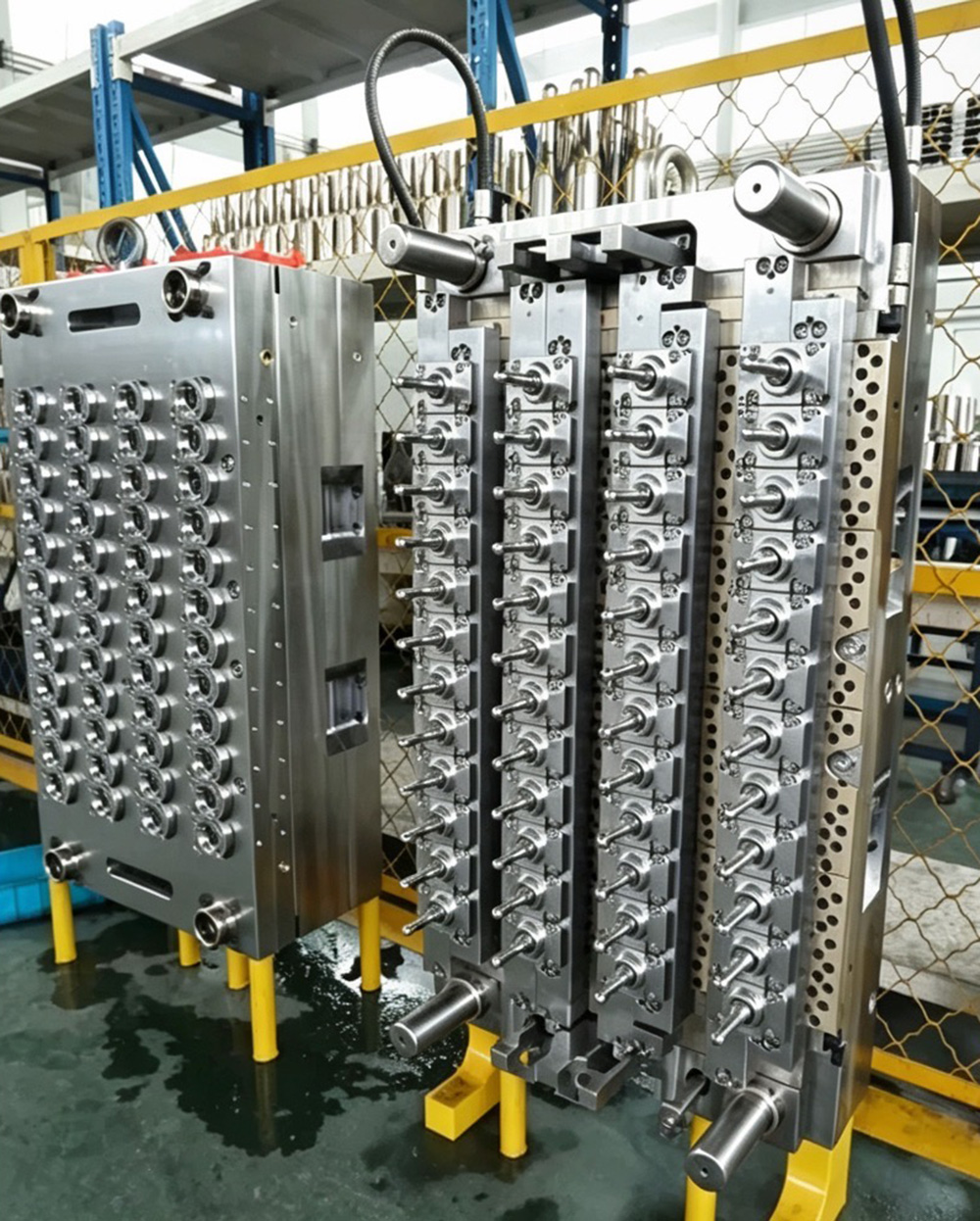
How to Reduce Material Waste in Preform Production Through Optimized Runner Design
A Technical Engineering Manual on Rheological Manifold Balancing, Cold Slug Elimination, and Material Efficiency by GTWMOULD
Introduction: The Financial and Environmental Cost of Material Scrap in PET Molding
In high-cavitation Polyethylene Terephthalate (PET) bottle preform manufacturing, raw resin represents up to 70% to 80% of total unit operational cost. As global sustainability regulations tighten and PET resin price volatility continues, minimizing resin consumption and eliminating material waste are critical drivers for converter profitability.
While lightweighting preform design reduces structural polymer weight, substantial material waste occurs directly within the melt distribution system during plasticization and injection. Suboptimal hot runner design leads to excessive cold sprue waste, degradation-induced scrap, high Acetaldehyde (AA) spikes, and uneven shot weights across multi-cavity layouts. As a premier Chinese manufacturer and specialized solution provider, GTWMOULD engineers high-precision PET preform molds integrated with low-shear, zero-waste hot runner architectures. This guide presents an in-depth technical analysis on optimizing hot runner manifold design to achieve zero material waste and maximum operational ROI.
1. Cold Runners vs. Hot Runners: The Foundation of Waste Elimination
Traditional cold runner systems generate cold sprues and runner branches during every molding cycle. In multi-cavity PET molding, re-grinding these sprues introduces severe quality risks: thermal degradation, Intrinsic Viscosity (IV) loss, dust contamination, and yellowing. Transitioning to advanced valve gate hot runner systems is the primary step in eliminating physical runner scrap.
| Melt Delivery Architecture | Material Scrap Percentage | Impact on Intrinsic Viscosity (IV) | Cycle Time & Recycled Resin Risk |
|---|---|---|---|
| Cold Runner System | $8\%\text{--}15\%$ (Runner scrap requiring re-grind) | Severe IV drop during re-melting ($> 0.05 \text{ dL/g}$) | Longer cooling cycles; high risk of black spots and dust inclusions. |
| Standard Hot Runner (Thermal Gate) | $1\%\text{--}3\%$ (Gate vestige stringing and purge loss) | Moderate IV drop due to thermal stagnation zones | Prone to gate drooling, crystallization hazing, and frequent nozzle cleaning. |
| GTWMOULD Valve Gate Hot Runner | Near 0% Material Waste | Zero IV Loss (Shear-optimized flow channels) | Instantaneous mechanical shut-off; flush gate vestige; maximum cycle speed. |
2. Rheological Manifold Balancing via Computer-Aided Engineering (CAE)
In multi-cavity tools (ranging from 24 to 128 drops), unbalanced melt flow causes over-packing in center cavities while peripheral cavities suffer short shots. Over-packing forces excess material into center preforms, adding unneeded weight and increasing wall thickness variation.
Naturally Balanced Flow Geometry
GTWMOULD utilizes Finite Element Analysis (FEA) polymer simulation to design naturally balanced, H-bridge hot runner manifolds. By ensuring identical flow path lengths, runner channel diameters, and turn radii across every nozzle drop, melt pressure drop remains identical across all cavities:
$$\Delta P_{\text{drop}_1} = \Delta P_{\text{drop}_i} = \Delta P_{\text{drop}_N} \quad (i = 1, 2, \dots, N)$$
Shear Rate Optimization & Acetaldehyde (AA) Control
Excessive shear rate inside runner channels breaks polymer chains, lowering IV and generating Acetaldehyde (AA), an organic compound that alters the taste of bottled water. GTWMOULD optimizes internal runner diameters and polishes channel walls to an SPI A1 mirror finish, restricting shear rates strictly under safety thresholds ($< 10,000 \text{ s}^{-1}$) and maintaining AA generation below $1.8 \text{ ppm}$.
3. Synchronized Pneumatic Valve Gate Technology
Material waste frequently occurs at the preform gate base in the form of long gate vestiges, stringing, or pinhole leaks. GTWMOULD solves gate waste through synchronized pneumatic valve gate shut-off pins:
- Flush Gate Vestige ($\le 0.2 \text{ mm}$): Individual pneumatic actuators drive micro-polished shut-off pins to seal the gate base flush with the preform dome, eliminating gate tailing and preventing gate punctures during stretch blow molding.
- Beryllium-Copper (BeCu) Thermal Inserts: Press-fitted BeCu alloy inserts ($k \approx 100\text{--}130 \text{ W/m}\cdot\text{K}$) surround each nozzle tip, extracting heat rapidly during gate seal-off to eliminate gate crystallization hazing.
- Leak-Free Melt Sealing: Double-sealed nozzle interfaces prevent internal manifold resin leakage, eliminating material loss and protecting electrical heater bands from burnouts.
4. Sub-Micron Core Alignment: Preventing Structural Material Overuse
When core pins shift under high injection pressures ($1200\text{--}1500 \text{ bar}$), preform wall thickness becomes asymmetrical. To guarantee minimum wall thickness on the thin side, operators are often forced to increase shot weight, wasting grams of PET per preform across millions of cycles.
GTWMOULD solves wall eccentricity by embedding a proprietary triple-taper self-locking alignment system across core pins, cavity inserts, and neck split rings, guaranteeing strict concentricity retention:
$$\Delta \le 0.015 \text{ mm}$$
This restricts total wall variation under $0.025 \text{ mm}$, enabling tight target shot weights, consistent resin consumption, and zero material waste.
5. Strategic Metallurgy and Long-Term Tooling Efficiency
To ensure runner manifolds withstand continuous high-temperature ($270^\circ\text{C}\text{--}290^\circ\text{C}$) operation without thermal distortion or resin leakage, GTWMOULD specifies premium certified materials:
- Certified Swedish S136 Stainless Steel: Hardened to $48\text{--}52 \text{ HRC}$ for all moulding inserts, providing complete protection against corrosive polymer outgassing.
- Independent Zone Heaters: PID multi-zone temperature controllers maintain uniform heating ($\pm 1^\circ\text{C}$) across the entire manifold, preventing localized polymer degradation and degradation purges.
- Diamond-Like Carbon (DLC) Coatings: Applied to neck split slides for smooth oil-free mechanical actuation, preventing lubricant contamination on preform thread finishes.
Conclusion: Maximize Material Savings with GTWMOULD Engineering
Understanding **How to Reduce Material Waste in Preform Production Through Optimized Runner Design** demonstrates that material efficiency depends on scientific hot runner engineering, rheological manifold balancing, and sub-micron core stability. Partnering with **GTWMOULD** guarantees access to world-class PET preform molds designed for maximum polymer yield, zero runner scrap, and lowest unit production cost.
Contact GTWMOULD's technical engineering team today to evaluate your preform mold design and receive a tailored tooling proposal.