
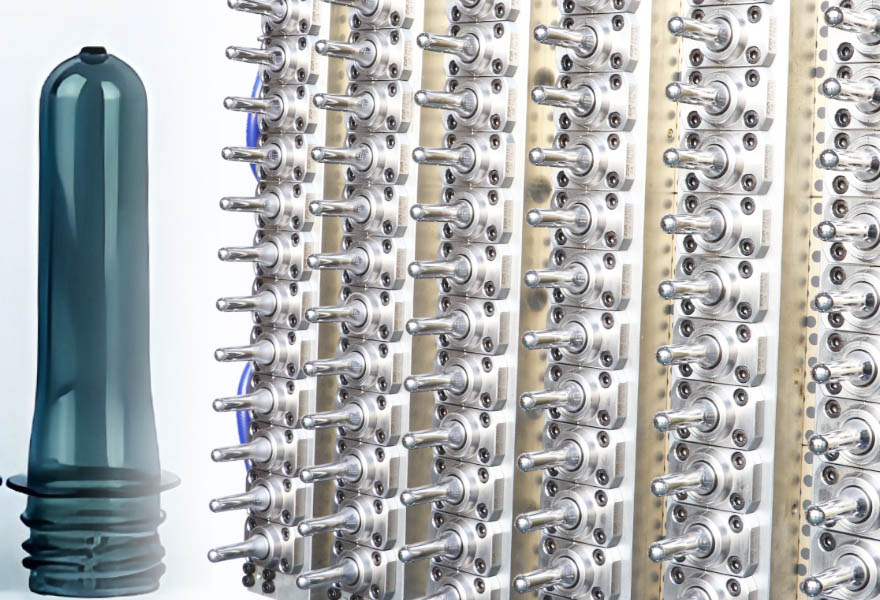
In the world of plastic packaging, the quality of the final PET bottle is determined long before the blowing process. It starts with the PET preform. And the quality of the preform is entirely dependent on the mold that produces it.
For manufacturers, investing in a high-quality preform mold is not just an expense; it is a critical decision that impacts production efficiency, product consistency, and long-term profitability. But with so many suppliers in the market, how can you distinguish a superior mold from a substandard one?
Here are the key factors to look for when evaluating PET preform mold quality.
1. Cavity Construction: Monobloc vs. Inserts
The construction of the cavity is the backbone of the mold.
Monobloc Construction: High-quality molds often feature a monobloc design where the neck finish and the body are machined from a single piece of steel. This eliminates any potential seam or weak point, ensuring perfect alignment, longer cavity life, and superior cooling efficiency.
Inserted Neck Rings: While some molds use separate neck inserts to save costs, this introduces potential misalignment and parting lines. If inserts are necessary, ensure they are manufactured with ultra-high precision to guarantee a perfect seal later in the bottling process.
2. Steel Grade and Hardness
The raw material of the mold dictates its lifespan.
Quality Steel: Top-tier molds are made from high-quality, corrosion-resistant steel, such as hardened stainless steel (e.g., 420SS or equivalent). This prevents rust from cooling water corrosion and withstands the high-pressure injection process.
Hardness: The cavities should be heat-treated to a specific Rockwell hardness (typically 48-52 HRC). This ensures the mold resists wear and tear from abrasive PET material, maintaining critical dimensions over millions of cycles.
3. Cooling System Efficiency
The cycle time of an injection molding machine is largely determined by how quickly the preform cools.
Conformal Cooling: The best molds utilize advanced cooling channels that follow the contour of the preform (conformal cooling). This ensures uniform heat extraction from the neck to the end cap.
Turbulent Flow: A well-designed cooling system promotes turbulent water flow rather than laminar flow, which maximizes heat transfer. If the cooling is inefficient, you will face longer cycle times and higher energy costs.
4. Precision and Tolerances
A "good" mold is a precise mold.
Weight Consistency: The mold must produce preforms with extremely tight weight tolerances (usually within ±0.1 grams). Variation in weight leads to variation in bottle wall thickness and performance.
Neck Finish Accuracy: The neck finish is the most critical part of the preform. High-quality molds ensure the neck dimensions are perfect to prevent leaking caps or faulty seals downstream.
5. Gate Quality and Design
The gate is where the plastic enters the mold.
Gate Witness: Look at the gate area on a produced preform. A high-quality mold will leave a clean, small, and consistent gate mark. A poor mold often results in "gate blush" (cosmetic imperfections) or "stringing," which leads to rejected preforms.
Valve Gate Control: Superior molds utilize hot runner systems with individual valve gate control, allowing for precise melt flow adjustment for each cavity.
6. Maintenance and Interchangeability
Quality engineering considers the human factor.
Quick Change Components: High-end molds feature standardized, interchangeable components (stripper plates, neck rings, gate inserts). This allows for rapid maintenance and spare part replacement, minimizing downtime.
Venting: Proper venting (usually 0.02mm to 0.03mm depth) allows air to escape during injection. Without it, you get burning marks (diesel effect) or short shots.
Conclusion
Choosing the right PET preform mold is a balance of upfront cost versus total cost of ownership. A cheaper mold may save money initially, but it will cost you more in the long run through longer cycle times, higher rejection rates, and frequent repairs. By focusing on steel quality, cooling technology, and precision engineering, you ensure a mold that delivers consistent quality and high returns for years to come.