
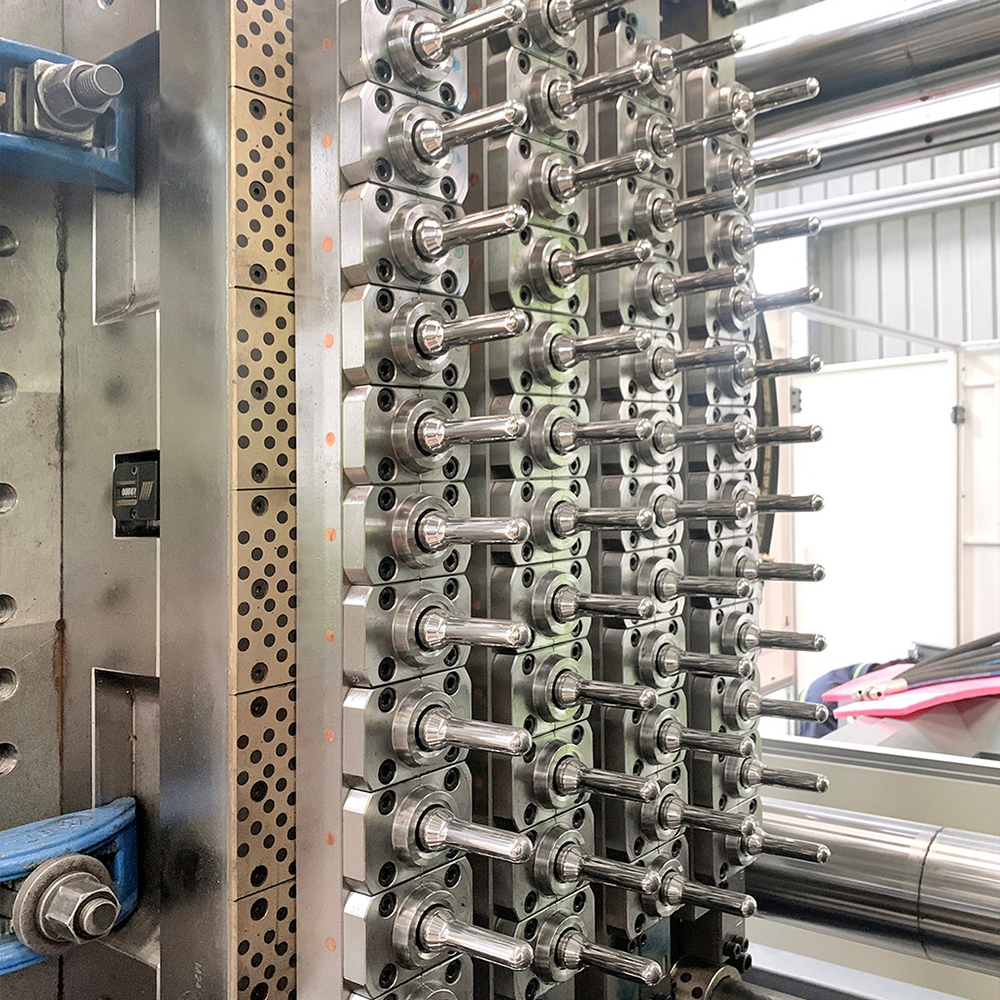
In high-speed, high-cavity PET preform production, achieving zero-defect manufacturing is paramount to maximizing uptime and profitability. However, processing anomalies can trigger persistent structural and aesthetic imperfections. This troubleshooting guide provides clear diagnostics and actionable parameters to eliminate three critical PET preform defects: Flashing, Bubbles, and Acetaldehyde (AA) contamination.
1. Understanding and Fixing Flashing (Parting Line Flash)
Flashing occurs when molten PET resin escapes into the parting lines or venting channels of the preform mold components, creating unwanted plastic protrusions. This defect damages the aesthetic value, threatens downstream blow molding integrity, and accelerates mold component wear.
Primary Root Causes:
- Excessive Injection Pressure or Speed: Forcing PET resin into the cavities too quickly or with overwhelming force overrides the machine's clamping capabilities.
- Insufficient Clamp Force: If the injection molding machine's clamping tonnage is too low for the mold size or multi-cavity project, the dynamic injection pressure will micro-separate the mold halves.
- Component Wear or Mismatch: Over time, poor-quality mold materials yield to indentation, specifically around the neck ring inserts, core-cavity alignment keys, or parting surfaces.
Actionable Solutions & Parameter Tuning:
| Target Area | Diagnostic Action / Adjustment |
|---|---|
| Injection Profile | Transition from injection to holding pressure earlier (optimize V-P switchover point). Reduce peak injection pressure by 5-10%. |
| Clamping Tonnage | Ensure the machine's actual clamping force matches the dynamic hydraulic requirements of the mold. Increase clamping pressure safely within machine specs. |
| Mold Maintenance | Inspect parting lines for debris or localized crushed steel. GUTEWEI uses premium Swedish S136 steel with high hardness to eliminate core/cavity indentation and prevent flash. |
2. Eliminating Bubbles and Voids in PET Preforms
Bubbles inside a PET preform are usually categorized into two distinct types: Moisture Bubbles (caused by inadequate resin drying) and Vacuum Voids (caused by thermal contraction during cooling). Identifying the difference is vital for effective troubleshooting.
Pro-Tip Checklist: If the bubble can be flattened out by reheating or localized compressing, it is likely a vacuum void. If it pops or cracks upon destructive testing, it points to trapped gas or moisture.
Primary Root Causes:
- Inadequate Resin Drying: PET is highly hygroscopic. If raw material moisture content exceeds 0.005%, water vaporizes inside the hot runner, yielding structural bubbles and hydrolytic degradation.
- Insufficient Holding Pressure: If the packing stage lacks enough volume or pressure, the core center cools down and shrinks outward, creating a hollow vacuum center.
- Poor Core/Cavity Cooling: Uneven thermal distribution prevents uniform solidification.
Actionable Solutions & Parameter Tuning:
- Audit Dehumidifier Drying: Confirm raw PET material is dried at 160°C - 175°C for at least 4 to 6 hours with a dew point below -40°C.
- Optimize Holding Stage: Gradually raise the packing/holding pressure and extend holding time to ensure sufficient melt feeds into the preform center as it contracts.
- Maximize Mold Cooling Efficacy: Ensure internal cooling channels are clean and scale-free. Advanced GUTEWEI molds utilize independent cooling circuits for each cavity to achieve rapid, uniform heat extraction.
3. Mitigating Acetaldehyde (AA) Contamination
Acetaldehyde (AA) is a natural byproduct resulting from the thermal degradation of PET resin during processing. While harmless in small quantities, elevated AA levels taint the taste of bottled water and sensitive beverages. Managing the AA level is a high priority for beverage packaging plants.
Primary Root Causes:
- Excessive Melt Temperature: Running barrel zones, nozzle tips, or hot runner manifolds at elevated temperatures triggers rapid chemical breakdown of the PET chain.
- High Screw Shear Stress: High backpressure or excessive screw rotation speeds create severe frictional shear heat.
- Long Material Residence Time: Keeping hot resin inside the barrel or hot runner system for extended periods increases AA generation exponentially.
Actionable Solutions & Parameter Tuning:
| Operational Metric | Recommended Action for AA Reduction |
|---|---|
| Temperature Controls | Lower the barrel and hot runner nozzle temperatures in stages of 5°C until the minimum viable melt profile is reached. |
| Shear & Friction | Reduce screw rotation speed (RPM) and minimize backpressure to the lowest stable limit required for consistent plasticizing. |
| Hot Runner System | Employ balanced, streamlined valve gate hot runner systems. GUTEWEI designs internal channels with zero dead-ends to prevent material stagnation and degradation. |
Conclusion: The Synergy of Process Control & Mold Quality
While modifying machine parameters can mitigate occasional defects, sustained, zero-defect production relies on the engineering precision of the mold. High-cavity injection demands balanced hot runner distribution, robust alignment mechanics, and resilient metallurgy. Investing in optimized hardware drastically widens your processing window, making operations less vulnerable to minor parameter variances.
Need Technical Support or High-Performance Mold Upgrades?
At GUTEWEI MOULD, we specialize in high-efficiency, multi-cavity PET preform molds designed for minimal maintenance and optimal cycle times. Contact our engineering consultants today to optimize your factory production line.