
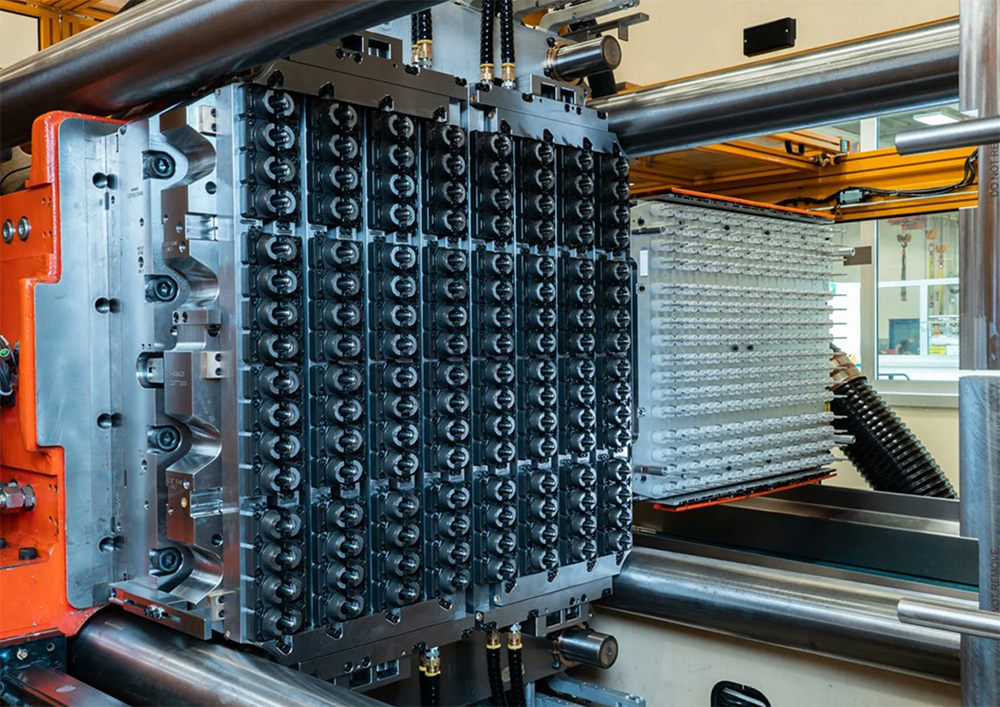
How to Design PET Preform Molds for Lightweight Preforms: Key Technical Considerations
A Comprehensive Engineering Guide to Material Reduction, Core Alignment, and Thermal Precision by GTWMOULD
Introduction: The Engineering Imperative of Preform Lightweighting
In the global beverage packaging and plastic converter industries, raw Polyethylene Terephthalate (PET) resin accounts for up to 70% to 80% of total manufacturing operational expenditure. Driven by aggressive sustainability goals, carbon reduction mandates, and rising material costs, beverage brand owners and packaging converters are continuously pushing the boundaries of preform lightweighting.
However, shaving off even 0.5 to 2.0 grams from a preform profile without altering final container top-load strength or blow-molding yield presents severe technical challenges. Thinner preform walls dramatically narrow the injection molding process window, increase injection shear stress, and amplify mechanical alignment tolerances. As a leading Chinese manufacturer and specialized solution provider, GTWMOULD engineers high-precision PET preform molds designed specifically to overcome these lightweighting barriers. This comprehensive guide details the critical engineering considerations required to design high-performance molds for lightweight PET preforms.
1. Structural Geometry Optimization and Stretch Ratio Dynamics
Lightweighting is not merely a matter of shrinking dimensions; it requires re-engineering the entire preform geometric profile to optimize biaxial orientation during the stretch blow molding phase.
Optimizing Wall Thickness and Taper Angles
When reducing preform wall thickness, the transition zone between the neck finish, body wall, and gate base must be designed with gradual tapers to prevent material stress concentration. A well-designed lightweight preform geometry ensures balanced axial and hoop stretch ratios:
- Axial Stretch Ratio ($SR_a$): Typically optimized between $2.5 \text{ and } 3.0$.
- Hoop Stretch Ratio ($SR_h$): Typically optimized between $3.5 \text{ and } 4.5$.
GTWMOULD utilizes Finite Element Analysis (FEA) preform simulation to calculate resin flow behavior and mechanical stress distribution before tool steel is cut. This guarantees that lightweight containers retain required top-load resistance ($\ge 200\text{--}250 \text{ N}$) and drop-impact strength.
2. Sub-Micron Core Alignment: Neutralizing Wall Thickness Eccentricity
As preform body walls become thinner (often reaching $1.5\text{--}2.2 \text{ mm}$ in aggressive lightweight designs), even minute core pin deflections under high hydraulic injection pressures ($1200\text{--}1500 \text{ bar}$) result in severe wall thickness eccentricity.
| Design Challenge in Lightweighting | Risk of Substandard Tooling Alignment | GTWMOULD Precision Solution | Quantified Performance Impact |
|---|---|---|---|
| Core Pin Bending / Deflection | Uneven wall thickness causes thin spots that blow out during stretch blow molding. | Proprietary triple-taper self-locking alignment system across core, cavity, and neck splits. | Locks core concentricity within $\Delta \le 0.015 \text{ mm}$, limiting wall variation under $0.02 \text{ mm}$. |
| Neck Finish Deformation | Lightweight thread finishes distort under mechanical ejection, causing cap leaks. | Hardened neck split inserts with independent water cooling and DLC low-friction coatings. | Zero thread finish ovality and flash-free parting line performance. |
| High Injection Pressure Drops | Narrow cavity channels cause high melt shear, short shots, and polymer degradation. | FEA-optimized naturally balanced valve gate hot runners with micro-polished channels. | Reduces injection pressure requirements by $15\%\text{--}20\%$, keeping Acetaldehyde ($< 2.0 \text{ ppm}$). |
3. Hyper-Conductive Thermal Management and Gate Quenching
Thinner preform wall sections require ultra-fast, highly uniform heat extraction to freeze the amorphous polymer structure instantly and achieve rapid cycle times.
Spiral Cavity Cooling Loops
GTWMOULD integrates high-pitch spiral cooling channels wrapping closely around each cavity insert. This geometry maintains high fluid turbulence ($Re > 4000$), accelerating convective heat transfer and preventing thermal buildup along the preform body.
Beryllium-Copper (BeCu) Thermal Inserts
Lightweight preforms are particularly prone to gate hazing (crystallization) due to high local injection shear rates. GTWMOULD embeds press-fitted Beryllium-Copper (BeCu) alloy inserts ($k \approx 100\text{--}130 \text{ W/m}\cdot\text{K}$) directly into the gate base and neck split zones. Because BeCu conducts thermal energy up to 10x faster than standard stainless steel, localized heat is quenched rapidly below the PET glass transition temperature ($T_g \approx 75\text{--}80^\circ\text{C}$), ensuring crystal-clear transparency.
4. Premium Metallurgy and Hot Runner Engineering
To withstand continuous 24/7 high-speed production cycles, lightweight preform tooling requires certified, high-grade metallurgical components:
- Swedish S136 Tool Steel Inserts: Vacuum-hardened to $48\text{--}52 \text{ HRC}$, providing exceptional wear resistance and complete protection against corrosive polymer outgassing.
- Synchronized Pneumatic Valve Gate Hot Runners: Micro-finished shut-off pins deliver a smooth, flush gate vestige with zero stringing, preventing gate punctures during bottle blowing.
- Diamond-Like Carbon (DLC) Coatings: Applied to sliding neck components to enable oil-free, dry mechanical operation, eliminating lubricant contamination on preform thread finishes.
Conclusion: Partner with GTWMOULD for Lightweight Preform Tooling Excellence
Designing molds for lightweight PET preforms requires an advanced, engineering-led approach that balances structural profile dynamics, sub-micron core alignment, low-shear hot runner flow, and rapid thermal quenching. By integrating these key technical considerations into every custom tool frame, **GTWMOULD** enables global packaging converters and beverage brands to maximize resin cost savings, reduce carbon footprints, and achieve superior container yield.
Contact GTWMOULD's technical engineering team today to evaluate your lightweighting projects and receive a tailored tooling proposal for your manufacturing lines.