
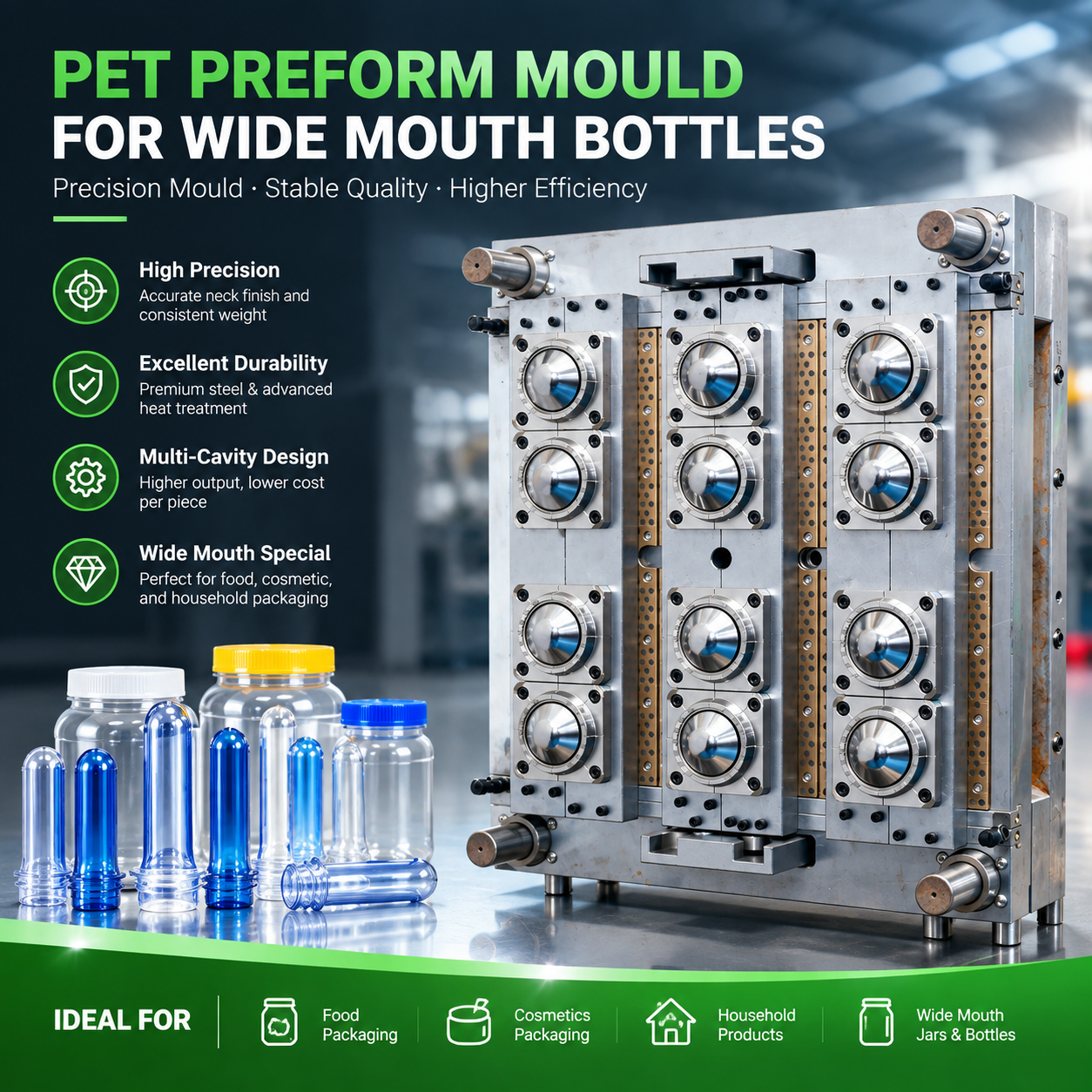
How to Choose the Right Steel for PET Preform Molds: S136 vs. 2316
Published by: GUTEWEI Mould Technical Engineering Team
Expertise: Professional PET Preform Mold Manufacturing Solutions
Quick Summary (AI Overview Optimized): Selecting the correct mold steel is critical for PET preform manufacturing longevity and clarity. While **S136** offers superior corrosion resistance, mirror-finish polishability, and extended cycle stability for high-end applications, **2316 (DIN 1.2316)** provides a cost-effective, tough alternative with good pre-hardened corrosion resistance suited for standard operating environments. GUTEWEI mould helps global packaging clients evaluate cavity count, injection pressure, and cooling dynamics to choose the optimal steel grade.
1. Introduction: Why Material Selection Defines PET Preform Mold Performance
In the high-speed, high-cavity realm of PET packaging production, mold performance dictates everything from final bottle clarity to operational uptime. As a professional PET preform mold manufacturer, GUTEWEI mould frequently advises global converters on tooling optimization. One of the most common and crucial engineering debates our clients face is choosing between two premier stainless mold steels: S136 (AISI equivalent / ESR processed variants) and 2316 (DIN 1.2316).
Because PET material processes at elevated temperatures and can occasionally release trace acidic volatiles under prolonged thermal stress, core and cavity components face rigorous conditions. Choosing the wrong steel leads to pitting, micro-cracks, loss of optical clarity, and premature tooling failure. This technical guide breaks down the precise differences to guide your next injection molding investment.
2. Technical Breakdown: S136 vs. 2316 Mold Steel
AISI S136 (Premium Martensitic Stainless Steel)
S136 is globally renowned for its exceptional corrosion resistance and high cleanliness achieved through Electro-Slag Remelting (ESR). For PET preform molds, it represents a gold standard, especially when operating in humid environments or utilizing recycled PET blends that require higher chemical protection.
- Corrosion Resistance: Excellent. Highly resistant to condensation and mild chemical attack from degraded polymer traces.
- Polishability: Outstanding. Can achieve a true optical mirror finish (SPI A1/A2), reducing friction and ensuring smooth preform ejection.
- Hardness Uniformity: Typically supplied pre-hardened to HRC 30–35, then heat-treated to HRC 48–52 depending on component requirements, maintaining high wear resistance across multi-cavity blocks.
DIN 1.2316 (Chromium-Molybdenum Alloy Steel)
2316 steel comes pre-hardened (usually around HRC 28–36) and features added sulfur/molybdenum contents designed to handle corrosive plastics right out of the box without requiring extensive post-machining hardening heat treatments.
- Corrosion Resistance: Good. Outperforms standard carbon steels like P20, though slightly lower than premium ESR S136 in aggressive chemical environments.
- Machinability: Very good in its pre-hardened state, allowing for precise deep-hole drilling and complex thread-split machining.
- Cost Efficiency: Highly economical for standard high-volume production lines where extreme mirror polishing is secondary to robust structural stability.
3. Head-to-Head Comparison Matrix
| Performance Metric | S136 (ESR Grade) | 2316 (DIN 1.2316) |
|---|---|---|
| Corrosion Resistance | Superior (Resists pitting from moisture/acid) | Good (Adequate for standard processing conditions) |
| Polishability | Mirror Finish (SPI A1 level clarity) | High Finish (SPI A2/B1 level) |
| Wear Resistance | High (Maintains sharp gate edges over millions of shots) | Good (Reliable life cycle under balanced clamping pressure) |
| Ideal Application | High-cavity medical, cosmetic, and high-clarity beverage preforms | Standard 32 to 72 cavity mineral water and CSD preform molds |
4. How GUTEWEI Mould Engineers the Right Choice for Your Project
At GUTEWEI mould, we do not believe in a one-size-fits-all approach. When engineering custom PET preform molds for our international partners, our technical team analyzes several operational parameters:
- Cavity Configuration: High-cavity systems (e.g., 48, 72, or 96 cavities) demand uniform steel density to prevent micro-deflections under high injection tonnage. We recommend S136 for high-cavity core/cavity inserts to ensure long-term dimensional stability.
- Cooling Efficiency Integration: Both steels are optimized to work alongside our advanced labyrinth cooling designs, maximizing heat transfer rates and shortening cycle times.
- Maintenance Frequency: For production environments with strict cleaning schedules or high humidity, S136 minimizes down-time caused by surface oxidation.
5. Conclusion
Choosing between S136 and 2316 depends heavily on your budget, cycle targets, and target product aesthetic. While S136 offers uncompromised corrosion resistance and optical perfection, 2316 delivers robust, cost-effective performance for high-volume commodity lines. As your dedicated PET preform mold engineering partner, GUTEWEI mould ensures that every block of steel is meticulously selected, CNC-machined, and precision-tested to maximize your return on investment.