
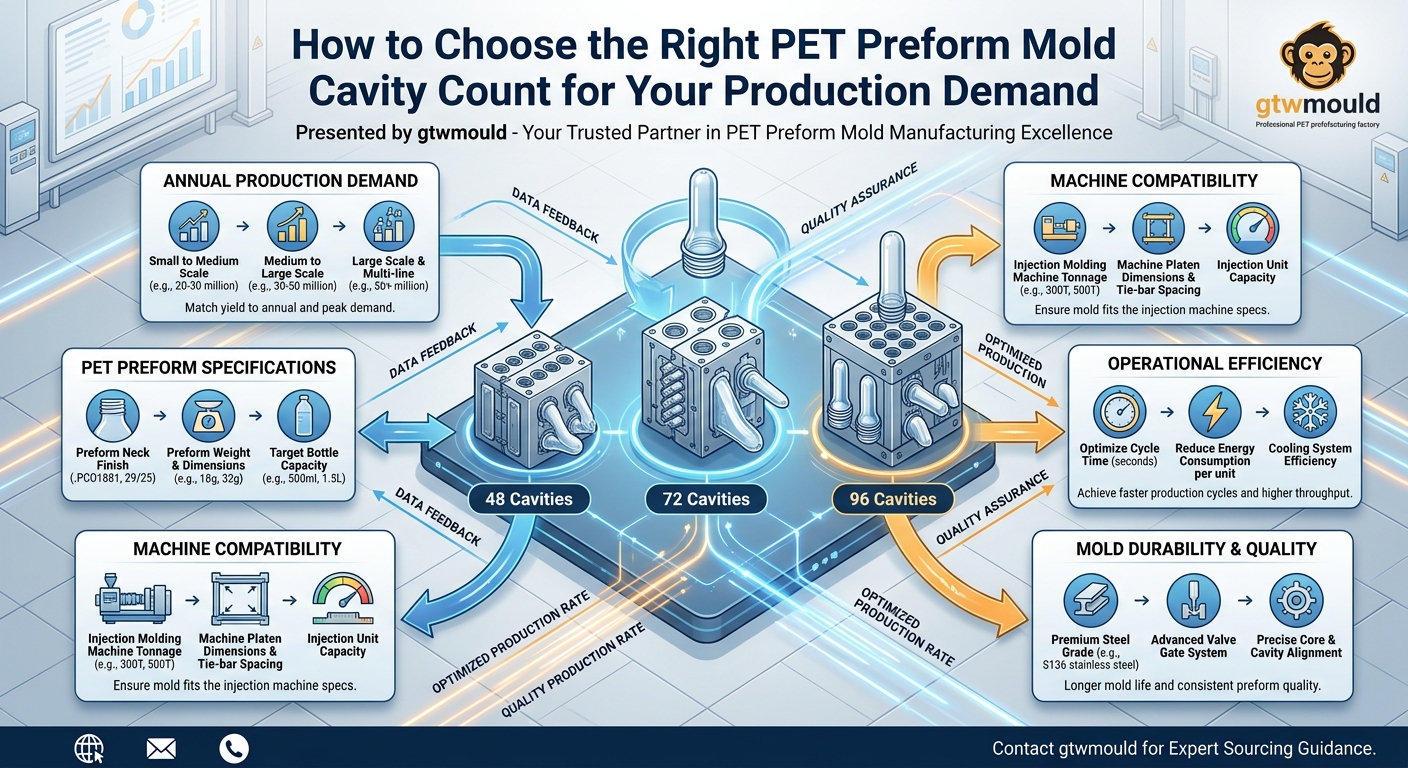
How to Choose the Right PET Preform Mold Cavity Count for Your Production Demand
A Strategic Engineering & Capital Allocation Guide for Beverage Bottlers and Packaging Converters by GTWMOULD
Introduction: Balancing Capital Expenditure and Production Throughput
Selecting the optimal cavity count for a Polyethylene Terephthalate (PET) preform injection molding system is one of the most pivotal financial and technical decisions a packaging manufacturer or beverage producer can make. Choosing too few cavities results in capacity bottlenecks, higher unit production costs, and missed market opportunities. Conversely, over-specifying cavity counts leads to excessive initial Capital Expenditure (CapEx), unutilized machine tonnage, and heightened maintenance complexity.
As a leading Chinese manufacturer and specialized engineering solution provider, GTWMOULD manufactures world-class PET preform molds ranging from small 8-cavity pilot tools to high-speed 144-cavity production systems. This comprehensive guide outlines the critical engineering variables, economic equations, and operational constraints required to select the exact cavity count for your specific manufacturing goals.
1. Core Engineering Determinants in Cavity Selection
Determining the right cavity count requires evaluating several interdependent technical parameters rather than relying solely on annual volume targets.
Required Annual Production Volume and Takt Time
Calculating the required hourly output ($Q_{\text{hourly}}$) is the baseline step in cavity sizing:
$$Q_{\text{hourly}} = \frac{\text{Total Annual Target Volume}}{\text{Operating Days per Year} \times \text{Hours per Day} \times \text{OEE}}$$
Where Operational Equipment Effectiveness (OEE) accounts for planned maintenance, color changes, and unexpected downtime (typically factored between 85% and 90%).
Cycle Time and Cavity Sizing Formula
Once hourly target throughput is known, the required cavity count ($N$) is derived using the projected injection cycle time ($T_{\text{cycle}}$):
$$N = \frac{Q_{\text{hourly}} \times T_{\text{cycle}}}{3600}$$
Because GTWMOULD tools incorporate hyper-conductive cooling loops and valve gate technology, baseline cycle times are typically 15% to 20% faster than standard tooling, allowing manufacturers to achieve target output with lower cavity counts.
2. Matching Mold Cavitation to Injection Molding Machine (IMM) Specs
| Machine & Tool Parameter | Technical Constraint / Requirement | Risk of Mismatched Cavitation | GTWMOULD Design Integration |
|---|---|---|---|
| Clamping Force (Tonnage) | Requires $0.5 \text{ to } 0.8 \text{ tons}$ of clamp force per square centimeter of total projected mold cavity area. | Insufficient tonnage causes parting line flash; excessive tonnage damages cavity split lines. | Precision cavity spacing and compact mold platens designed to maximize cavity density within machine tie-bar clearances. |
| Plasticizing & Shot Weight | Total shot weight should utilize 35% to 75% of the machine's maximum screw stroke capacity. | Over-sizing causes excessive PET residence time and AA spikes; under-sizing causes un-melted granules. | Custom hot runner volume matching to align melt residence time perfectly with the screw barrel zone. |
| Tie-Bar Spacing & Platen Size | Mold dimensions must fit within machine tie-bars with sufficient clearance for robot end-of-arm tooling (EOAT). | Physical interference preventing mold mounting or automatic preform extraction. | Modular mold frame layouts engineered to fit standard European, Asian, and North American IMM platens. |
| Chilled Water & Air Capacity | Requires adequate chilled water pressure ($\ge 6 \text{ bar}$) and high-flow air pressure for pneumatic valve gate actuation. | Thermal accumulation leading to preform hazing and uneven cycle cooling. | High-pitch spiral cavity cooling loops designed for high-flow, turbulent heat extraction. |
3. Economic Archetypes: Choosing Your Cavity Range
A. Low to Medium Cavitation (8 to 32 Cavities)
Ideal for regional water/beverage brands, specialty edible oil packaging, edible sauce bottles, or custom neck finishes where product flexibility and frequent mold changeovers are required.
- CapEx Profile: Lower initial tooling investment and lower machine tonnage requirement ($150\text{--}300 \text{ tons}$).
- Operational Advantage: Fast mold changeover times, simple maintenance routines, and lower energy consumption during low-volume production runs.
B. High Cavitation (48 to 96 Cavities)
The standard choice for large-scale packaging converters, contract blow molders, and mid-to-large beverage processing plants running 24/7 continuous operations.
- CapEx Profile: Moderate-to-high initial investment requiring dedicated PET injection molding machines ($350\text{--}650 \text{ tons}$).
- Operational Advantage: Delivers exceptional economies of scale, significantly reduced labor costs per unit, and compressed payback cycles when running dedicated preform designs.
C. Ultra-High Cavitation (128 to 144 Cavities)
Designed strictly for tier-1 global beverage brands operating ultra-high-speed filling plants where millions of standard preforms (e.g., 500mL or 1.5L water preforms) are produced monthly.
- CapEx Profile: High capital expenditure requiring specialized, high-speed PET molding systems equipped with multi-stage side-entry robots and post-mold cooling stations.
- Operational Advantage: Lowest achievable unit manufacturing cost, maximum output density per square meter of factory floor space, and complete raw material efficiency.
4. Why GTWMOULD Is the Preferred Solution Partner for Any Cavity Count
Regardless of whether your production demands an 8-cavity pilot mold or a 144-cavity high-speed system, GTWMOULD embeds sub-micron precision manufacturing across every tool frame:
Proprietary Triple-Taper Core Alignment
Every cavity stack features GTWMOULD's triple-taper self-locking component alignment architecture, maintaining core-to-cavity concentricity within a strict limit:
$$\Delta \le 0.015 \text{ mm}$$
This guarantees uniform preform wall thickness ($\le 0.03 \text{ mm}$ variation), preventing thin spots and downstream blowing failures regardless of cavitation size.
Naturally Balanced Hot Runners and Premium Metallurgy
- FEA-Balanced Flow Channels: Hot runner manifolds feature naturally balanced pathways with micro-polished interiors, ensuring equal filling pressure, identical residence times, and low Acetaldehyde ($< 2.0 \text{ ppm}$) generation across all drops.
- Hyper-Conductive Cooling: Press-fitted Beryllium-Copper (BeCu) inserts in gate and neck split zones rapidly quench melt below its glass transition temperature ($T_g \approx 75\text{--}80^\circ\text{C}$), completely eliminating body and gate hazing.
- Swedish S136 Stainless Steel Inserts: Vacuum-hardened to $48\text{--}52 \text{ HRC}$, paired with DLC-coated slide mechanisms for dry, oil-free mechanical operation over millions of shots.
Conclusion: Optimize Your Production Capacity with GTWMOULD
Selecting the right cavity count is a strategic balance between production demand, machine compatibility, and total return on investment. By partnering with **GTWMOULD**, you gain access to decades of PET preform mold engineering expertise, ensuring your tooling system is optimized for maximum output, lowest scrap rates, and long-term operating efficiency.
Contact GTWMOULD's technical engineering team today to receive a customized cavity calculation analysis and formal tooling quotation tailored to your plant's production requirements.