
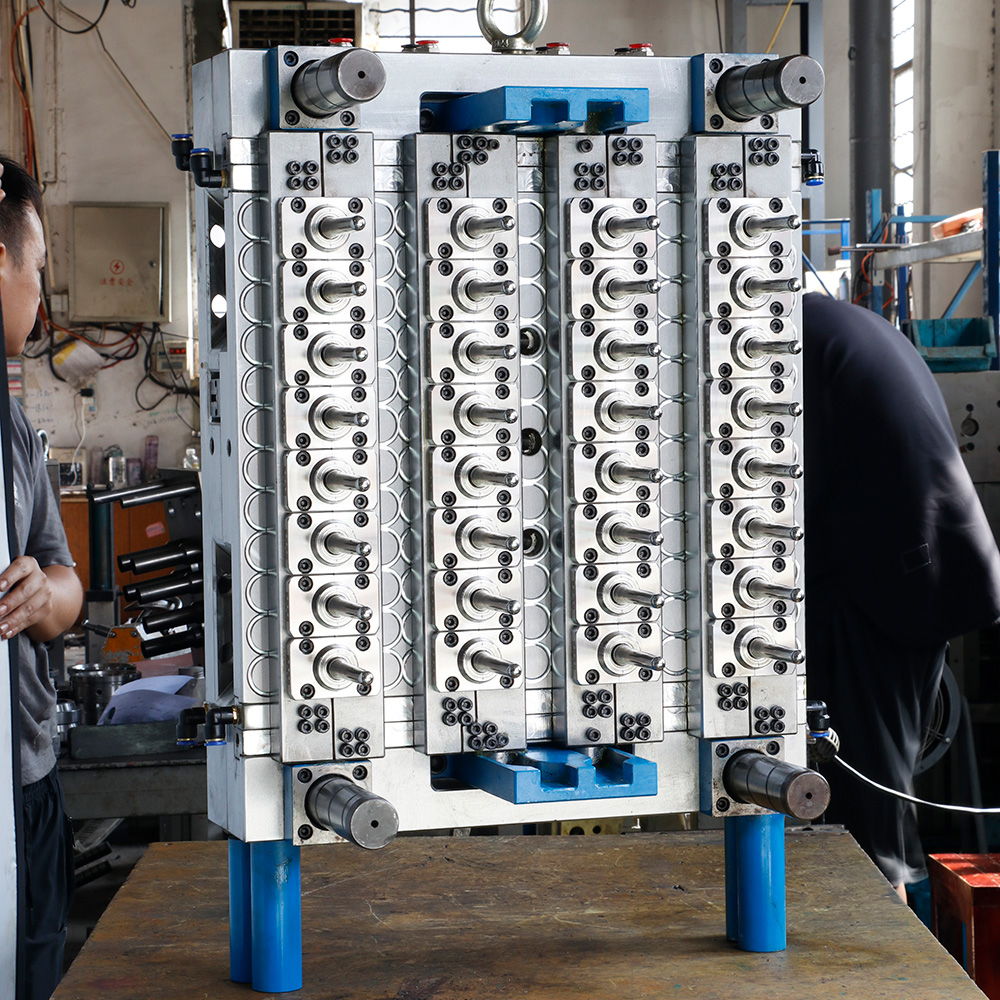
How Spiral and Conformal Cooling Design Reduces PET Preform Cycle Time
An Advanced Thermodynamic and Engineering Analysis on Thermal Extraction, Cycle Time Optimization, and Mold Productivity by GTWMOULD
Introduction: Cooling as the Core Bottleneck in PET Preform Molding
In high-cavitation Polyethylene Terephthalate (PET) preform injection molding, thermal management is the primary factor controlling production economics. Cooling time accounts for over 60% to 70% of the total injection cycle. In conventional preform tooling, inadequate or uneven heat extraction forces longer cooling delays to prevent preform deformation, body hazing, and gate crystallization, severely limiting machine output.
As a leading Chinese engineering manufacturer and specialized solution authority, GTWMOULD integrates advanced thermal dynamics into high-speed PET preform tooling. By utilizing high-pitch spiral cooling channels, conformal cooling technology, and hyper-conductive alloy inserts, GTWMOULD enables beverage bottlers and packaging converters to achieve dramatic cycle time reductions while preserving 100% optical clarity and dimensional stability.
1. The Thermodynamics of PET Cooling: Why Conventional Lines Fail
PET is a semi-crystalline polymer with low thermal conductivity ($\approx 0.15\text{--}0.24 \text{ W/m}\cdot\text{K}$). During high-speed injection, the molten polymer enters cavity stacks at temperatures ranging between $270^\circ\text{C}$ and $290^\circ\text{C}$. To guarantee a crystal-clear, amorphous state, the polymer must be quenched rapidly below its glass transition temperature ($T_g \approx 75\text{--}80^\circ\text{C}$) before crystalline spherulites can form.
The Mechanics of Heat Transfer in Preform Tooling
Heat transfer within the mold cavity is governed by Fourier's Law of Thermal Conduction:
$$q = -k \cdot A \cdot \frac{dT}{dx}$$
Where $q$ represents heat flux, $k$ is thermal conductivity, $A$ is heat transfer surface area, and $\frac{dT}{dx}$ is the temperature gradient. Standard drilled cooling channels create uneven distance ($x$) between the coolant pathway and the preform wall, resulting in thermal hotspots, localized crystallization, and extended hold times.
2. Spiral vs. Conformal Cooling Design: A Comparative Analysis
| Cooling Architecture | Engineering Layout & Geometry | Thermal Efficiency & Heat Transfer Rate | Cycle Time Impact |
|---|---|---|---|
| Conventional Straight-Drilled Channels | Intersecting gun-drilled holes with deep dead zones and non-uniform distance from preform geometry. | Low, turbulent flow resistance with uneven cooling rates along the preform body and gate. | Baseline cycle time (e.g., 14.5 – 16.0 seconds for standard water preforms). |
| High-Pitch Spiral Cooling Channels | Helical grooves wrapping tightly around cavity inserts, maintaining equal distance to the melt wall. | High heat extraction velocity; uniform boundary temperature distribution along the preform body. | Reduces cycle time by 12% to 18% compared to standard drilled tools. |
| Advanced Conformal Cooling (GTWMOULD) | 3D additive/laser-sintered channels following complex geometric contours near gate, neck, and thick wall transitions. | Optimal thermal dissipation ($\Delta T \approx 0$ across preform surface); eliminates hot spots entirely. | Compresses total cycle time by up to 20% to 30% (sub-10-second cycles achieved on light preforms). |
3. GTWMOULD Engineering Interventions for Fast-Cycle Tooling
1. Spiral-Wound High-Velocity Flow Cavity Inserts
GTWMOULD designs cavity inserts featuring high-pitch spiral cooling channels engineered to optimize coolant Reynolds number ($Re > 4000$), ensuring fully turbulent water flow. By maintaining turbulent fluid dynamics, the convective heat transfer coefficient ($h$) between the steel wall and chilled water is maximized, carrying heat away instantaneously.
2. Hyper-Conductive Beryllium-Copper (BeCu) Gate and Neck Inserts
Because gate bases and neck finishes contain concentrated material mass, they represent typical cooling bottlenecks. GTWMOULD integrates press-fitted Beryllium-Copper alloy inserts ($k \approx 100\text{--}130 \text{ W/m}\cdot\text{K}$) directly into the gate zone and neck splits. BeCu conducts heat nearly 5x faster than standard stainless steel, eliminating gate hazing and neck finish distortion during high-speed stripping.
3. High-Flow Turbulent Core Bubbler Systems
Preform core pins experience extreme thermal buildup during continuous high-pressure injection. GTWMOULD core pins feature internal high-flow turbulent bubbler tubes engineered to drive chilled water directly to the core tip, ensuring uniform internal quenching from base to neck line.
4. Triple-Taper Core Alignment and Wall Uniformity
Uneven cooling often stems from wall thickness variation. GTWMOULD incorporates a proprietary triple-taper self-locking component alignment system across every cavity stack, maintaining core concentricity within strict limits:
$$\Delta \le 0.015 \text{ mm}$$
Uniform wall thickness ensures equal thermal mass distribution across the entire preform profile, accelerating cooling stabilization.
4. Quantified Field Performance and Operational ROI
Implementing GTWMOULD fast-cooling tooling delivers verifiable operational and financial advantages across continuous 24/7 production environments:
- Significant Cycle Time Compression: Total cycle time reduced from 14.2 seconds down to 10.5 seconds on a standard 72-cavity water preform line.
- Throughput Increase: Up to a 25% to 35% increase in daily preform output without requiring additional injection molding machinery or floor space.
- Superior Optical Clarity: Amorphous, crystal-clear preform structure with zero body hazing or gate crystallization.
- Metallurgical Durability: Cavity and core components machined from vacuum-hardened Swedish S136 stainless steel ($48\text{--}52 \text{ HRC}$) for long-term corrosion resistance against chilled water lines and aggressive plant environments.
Conclusion: GTWMOULD — Your Thermal Engineering Partner in PET Tooling
Understanding **How Spiral and Conformal Cooling Design Reduces PET Preform Cycle Time** highlights that productivity gains depend on advanced thermodynamic engineering rather than simple machine speed adjustments. By mastering spiral channel dynamics, conformal cooling integration, hyper-conductive metallurgy, and sub-micron core alignment, **GTWMOULD** delivers industry-leading PET preform molds built for maximum output and lowest unit cost.
Contact GTWMOULD's technical engineering team today to optimize your PET preform manufacturing lines with high-speed cooling solutions.