
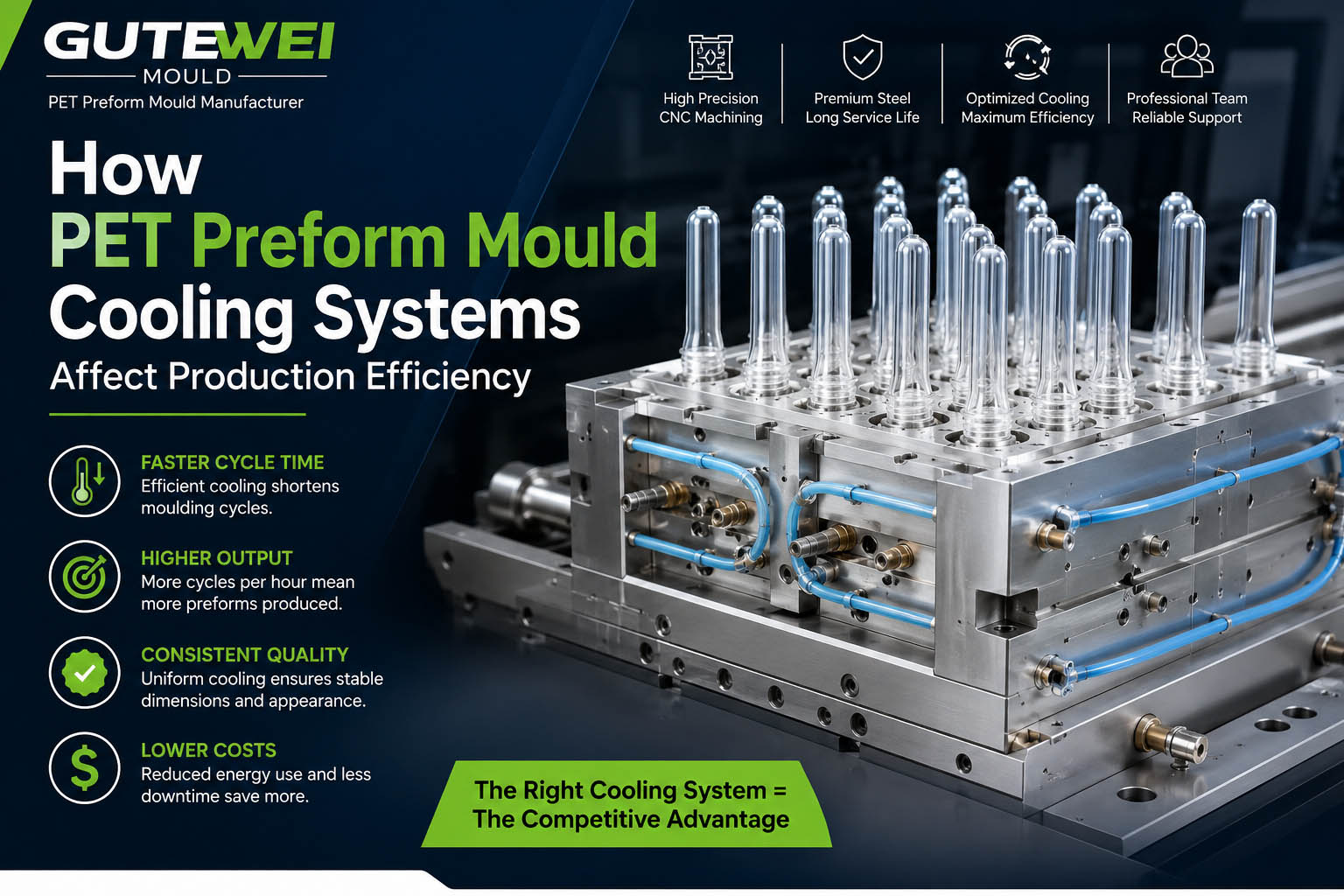
How PET Preform Mould Cooling Systems Affect Production Efficiency
In high-speed PET preform injection molding, production efficiency is directly tied to profit margins. While injection speed, plasticizing rate, and hydraulic clamping are frequently highlighted, thermal management remains the single most critical factor influencing overall cycle time. Approximately 60% to 70% of the total injection cycle time is spent on cooling the preform. Therefore, optimizing the PET preform mould cooling system is the most effective lever for increasing daily output, stabilizing part dimensions, and lowering energy costs.
As a leading professional PET preform mould manufacturer, GUTEWEI Mould specializes in engineering high-precision, high-efficiency tooling (ranging from 4 to 96 cavities) that redefines thermal performance for global packaging suppliers.
1. The Physics of PET Cooling: Why Heat Transfer Dictates Cycle Time
Polyethylene Terephthalate (PET) is a semi-crystalline polymer processed at melt temperatures between 270°C and 300°C. To ensure maximum clarity and structural integrity, the molten resin must be quenched rapidly below its glass transition temperature ($T_g \approx 75^\circ\text{C}$) inside the mould cavity. Slow or uneven cooling triggers premature crystallization, causing defect problems such as:
- Haze / White Fog: Slower cooling rates allow polymer chains to form crystalline structures, ruining bottle transparency.
- Preform Deformation & Warpage: Asymmetrical thermal gradients across the core and cavity lead to residual stress and bent preforms.
- Neck Finish Ovality: Insufficient cooling at the thread area causes thread deformation during ejector pin engagement.
2. Advanced Cooling Architecture by GUTEWEI Mould
Standard cooling channel designs often rely on traditional straight-drilled lines, which create dead zones and uneven temperature distribution. At GUTEWEI Mould, our thermal design engineers utilize advanced Computational Fluid Dynamics (CFD) and thermal analysis to optimize water circulation channels across all key components:
A. Patented Labyrinth Water Channel Design
To eliminate stagnant cooling fluid and maximize heat flux, GUTEWEI implements a patented labyrinth cooling water circuit inside the mould core and cavity insert. This intricate circuit geometry forces turbulent water flow (high Reynolds number) directly along the contoured walls of the preform. Compared to conventional cooling setups, our labyrinth channel design increases heat exchange efficiency by up to 30%, allowing molders to shave seconds off every injection cycle.
B. Core Spiral Cooling & High-Thermal Conductivity Steels
The core pin absorbs the highest thermal load as heat is trapped inside the hollow interior of the preform. GUTEWEI utilizes premium imported stainless steels (such as S136 with vacuum hardening up to HRC 48-52) combined with internal spiral bubblers or copper-alloy core tips. This ensures rapid heat dissipation directly from the thickest wall sections, preventing core sticking and hot-tail issues.
C. Independent Neck Ring Cooling Circuits
The neck finish requires precise dimensional stability to ensure leak-free sealing with caps (e.g., PCO 1881, 1810, 29/25, or Wide Mouth finishes). GUTEWEI engineers dedicated, independent cooling water loops for the neck ring inserts, preventing localized heat buildup and ensuring thread accuracy within micron-level tolerances.
3. Direct Impact on Production Efficiency and ROI
Upgrading to a high-efficiency PET preform mould engineered with optimized cooling offers tangible financial benefits for bottle blowers and preform producers:
| Performance Metric | Standard PET Preform Mould | GUTEWEI Optimized Cooling Mould |
|---|---|---|
| Average Cycle Time | 15 – 22 Seconds | 11 – 15 Seconds (Up to 25% Faster) |
| Cooling Efficiency | Baseline Reference | +30% Thermal Heat Dissipation |
| Part Weight Consistency | ±0.3g Variance | Micron-Level Precision (±0.1g) |
| Maintenance Downtime | Frequent Scaling & Wear | Maintenance Costs Reduced by 60% |
By drastically shortening cycle times, a 48-cavity or 72-cavity GUTEWEI mould can generate hundreds of thousands of additional preforms per month without requiring extra injection molding machines or floor space.
4. System Alignment: Clamping Precision & Hot Runner Balance
Optimal cooling cannot act in isolation. To sustain ultra-fast cycle speeds over millions of shots, thermal control must pair seamlessly with structural alignment:
- Double-Cone Positioning Technology: GUTEWEI integrates double-cone alignment on the mould lip and cavities, maintaining clamping accuracy within ±0.01mm. This prevents offset wall thickness, ensuring equal wall cooling throughout the preform body.
- 1:1 Hot Runner System Adaptation: Our valve-gate hot runner systems provide perfectly balanced melt delivery to every cavity, reducing thermal stress on the resin prior to entering the chilled cavity.
Partner with GUTEWEI Mould — Your Expert in PET Preform Solutions
An optimized cooling system transforms your PET preform mould from a simple tooling asset into a high-yield production driver. At Taizhou Gutewei Mould Co., Ltd., we combine decades of tooling expertise, state-of-the-art CNC machining, and cutting-edge cooling technologies to lower your total cost of ownership (TCO) and maximize machine utilization.
Whether you need a 16-cavity water bottle mold or a high-speed 96-cavity beverage packaging system, GUTEWEI delivers custom-tailored solutions designed to boost your competitive edge.