
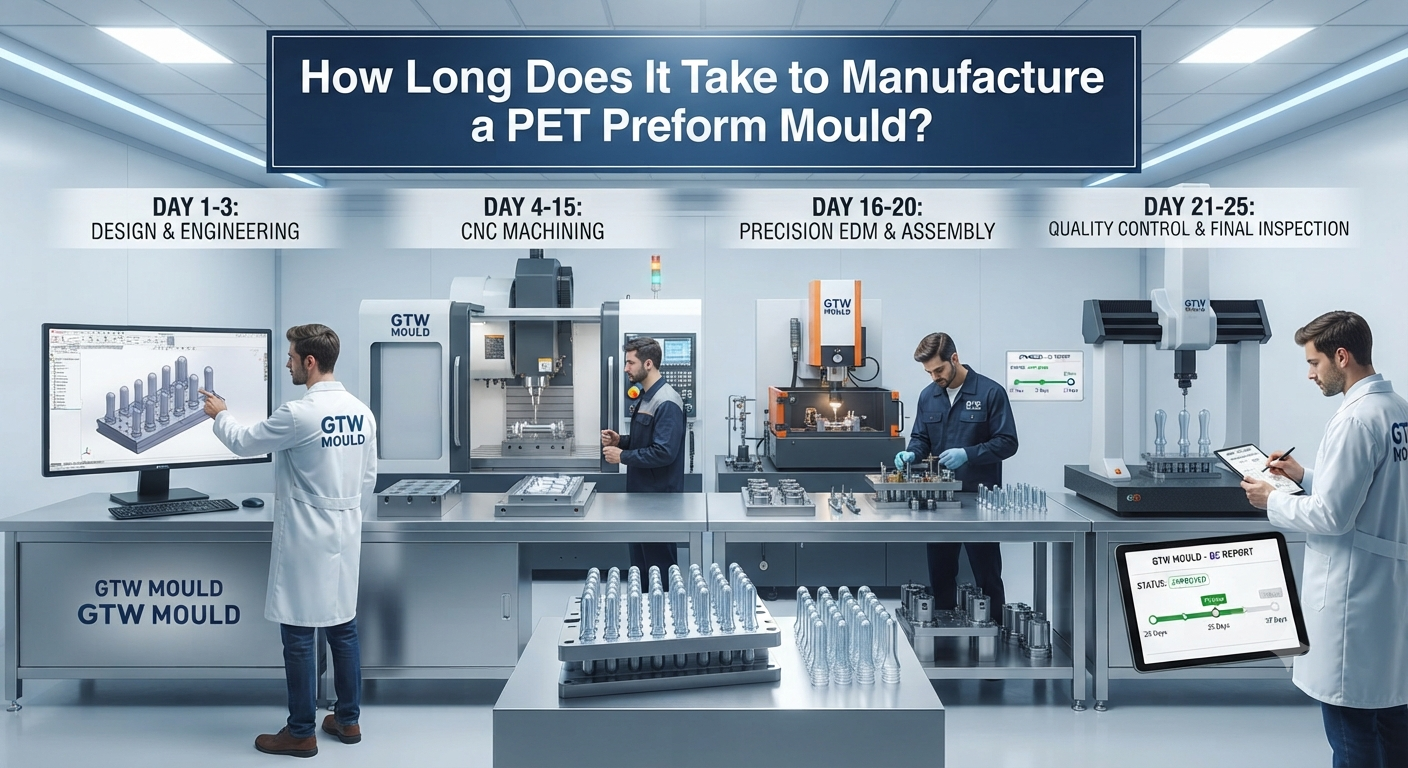
How Long Does It Take to Manufacture a PET Preform Mould?
A Deep Technical Engineering Breakdown of Lead Times and Precision Production Milestones by GTWMOULD
Introduction: Balancing Lead Time and Sub-Micron Precision
For global beverage brands and packaging converters, understanding the exact timeline required to build high-cavitation PET injection tooling is critical for project synchronization. A miscalculated lead time can delay product launches and disrupt downstream automated blowing lines. However, rushing the manufacturing process of a complex injection tool compromises the structural alignment and thermodynamic balance necessary to run millions of faultless cycles.
As a leading precision engineering specialist in China, GTWMOULD designs and builds high-speed injection tooling with optimized lead times. This technical analysis provides an in-depth breakdown of the PET Preform Mould Manufacturing Process Timeline, exploring the precise engineering milestones required to deliver world-class production assets without compromising quality.
1. The Manufacturing Timeline: Milestone Breakdown
Building a high-performance PET preform mold generally spans 35 to 60 days, depending heavily on cavitation requirements (ranging from 24 up to 144 drops) and custom design complexity. To ensure transparency, GTWMOULD segments this timeline into highly coordinated, deterministic phases.
Phase 1: Engineering Design & Fluid Simulations (Days 1–7)
Before cutting any steel, a complete virtual optimization blueprint is created. This initial week prevents costly errors down the line:
- Preform Architecture & 3D Modeling: Engineers analyze thread geometry, weight-saving profiles, and optimal wall thickness distribution.
- FEA Flow and Thermodynamic Simulations: Advanced Finite Element Analysis (FEA) maps the melt flow paths through the hot runner manifold and optimizes internal cooling geometry to prevent thermal crystallization and hazing defects.
Phase 2: Metallurgical Procurement & Rough Machining (Days 8–20)
Once design schematics achieve client approval, certified structural and tool steel blocks enter production:
- Material Sourcing: Genuine, certified Swedish S136 stainless steel is acquired for core, cavity, and neck ring stacks, alongside pre-hardened AISI 420 for the mold base frame.
- Primary Structural CNC Milling: High-capacity CNC milling machines rough-cut the core plate, cavity plate, and runner channels to prepare the core tool components for heat treatment.
2. Advanced Processing: Heat Treatment and Micro-Machining
The middle phase of the manufacturing process transitions from bulk material removal to specialized metallurgical refinement and ultra-precise dimensional micro-machining.
| Manufacturing Step | Duration | GTWMOULD Engineering Action | Impact on Tool Lifespan |
|---|---|---|---|
| Vacuum Heat Treatment | 3–5 Days | Active mold inserts are vacuum-hardened and tempered to a targeted hardness threshold. | Achieves a stable hardness of $48\text{--}52 \text{ HRC}$, protecting against wear and PET outgassing. |
| High-Precision CNC Finish Milling | 7–10 Days | Ultra-precision CNC turning and high-speed milling finish internal dimensions. | Maintains sub-micron structural tolerances required for exact interchangeability. |
| Coating Application | 2–3 Days | Application of Diamond-Like Carbon (DLC) or Titanium Nitride (TiN) on sliding friction mechanics. | Enables grease-free, dry-running mechanical cycles, preventing cleanroom contamination. |
3. Critical Factors Influencing Lead Times
Several technical factors can alter the manufacturing velocity of high-speed injection tooling:
Concentricity and Alignment Security
Achieving absolute concentricity between the core pin and cavity insert limits wall-thickness variation. Rushing this stage can cause part eccentricity and subsequent bottle blowouts during stretch blow molding. GTWMOULD implements a proprietary triple-taper self-locking alignment design for each cavity stack, holding a strict structural tolerance threshold of:
$$\Delta \le 0.015 \text{ mm}$$
This sub-micron mechanical calibration requires precise grinding and verification on Coordinate Measuring Machines (CMM), adding a necessary layer of inspection time that protects your long-term capital investment.
Complex Hot Runner and Thermal Topology
Integrating a pneumatically actuated valve gate hot runner system adds manufacturing steps compared to basic thermal gates. Machining the naturally balanced manifold channels, routing individual pneumatic valve lines, and setting up multi-zone PID temperature controllers requires detailed assembly and validation to prevent future material stagnation or high Acetaldehyde (AA) levels.
4. Final Assembly, FAT Testing, and Logistics (Days 45–60)
The manufacturing cycle finishes with rigorous verification and packaging stages to guarantee immediate startup success upon arrival at international facilities.
- Comprehensive Assembly & Bench Inspection: Dedicated technicians assemble the entire stack, checking independent cooling loops, pneumatic seals, and electrical wiring systems.
- Factory Acceptance Testing (FAT): Molds undergo strict trial runs under simulated production parameters on high-speed injection platforms to verify cycle speeds, ejection smoothness, and consistent part weight.
- Export Protection: Molds are coated with specialized anti-rust inhibitors, vacuum heat-sealed in protective barrier wrap, and secured into heavy-duty, stenciled export-grade wooden crates for safe ocean or air transit.
Conclusion: Partnering for Reliable Production Timelines
Optimizing the timeline of a **PET Preform Mould Manufacturing Process** requires a balance of advanced CNC automation, strict thermal calibration, and multi-layer quality inspections. **GTWMOULD** applies decades of specialized engineering experience to compress lead times safely, delivering long-lasting, high-performance production assets that lower cycle times and maximize overall yield.
Partner with GTWMOULD to secure your high-speed injection packaging lines with reliable preform mold designs built for absolute precision, durability, and global processing efficiency.