
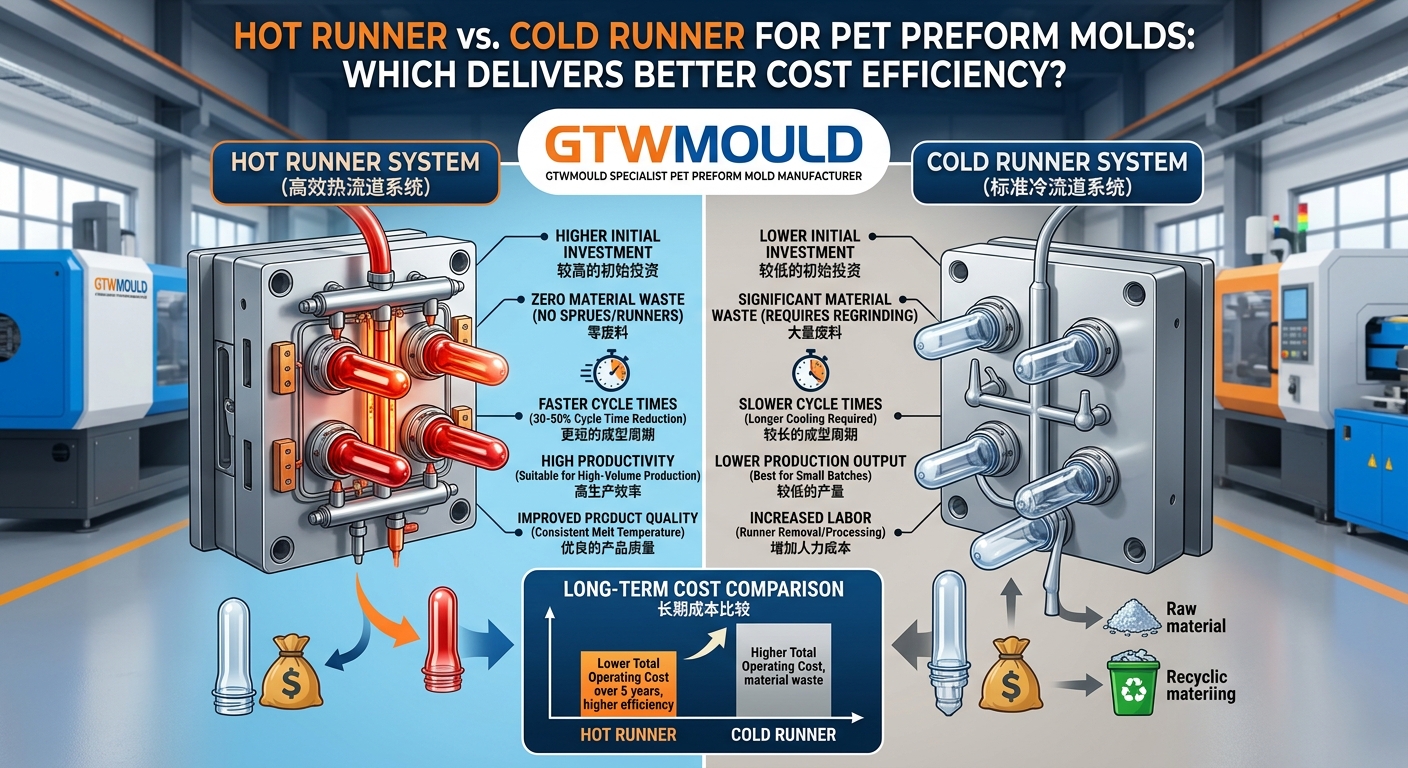
Hot Runner vs Cold Runner for PET Preform Molds: Which Delivers Better Cost Efficiency?
A Definitive Technical & Economic Analysis on Resin Utilization, Cycle Time Optimization, and Total Cost of Ownership (TCO) by GTWMOULD
Executive Summary: The Tooling Architecture Dilemma in PET Packaging
In high-speed Polyethylene Terephthalate (PET) injection molding operations, raw material costs account for 70% to 80% of total operational expenditure. As global packaging converters, beverage brands, and preform manufacturers scale up production, selecting the optimal runner architecture—Hot Runner vs. Cold Runner—becomes a critical determinant of manufacturing profitability, scrap rates, and thermal efficiency.
While cold runner tooling offers lower upfront capital expenditure (CapEx), it introduces significant material waste, extended cycle times, and severe thermal degradation risks for PET polymer. Conversely, advanced valve gate hot runner systems require higher initial investment but deliver unparalleled resin savings and lightning-fast cycle speeds. As a premier Chinese manufacturer and global solution provider, GTWMOULD presents a comprehensive technical breakdown to evaluate which runner topology delivers superior long-term cost efficiency for your manufacturing plant.
1. Fundamental Mechanics: Cold Runner vs. Hot Runner Architecture
Understanding the fundamental differences between runner systems requires examining how molten PET polymer flows from the injection unit nozzle into individual core-and-cavity stacks.
Cold Runner Systems in PET Molding
In a cold runner mold, the plastic fills both the actual preform cavities and a physical channel network (the runner). During the cooling phase, the resin inside these channels solidifies along with the preform, generating a solid sprue/runner grid that must be ejected and mechanically trimmed at every cycle.
- Material Inefficiency: Generates substantial regrind material that requires offline granulating, drying, and re-blending.
- Thermal Degradation Risk: Reprocessing PET regrind degrades Intrinsic Viscosity (IV) and increases Acetaldehyde (AA) levels, compromising container clarity and flavor neutral properties.
- Extended Cooling Duration: The thick cross-section of the cold runner network dictates the cooling time, artificially extending the overall injection cycle.
Hot Runner Systems in PET Molding
In a hot runner mold, the manifold and nozzle drops are heated independently using multi-zone PID temperature controllers. The PET resin remains in a continuously molten, liquid state inside the internal distribution channels. Only the preform cavity itself freezes and ejections occur cleanly at the gate interface.
- Zero Runner Scrap: 100% of injected plastic enters the preform body, eliminating regrind handling and material waste.
- Preserved Resin Integrity: Virgin PET resin experiences uniform shear stress and controlled residence time, preventing IV drop and keeping AA generation below strict limits ($< 2.0 \text{ ppm}$).
- Compressed Cycle Times: Cooling is dictated purely by the preform wall thickness rather than thick runner channels.
2. Comprehensive Engineering Comparison Matrix
To provide clear visibility for plant managers and procurement directors, GTWMOULD has systematically mapped the operational parameters of both tooling architectures:
| Performance Parameter | Cold Runner Molds | GTWMOULD Advanced Hot Runner Molds | Impact on Operational Cost |
|---|---|---|---|
| Resin Yield Efficiency | 80% – 88% (12%–20% sprue waste) | 100% Direct Shot Conversion | Direct raw material cost savings up to hundreds of thousands of dollars annually. |
| Cycle Time Performance | 18.0 – 28.0 seconds (slow cooling of runner) | 8.5 – 14.0 seconds (optimized cooling) | Doubles daily preform production throughput per machine unit. |
| Gate Vestige Quality | Rough sprue cut; requires manual/mechanical trim | Flush valve gate shut-off needle | Eliminates post-processing labor and prevents downstream robot transfer jam-ups. |
| Intrinsic Viscosity (IV) Loss | High loss due to thermal history of regrind | Minimal loss ($\Delta \text{IV} \le 0.02 \text{ dL/g}$) | Ensures superior stretch-blow molding yield and top-load bottle strength. |
| Initial Capital Investment (CapEx) | Low initial tool fabrication cost | Higher upfront investment | Hot runner CapEx is fully amortized within 6 to 12 months of active operation. |
3. Economic Modeling: Total Cost of Ownership (TCO) & ROI Analysis
Evaluating cost efficiency requires looking beyond initial purchase price to analyze the Total Cost of Ownership (TCO) across millions of production cycles. Consider a standard 48-cavity preform production line operating 24/7:
Raw Material Savings Calculation
Assuming a target preform weight of 15 grams, an annual output of 50 million preforms, and a PET resin cost of $1.10/kg:
- Cold Runner Waste Stream: A 15% runner waste factor generates 112.5 metric tons of regrind per year. Re-drying and reprocessing regrind introduces a 2% net material loss plus elevated energy overhead, resulting in direct annual losses exceeding $120,000.
- Hot Runner Direct Conversion: Zero waste generation ensures 100% of purchased resin is converted directly into sellable product.
Cycle Time Savings & Capacity Expansion
Compressing the injection cycle time from 20 seconds (cold runner) down to 10 seconds (GTWMOULD hot runner) effectively doubles plant production capacity on the same press footprint without purchasing additional injection molding machines or increasing floor space.
$$\text{ROI Payback Period} = \frac{\Delta \text{ Initial Tooling Cost}}{\text{Annual Resin Savings} + \text{Capacity Energy Gain}} \approx 6.4 \text{ Months}$$
4. GTWMOULD Specialized Hot Runner Engineering Innovations
While hot runner systems are mathematically superior for PET preforms, poorly engineered hot runners can suffer from leakage, thermal imbalances, and valve needle wear. GTWMOULD resolves these challenges through custom proprietary engineering features:
Proprietary Naturally Balanced Flow Pathways
Utilizing advanced Finite Element Analysis (FEA) rheology modeling, GTWMOULD designs naturally balanced manifold channels with micro-polished interior walls. This ensures equal shear rates, identical flow lengths, and uniform residence times across all cavity drops—from 24 up to 144 cavities.
Pneumatic Individual Valve Gate Control
GTWMOULD integrates individual pneumatically actuated valve gate needles crafted from hardened tool steel. The precise mechanical shut-off guarantees a perfectly smooth, flush gate vestige with zero stringing, drooling, or base crystallization.
Sub-Micron Concentricity and Thermal Quenching
- Triple-Taper Alignment System: Mechanical interlocking guarantees core-to-cavity concentricity within $\Delta \le 0.015 \text{ mm}$, eliminating wall thickness variation ($\le 0.03 \text{ mm}$).
- Hyper-Conductive Cooling: High-pitch spiral cavity cooling combined with press-fitted Beryllium-Copper (BeCu) inserts rapidly quenches PET resin below its glass transition temperature ($T_g \approx 75\text{--}80^\circ\text{C}$), ensuring crystal-clear optical clarity.
- Premium Metallurgical Construction: Vacuum-hardened Swedish S136 stainless steel inserts ($48\text{--}52 \text{ HRC}$) paired with DLC-coated neck split slides ensure oil-free, corrosion-resistant operation over millions of shots.
Conclusion: The Clear Verdict on PET Preform Cost Efficiency
In the debate of **Hot Runner vs Cold Runner for PET Preform Molds**, the technical and economic data is clear: while cold runner molds may appeal to small-scale, low-budget entry applications, **hot runner valve gate systems are indispensable for professional, commercial-scale PET preform production**.
By eliminating material waste, dramatically accelerating cycle speeds, and preserving resin Intrinsic Viscosity, high-precision hot runner tooling from **GTWMOULD** delivers the lowest total cost per preform and the highest return on investment for high-speed manufacturing facilities worldwide.
Partner with GTWMOULD today to upgrade your PET tooling architecture and maximize your plant's production efficiency.