
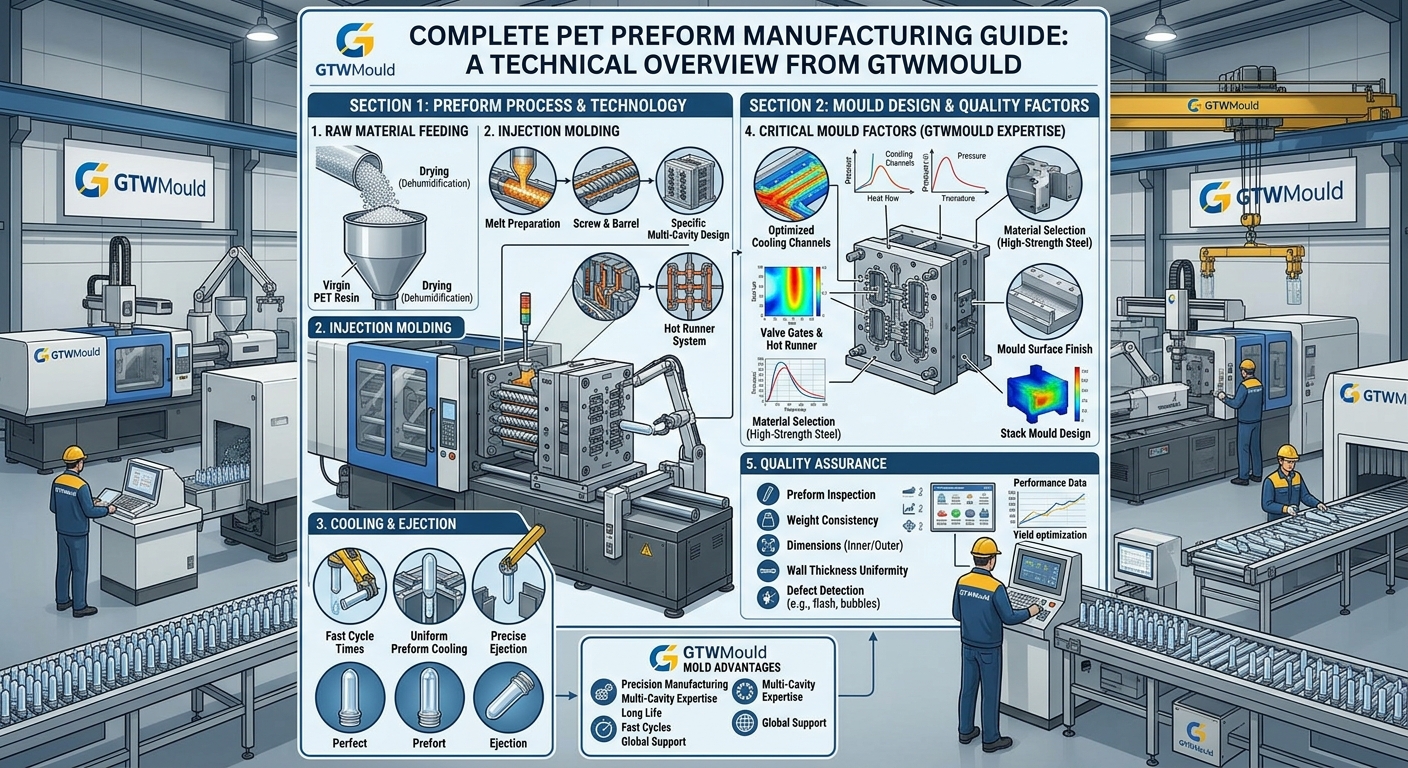
Complete PET Preform Manufacturing Guide
An End-to-End Technical Manual for High-Precision Preform Tooling and Processing Excellence by GTWMOULD
Introduction: Modern Industrial Standards for High-Volume PET Preform Production
In global beverage bottling, food packaging, and consumer goods manufacturing, Polyethylene Terephthalate (PET) preforms serve as the crucial structural precursor for high-speed stretch blow molding. Achieving absolute efficiency, sub-gram weight consistency, and maximum optical clarity requires total system control across resin dehumidification, polymer melt rheology, thermodynamic quenching, and mechanical tool centering.
As a leading global specialist in high-precision injection mold engineering, GTWMOULD manufactures high-cavitation preform tooling systems built for continuous 24/7 manufacturing environments. This Complete PET Preform Manufacturing Guide provides plant managers, tooling engineers, and processing specialists with an authoritative technical overview of the injection molding workflow, key engineering parameters, and preventive maintenance frameworks.
1. Resin Preparation and Dehumidification Control
The processing of PET resin is highly sensitive to ambient humidity due to the polymer's hygroscopic nature. Processing raw PET material without proper moisture management leads to hydrolytic degradation during plasticization, resulting in severe Intrinsic Viscosity (IV) drops, brittle bottle structures, and silver streaking.
Key Parameters for Resin Drying
- Target Moisture Level: Must be reduced to less than $0.005\%$ ($50 \text{ ppm}$) prior to entering the injection barrel.
- Desiccant Air Dew Point: Maintained strictly between $-40^\circ\text{C}$ and $-50^\circ\text{C}$.
- Drying Temperature and Duration: Heated dry air at $160\text{--}180^\circ\text{C}$ for a continuous residence period of 4 to 6 hours.
2. Polymer Plasticization and Low-Shear Hot Runner Engineering
Once dried, the resin is plasticized in the injection unit and transferred through an advanced hot runner manifold into individual cavity inserts. Controlling shear stress and thermal dwell time is paramount to preventing Acetaldehyde (AA) generation and polymer degradation.
| Tooling Sub-System | Processing Risk | GTWMOULD Engineering Solution | Operational Advantage |
|---|---|---|---|
| Hot Runner Flow Channels | Shear heating and stagnant melt zones leading to high AA levels and off-flavor contamination. | FEA-optimized, naturally balanced runner pathways with micro-polished interior channels. | Low-shear, uniform resin velocity across all drops (24 to 144 cavities) preserving resin IV. |
| Injection Gate Shut-Off | Thermal gate drooling, long stringing tails, and preform jam-ups during mechanical robot transfer. | Pneumatically actuated valve gate hot runner system with individual mechanical pin shut-off. | Ultra-clean, flush gate vestige with zero tailing or stringing defects. |
| Thermal Regulation | Temperature fluctuations causing density variations and shot-to-shot weight inconsistency. | Multi-zone PID thermal control maintaining absolute thermal balance across the entire manifold block. | Identical melt parameters and precise volumetric filling for every individual cavity. |
3. Sub-Micron Alignment and Hyper-Conductive Thermal Quenching
To produce preforms that stretch uniformly during blow molding without wall blowouts, preform molds must maintain sub-micron core alignment and achieve rapid amorphous cooling.
Triple-Taper Self-Locking Alignment Security
Under extreme injection pressures ($1000\text{--}1500 \text{ bar}$), core pins can shift if the tool lacks adequate mechanical interlocking. GTWMOULD incorporates a proprietary triple-taper self-locking component alignment system across every cavity stack, maintaining core-to-cavity concentricity within a strict tolerance threshold:
$$\Delta \le 0.015 \text{ mm}$$
This structural precision restricts total preform wall-thickness variation to under 0.03mm, guaranteeing uniform material distribution during subsequent biaxial stretch blow molding.
Rapid Amorphous Thermal Quenching
To prevent PET from forming crystalline structures that cause white cloudy hazing, the molten material must be quenched rapidly below its glass transition temperature ($T_g \approx 75\text{--}80^\circ\text{C}$). GTWMOULD utilizes high-pitch spiral-wound cavity cooling loops, high-velocity internal core bubblers, and press-fitted Beryllium-Copper (BeCu) inserts at the neck split and gate zones to maximize heat extraction and preserve optical clarity.
4. Metallurgical Composition and System Lifecycle Maintenance
Achieving millions of faultless cycles in 24/7 manufacturing plants requires heavy-duty metallurgical selection and structured maintenance routines:
- Swedish S136 Stainless Steel Inserts: All active cores, cavities, and neck rings are crafted from genuine Swedish S136 tool steel, vacuum-hardened to $48\text{--}52 \text{ HRC}$ for maximum resistance against abrasive friction and corrosive PET outgassing.
- Dry-Running DLC Coatings: Sliding neck split sliders feature Diamond-Like Carbon (DLC) surface treatments, enabling oil-free mechanical movement that prevents lubricant contamination on preforms.
- Corrosion-Proof AISI 420 Base Frame: Structural mold plates built from AISI 420 stainless steel eliminate oxidation inside internal water channels, maintaining constant thermal efficiency over years of continuous operation.
Conclusion: Partnering with GTWMOULD for Turnkey Preform Solutions
Mastering the complete **PET Preform Manufacturing Process** requires integrating raw material control, sub-micron mechanical engineering, low-shear valve gate technology, and hyper-conductive cooling topologies. **GTWMOULD** translates decades of specialized engineering experience into high-performance preform molds designed to lower cycle times, eliminate scrap, and maximize operational profitability.
Contact GTWMOULD today to optimize your high-speed bottling and injection molding lines with reliable preform tooling built for absolute precision, durability, and processing efficiency.