
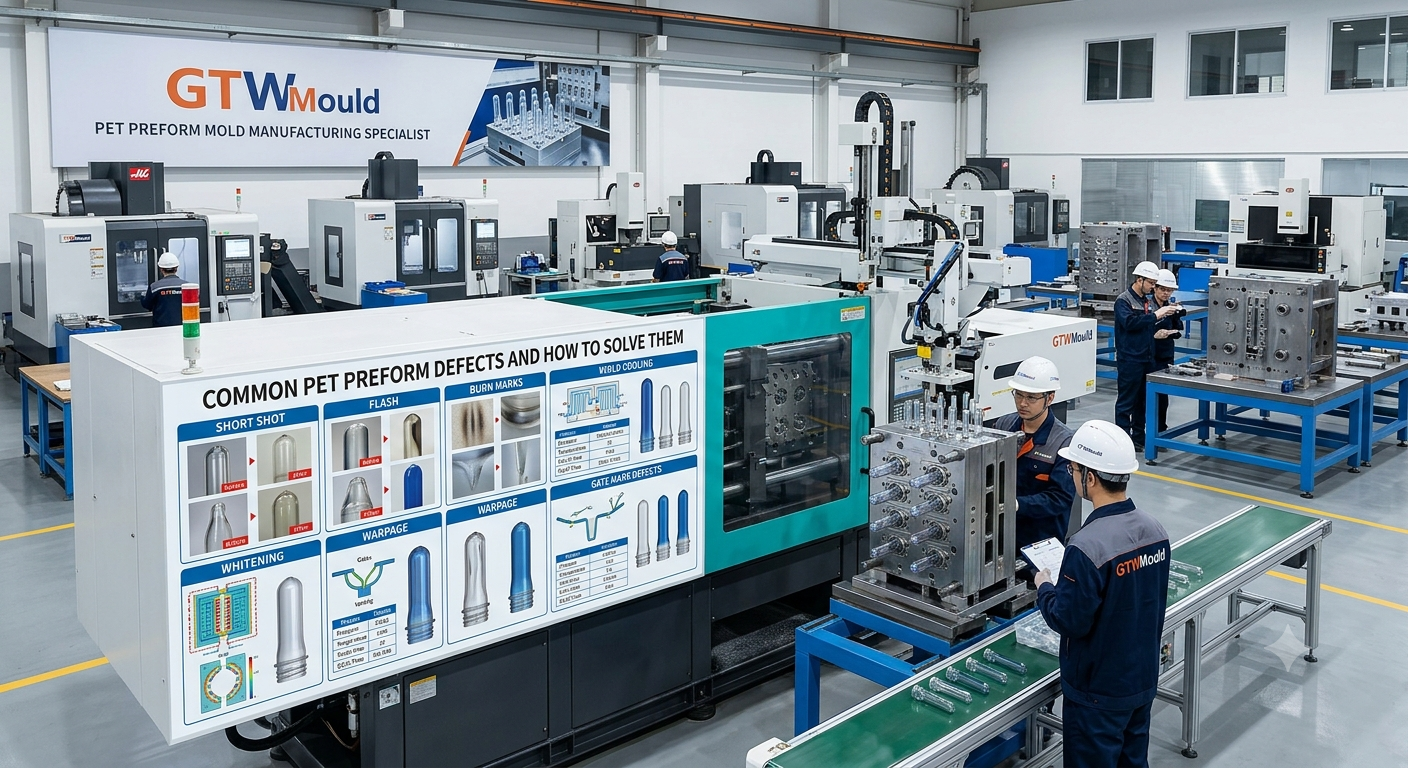
Common PET Preform Defects and How to Solve Them
A Deep Technical Troubleshooting Guide & Tooling Optimization Manual by GTWMOULD
Introduction: Root Cause Analysis in PET Preform Injection Molding
In high-speed PET injection molding, achieving consistent, flawless preform quality requires absolute control over melt rheology, thermodynamic cooling, and mechanical alignment. Minor variances in temperature, pressure, or component wear can manifest as structural or visual defects. Unresolved defects lead to high scrap rates, mold damage, and failure during downstream stretch blow molding.
As an industry-leading manufacturer of high-precision injection tooling, GTWMOULD engineers advanced mold systems designed to eliminate molding instability at the source. This technical guide provides a comprehensive breakdown of Common PET Preform Defects and How to Solve Them through root cause diagnosis and tooling optimization.
1. Thermal and Crystallization Defects
Thermal defects occur when cooling rates fail to rapidly quench the molten PET polymer, allowing polymer chains to form crystalline structures that ruin optical clarity and mechanical integrity.
| Preform Defect | Root Cause Analysis | Process & Tooling Solution | GTWMOULD Engineering Standard |
|---|---|---|---|
| Body Hazing / Crystallization | Insufficient cooling rate in thick cross-sections; chilled water flow is too low or water temperature is too high. | Increase water flow velocity; lower chilled water supply temperature ($6\text{--}10^\circ\text{C}$). Optimize cavity cooling channel design. | High-pitch spiral-wound cavity cooling channels combined with internal high-velocity turbulent bubblers. |
| Gate Hazing / White Gate | Excessive heat buildup around the gate area during injection; slow heat extraction at the cavity base. | Lower hot runner nozzle tip temperature; reduce hold pressure time; increase gate cooling efficiency. | Press-fitted Beryllium-Copper (BeCu) gate inserts that dissipate heat up to ten times faster than tool steel. |
| Thread Deformation / White Neck | Inadequate cooling of the neck ring area before ejection, causing material distortion during mechanical stripping. | Extend cooling time; optimize neck ring cooling water circuits; ensure proper mold parting line clearance. | Dedicated BeCu neck split inserts with independent high-flow water channels for rapid thread solidification. |
2. Structural and Geometrical Defects
Geometrical flaws weaken the preform structure, leading to off-center wall thickness, weak stretch performance, or unstable bottle bottoms.
Uneven Wall Thickness (Eccentricity)
When preform wall thickness varies across its cross-section, the thinner side stretches faster during blow molding, resulting in uneven bottle strength or wall blowouts.
- Root Cause: Core pin deflection caused by unbalanced injection pressure, worn centering tapers, or loose cavity alignment.
- GTWMOULD Solution: We implement a proprietary triple-taper self-locking alignment design for each cavity stack. By maintaining sub-micron mechanical tolerances:
$$\Delta \le 0.015 \text{ mm}$$
This alignment system keeps total wall-thickness variation strictly under 0.03mm, completely preventing core shift under high injection pressures.
Gate Tailing, Stringing, and Protrusion
Long gate vestiges or stringing strings interfere with downstream preform loading arms, stretch rods, and base cooling.
- Root Cause: Excessive hot runner tip temperature, damaged mechanical valve pins, or improper pneumatic shut-off timing.
- GTWMOULD Solution: Integration of an advanced pneumatically actuated valve gate hot runner system. Individual pneumatic pins mechanically seal the gate flush with the base, delivering a smooth, clean gate profile with zero stringing.
3. Material Degradation and Aesthetic Surface Defects
Cosmetic defects and chemical degradation compromise product shelf appearance and food-grade packaging safety compliance.
High Acetaldehyde (AA) Levels
Acetaldehyde is a byproduct of PET thermal degradation. Elevated AA levels transfer an off-taste to bottled mineral water and beverages.
- Root Cause: Overheating the PET melt inside the barrel or hot runner manifold, high shear stress in narrow runner paths, or prolonged dwell time.
- Tooling Solution: Utilize FEA-optimized, naturally balanced manifold channels with micro-polished interior flow paths to ensure low-shear, uniform resin delivery across all cavities.
Bubbles, Moisture Marks, and Flash
- Bubbles / Voids: Caused by trapped air or excessive shrinkage in thick preform sections. Solved by increasing hold pressure and optimizing pack time.
- Silver Streaks / Moisture Marks: Caused by inadequately dried resin (PET moisture content must remain below 0.005%). Solved by verifying desiccant dryer dew point ($-40^\circ\text{C}$).
- Preform Flash: Excess plastic along parting lines caused by excessive clamping pressure, damaged neck split surfaces, or worn cavity faces. Solved by refurbishing mold parting lines and re-calibrating clamping force.
4. Premium Tool Metallurgy and Preventative Maintenance
Eliminating defects long-term requires superior tooling materials capable of withstanding continuous production stresses without mechanical degradation.
- Swedish S136 Stainless Steel: Cores, cavities, and neck splits are manufactured from vacuum-hardened S136 steel ($48\text{--}52 \text{ HRC}$), providing exceptional resistance to mechanical wear and corrosive PET off-gassing.
- Diamond-Like Carbon (DLC) Coatings: High-wear sliding components, such as neck split slides, feature DLC coatings. This enables dry, grease-free mechanical operation, preventing oil contamination on preforms.
- Corrosion-Resistant AISI 420 Mold Base: Stainless steel plates prevent oxidation within cooling channels, ensuring consistent heat transfer over years of operation.
Conclusion: Partnering with China's Premier Preform Tooling Expert
Resolving Common PET Preform Defects requires a combination of precise process control, advanced thermodynamic cooling, and sub-micron tool engineering. **GTWMOULD** engineers high-cavitation PET preform molds designed to eliminate production defects, reduce cycle times, and maximize yield.
Partner with GTWMOULD to upgrade your bottling and injection molding lines with high-performance preform tooling built for absolute precision, durability, and operational efficiency.