
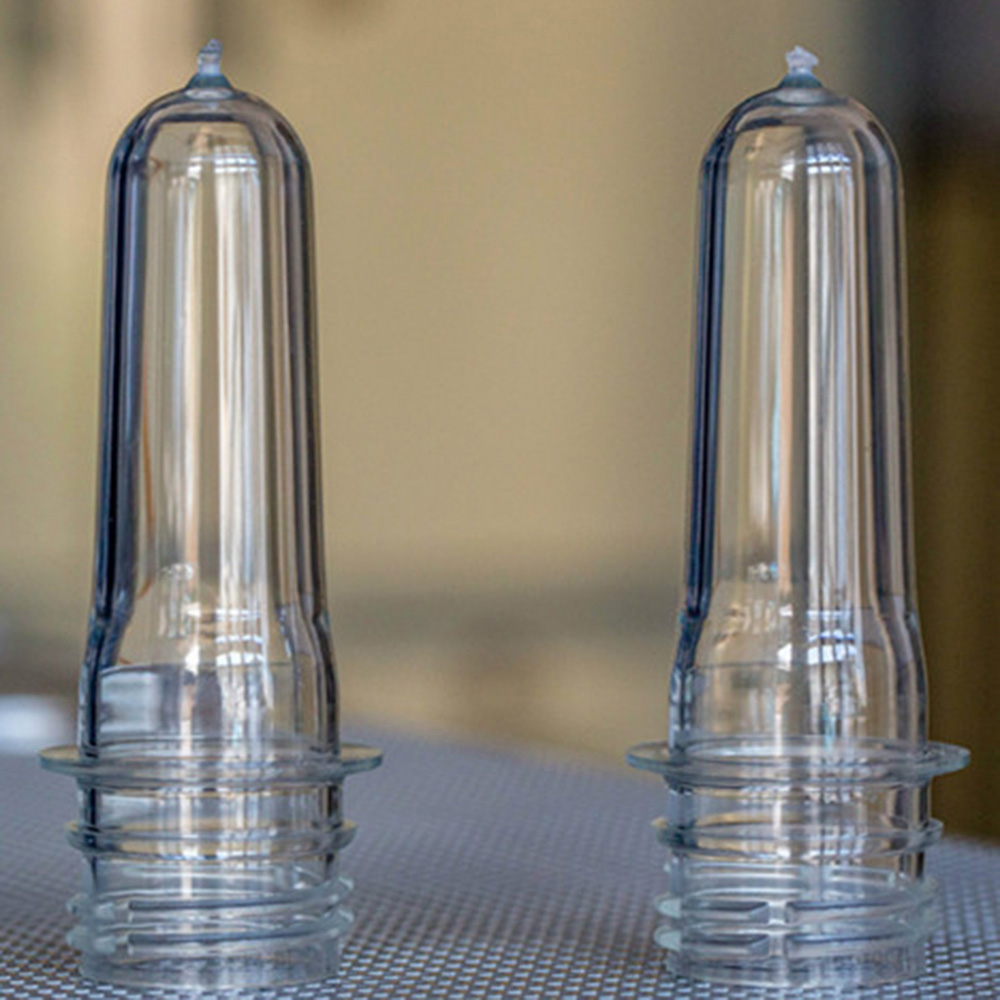
Case Study: Upgrading from 48-Cavity to 96-Cavity — A Customer's Capacity Expansion Journey
A Technical & Financial Engineering Analysis on High-Cavitation Tooling, Machine Interface Retrofitting, and Operational Throughput Multiplication by GTWMOULD
Executive Summary: Doubling Throughput Without Doubling Floor Space
In high-speed Polyethylene Terephthalate (PET) preform manufacturing, scaling production output to meet growing beverage market demands often presents a dilemma: invest in new injection molding machinery and facility expansion, or double cavitation within existing machine footprints. For high-volume bottle converters and multinational beverage brands, doubling cavitation on existing injection presses yields the highest return on capital investment by maximizing plant floor productivity.
This technical case study details how GTWMOULD, a premier Chinese manufacturer specializing in high-precision PET preform tooling solutions, partnered with a major packaging converter to upgrade an active packaging line from a 48-cavity to a 96-cavity PET preform mold. By integrating FEA-optimized hot runner manifolds, sub-micron mechanical core alignment, and hyper-conductive thermal management, GTWMOULD doubled daily output while compressing cycle times and maintaining strict dimensional tolerances.
1. The Scaling Challenge: The Constraints of Legacy 48-Cavity Systems
The client operated a high-volume beverage packaging plant supplying 18.5-gram water preforms (28mm PCO 1881 finish). Faced with a 90% increase in regional demand, their existing 48-cavity system created severe operational bottlenecks:
Key Production & Technical Bottlenecks
- Floor Space & Capital Constraints: Adding a second injection molding press required $1.2M+ in machinery, auxiliary dehumidifiers, and additional plant square footage.
- Thermal & Pressure Imbalance: Simply scaling mold plate dimensions introduced risks of melt pressure drops, runner shear heating, and Acetaldehyde (AA) degradation ($> 3.0 \text{ ppm}$).
- Clamping Force & Weight Tolerances: Doubling the cavity count within the press tie-bar distance required minimizing mold weight and optimizing clamping force distribution to prevent parting line flash.
2. GTWMOULD Technical Engineering Interventions
GTWMOULD conducted a full Computer-Aided Engineering (CAE) mold flow analysis and structural finite element analysis (FEA) to retrofit a high-density 96-cavity mold onto the client's existing 400-ton PET injection press.
| Engineering Sub-System | 48-Cavity Baseline Tool | GTWMOULD 96-Cavity Upgrade Solution | Quantified Operational Outcome |
|---|---|---|---|
| Cavitation Density & Pitch | Standard 48-cavity layout ($12 \times 4$) with wide pitch spacing. | High-density 96-cavity layout ($12 \times 8$) using compact, high-efficiency plate geometries. | 100% capacity boost within the existing press tie-bar envelope. |
| Hot Runner System | Conventional branching manifold prone to localized shear heating. | Naturally balanced, FEA-simulated 96-drop valve gate hot runner with polished flow channels. | Identical pressure drop ($\Delta P \approx 0 \text{ bar}$) across all 96 drops; AA levels kept $< 1.8 \text{ ppm}$. |
| Core Alignment Integrity | Standard taper locking prone to shift under high injection pressures. | Proprietary triple-taper self-locking component alignment system. | Core-to-cavity concentricity locked strictly within $\Delta \le 0.015 \text{ mm}$. |
| Thermal Quenching Design | Standard drilled cooling channels with localized heat accumulation. | High-pitch spiral cavity cooling loops with press-fitted Beryllium-Copper (BeCu) inserts. | Compressed total cycle time from 12.5s down to 9.8s. |
3. Sub-Micron Alignment and Mechanical Repeatability
Doubling cavitation inside an existing platen area narrows cavity pitch spacing, making core pin rigidity and thermal management paramount. Under high hydraulic injection pressures ($1200 \text{ bar}$), core pin deflection causes severe wall thickness variation, resulting in thin spots that fail during stretch blow molding.
Triple-Taper Mechanical Lockup
GTWMOULD resolved core stability issues by embedding a triple-taper interlocking architecture across every cavity drop:
$$\text{Core-to-Cavity Concentricity Limit: } \Delta \le 0.015 \text{ mm}$$
By securing the core pin, cavity insert, and neck split individually along three independent precision mechanical tapers, core deflection is completely neutralized. This restricts total preform wall variation under $0.025 \text{ mm}$ across all 96 cavities, guaranteeing 100% downstream blow-molding yield.
Low-Friction Dry Operation
Neck split slider components were coated with Diamond-Like Carbon (DLC) surface treatments, allowing oil-free mechanical movement that eliminates lubricant contamination on preform thread finishes during fast 9.8-second cycle stripping.
4. Metallurgical Superiority and Production ROI Metrics
To sustain 24/7 continuous high-speed production over multi-million cycles, GTWMOULD built the 96-cavity tool with premium certified materials:
- Certified Swedish S136 Stainless Steel: Vacuum-hardened to $48\text{--}52 \text{ HRC}$, providing complete immunity against corrosive polymer outgassing and internal cooling channel rust scale.
- Hyper-Conductive BeCu Gate Inserts: Heat-dissipating alloy blocks extract thermal energy instantly at the gate base, preventing gate hazing and thermal crystallization.
- AISI 420 Stainless Steel Mold Frame: Maintains structural stability under heavy clamping tonnage while protecting internal water circuits from oxidation.
Quantified Production Results Post-Commissioning
- Daily Output Growth: Daily production expanded from 330,000 units (48-cavity @ 12.5s) to over 845,000 units (96-cavity @ 9.8s)—a net 156% output increase on the same press line.
- Energy Consumption Reduction: Reduced specific energy consumption (kWh/kg of processed PET) by 28% due to higher volumetric output per motor cycle.
- Scrap Rate Minimization: Post-commissioning production rejection rate dropped from 2.1% to under 0.12%.
- Capital Payback Period: The client fully recovered their tooling upgrade investment within 4.5 months of continuous operation.
Conclusion: Partner with GTWMOULD for High-Cavitation Scaling
This case study proves that doubling preform production capacity does not require purchasing new injection machines or expanding factory facilities. Upgrading to high-density, multi-cavity tooling through GTWMOULD delivers massive capacity scaling, lower unit manufacturing costs, and rapid ROI.
By mastering sub-micron component alignment, rheologically balanced hot runner design, and rapid thermal quenching, GTWMOULD serves as a trusted technical partner for beverage bottlers and packaging converters worldwide.
Contact GTWMOULD's technical engineering team today to evaluate your plant's capacity expansion potential and receive a customized high-cavitation tooling proposal.