
Case Study: Producing Lightweight Preforms for Hot-Fill Beverage Applications
A Technical Engineering Analysis on Thermal Crystallization, Neck Finish Integrity, and Material Optimization in High-Temperature Packaging by GTWMOULD
Executive Summary: Balancing Weight Reduction with Thermal Stability
Hot-fill beverage processing—typically operating between $82^\circ\text{C}$ and $95^\circ\text{C}$ for juices, teas, and functional sports drinks—presents unique engineering challenges for Polyethylene Terephthalate (PET) packaging. Unlike carbonated soft drink (CSD) or ambient water bottles, hot-fill containers must withstand severe thermal vacuum forces post-capping without thermal distortion, panel panelling, or neck finish deformation.
For high-volume converters, reducing preform weight is the primary lever for cutting unit manufacturing costs and resin consumption. However, lightweighting hot-fill preforms without compromising neck finish rigidity risks cap seal failure and vacuum leaks. This technical case study examines how GTWMOULD, a premier Chinese manufacturer and specialized PET preform tooling solution provider, engineered a custom lightweight hot-fill preform tooling solution that reduced preform weight by 14% while preserving full thermal structural integrity.
1. The Engineering Challenge: Lightweighting Under High Thermal Loads
A multinational juice beverage producer sought to optimize its 500 ml hot-fill line ($88^\circ\text{C}$ filling temperature). Their legacy 28g preform utilized a heavy crystallized neck finish (38mm 3-lead finish) to prevent neck distortion during thermal capping. The client faced three critical engineering constraints:
Key Technical Bottlenecks
- Neck Finish Ovality & Thermal Shrinkage: Thinning the neck wall risked thermal deformation during hot juice filling, causing cap leakages and vacuum seal loss.
- Crystallization Hazing & Cycle Penalties: Conventional hot-fill tooling required long mold residence times to induce thermal resistance, increasing total cycle times to over 16 seconds.
- Acetaldehyde (AA) & Intrinsic Viscosity (IV) Sensitivity: Elevated melt temperatures needed for delicate wall transitions risked shear degradation and AA spikes ($> 2.5 \text{ ppm}$).
2. GTWMOULD Technical & Tooling Innovations
GTWMOULD performed rigorous Finite Element Analysis (FEA) structural simulations and thermal dissipation modeling to redesign the preform geometry and mold cooling sub-systems, successfully dropping target weight from 28g to 24g.
| Engineering Sub-System | Legacy 28g Hot-Fill Tooling | GTWMOULD 24g Lightweight Solution | Quantified Operational Impact |
|---|---|---|---|
| Neck Finish Geometry | Heavy, thick-walled 38mm neck finish designed for passive thermal resistance. | Optimized thin-wall rib-reinforced neck finish profile with precise thread root radii. | 14% direct resin savings ($4.0\text{g}$ saved per preform) without capping deformation. |
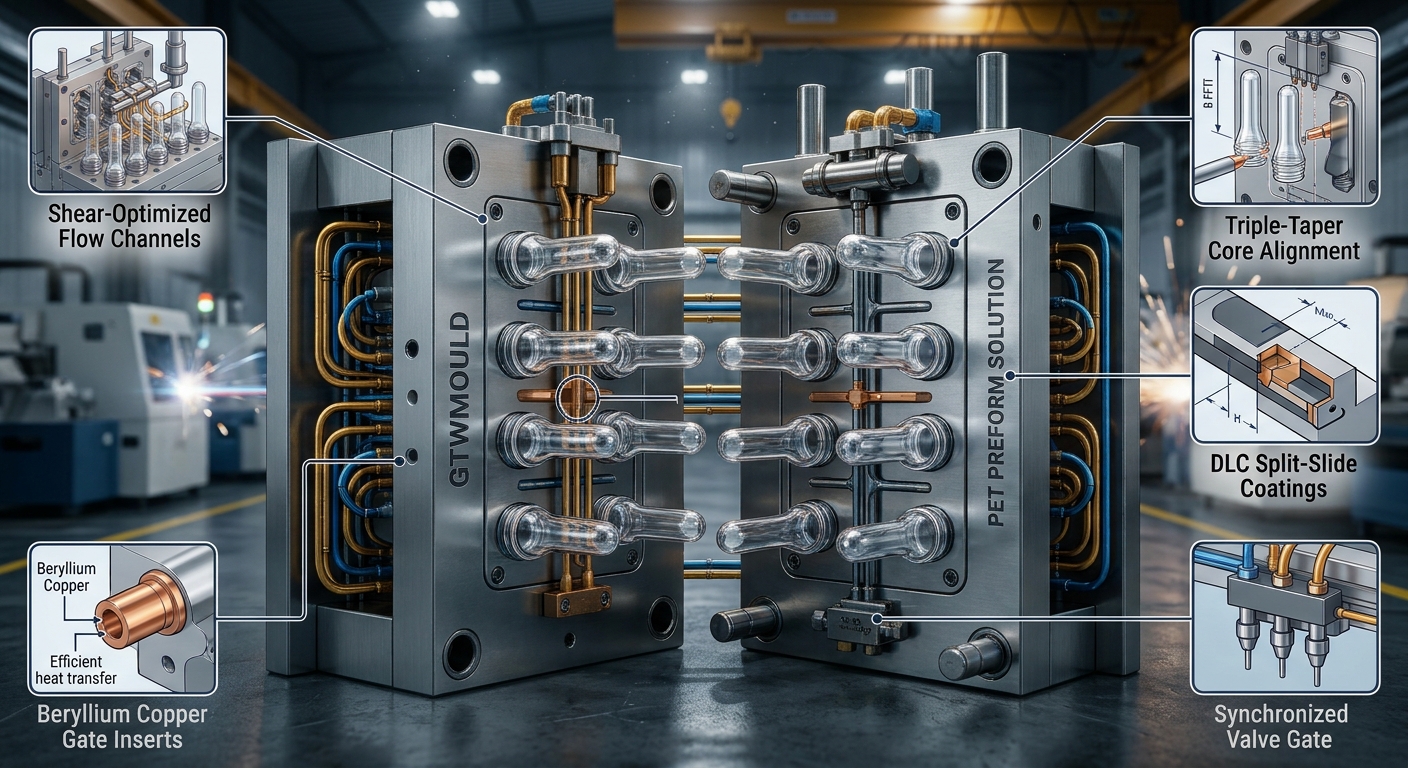
| Thermal Quenching Architecture | Standard drilled cooling channels with slow thermal extraction around the neck base. | Press-fitted Beryllium-Copper (BeCu) neck split inserts paired with high-pitch spiral cavity loops. | Cycle time compressed from 16.2s down to 11.4s (29.6% efficiency gain). |
| Concentricity Control | Standard taper alignment prone to thermal expansion misalignment. | Proprietary triple-taper self-locking component alignment system. | Core-to-cavity concentricity held strictly within $\Delta \le 0.015 \text{ mm}$. |
| Melt Distribution System | Conventional thermal gate runner prone to shear heating and gate tailing. | Naturally balanced pneumatic valve gate hot runner with micro-polished flow paths. | Acetaldehyde (AA) levels kept strictly $< 1.5 \text{ ppm}$; flush gate vestige $\le 0.2 \text{ mm}$. |
3. Sub-Micron Alignment and Wall Thickness Uniformity
Lightweighting hot-fill preforms narrows the wall thickness tolerance window. Any core pin deflection caused by asymmetric injection pressure forces leads to wall eccentricity. Thin sidewalls warp during hot filling, causing vacuum panelling and bottle failure.
Triple-Taper Mechanical Lockup Architecture
GTWMOULD eliminated core deflection by embedding a triple-taper interlocking system across every cavity stack, maintaining core-to-cavity concentricity strictly within:
$$\Delta \le 0.015 \text{ mm}$$
This restricts total wall thickness variation under $0.025 \text{ mm}$ across all cavities, ensuring uniform stretch ratios and consistent material distribution during stretch blow molding.
Low-Friction Dry Operation
Neck split slider mechanisms were coated with Diamond-Like Carbon (DLC) surface treatments. This enables clean, oil-free mechanical actuation, eliminating lubricant contamination risks on preform neck finishes during rapid stripping.
4. Premium Metallurgy and Production Performance ROI
To sustain high-speed production over multi-million cycles under aggressive thermal conditions, GTWMOULD built the tool using certified high-grade metallurgy:
- Certified Swedish S136 Stainless Steel: Cavity inserts and core pins utilize electro-slag remelted (ESR) Swedish S136 steel vacuum-hardened to $48\text{--}52 \text{ HRC}$, offering total corrosion resistance against cooling water scale and acidic resin outgassing.
- Hyper-Conductive BeCu Neck Inserts: High thermal conductivity alloy inserts rapidly dissipate heat at the neck thread and gate base, preventing thermal crystallization hazing and maintaining crystal clarity.
Quantified Production Results Post-Commissioning
- Resin Consumption Savings: Saving 4.0g per preform yielded over $480,000 in raw material cost savings per annum per 48-cavity machine line.
- Throughput Increase: Reducing cycle time from 16.2s to 11.4s increased daily output from 256,000 to over 363,000 preforms on the same injection press.
- Hot-Fill Compliance Yield: Downstream bottle hot-fill thermal distortion testing achieved a 99.94% pass rate at $88^\circ\text{C}$ filling temperature.
Conclusion: Partner with GTWMOULD for Hot-Fill Tooling Innovation
This case study proves that lightweighting hot-fill beverage preforms does not require compromising container strength or capping integrity. Through FEA-guided geometric optimization, hyper-conductive thermal management, sub-micron concentricity control, and certified tool steel metallurgy, **GTWMOULD** delivers industry-leading PET preform molds engineered for maximum performance and minimum material cost.
Contact GTWMOULD's technical engineering team today to evaluate your hot-fill preform lightweighting potential and receive a tailored tooling proposal.