
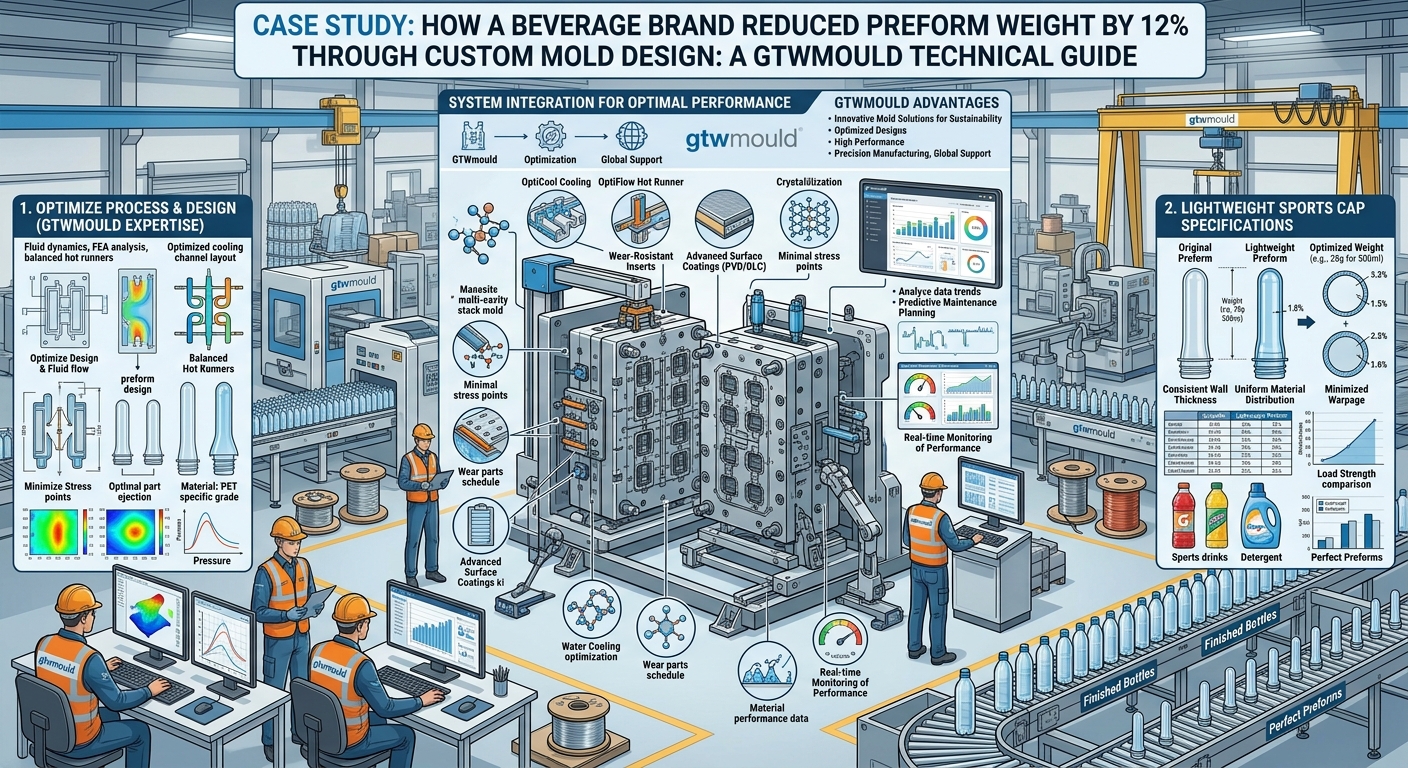
Case Study: How a Beverage Brand Reduced Preform Weight by 12% Through Custom Mold Design
A Technical Engineering Analysis on Resin Optimization, Structural Integrity, and Tooling Precision by GTWMOULD
Executive Summary: The Economic Imperative of Lightweighting
In high-speed, continuous beverage packaging operations, raw PET resin accounts for up to 80% of total preform manufacturing expenditure. For global beverage brands running high-cavitation injection lines, even fractional weight reductions yield immense annual cost savings while advancing corporate sustainability metrics. However, aggressive lightweighting often triggers critical failure modes during downstream stretch blow molding, such as stress cracking, top-load weakness, and non-uniform wall distribution.
This technical case study explores how GTWMOULD, a premier Chinese manufacturer specializing in high-precision PET preform tooling, engineered a custom preform mold solution that enabled a leading multinational beverage enterprise to achieve a 12% reduction in preform weight without compromising bottle top-load strength or stretch-blow yield.
1. The Challenge: Overcoming Structural Failures in Lightweight Preform Design
The client operated a high-cavitation bottled water packaging line producing 500mL containers. Prior to partnering with GTWMOULD, the brand utilized standard 14.5-gram preforms. Due to rising raw material tariffs and carbon footprint mandates, the client targeted a weight reduction down to 12.76 grams—a 12% net resin saving.
Initial Project Bottlenecks with Conventional Tooling
- Wall Thickness Eccentricity: Core pin deflection under high injection pressures caused thin wall spots. During infrared reheating, thin sections absorbed heat too rapidly, leading to localized blowouts.
- Crystallization at the Gate Zone: Reducing wall thickness meant accelerating injection speed, which induced thermal shear stress and gate hazing (crystallization), weakening the base of the blown bottle.
- Top-Load Strength Collapse: Conventional preform geometry adjustments compromised axial load resistance, causing filled bottles to collapse during pallet stacking and transport.
2. The Engineering Solution: Custom Mold Redesign by GTWMOULD
GTWMOULD applied a comprehensive, multi-disciplinary engineering approach combining Finite Element Analysis (FEA) preform profile optimization, sub-micron mechanical alignment, and hyper-conductive thermal management.
| Engineering Sub-System | Technical Defect / Bottleneck | GTWMOULD Custom Engineering Intervention | Quantified Operational Outcome |
|---|---|---|---|
| Preform Profile Geometry | Inadequate stretch ratios and poor resin distribution during biaxial orientation. | FEA-assisted redesign of preform transition zone, optimizing wall-taper and neck transition angle. | Maintained baseline top-load structural strength (≥220 N) despite 12% mass reduction. |
| Core Alignment Security | Core displacement under $1200 \text{ bar}$ injection pressure causing wall variation ($\Delta > 0.05 \text{ mm}$). | Integration of proprietary triple-taper self-locking component alignment system across every cavity stack. | Core concentricity held strictly within $\Delta \le 0.015 \text{ mm}$; wall variation restricted under $0.02 \text{ mm}$. |
| Hot Runner System | High shear stress, thermal degradation, and Acetaldehyde (AA) generation at elevated injection speeds. | Low-shear, naturally balanced valve gate hot runner system with micro-polished flow channels. | Preserved resin Intrinsic Viscosity (IV) and maintained AA levels below $2.0 \text{ ppm}$. |
| Thermodynamic Cooling | Slow cooling in thin-wall transition zones causing amorphous hazing. | High-pitch spiral cavity cooling loops combined with press-fitted Beryllium-Copper (BeCu) neck and gate inserts. | Achieved ultra-fast thermal quenching, reducing overall cycle time by 14%. |
3. Sub-Micron Precision and Structural Alignment Integrity
Achieving extreme lightweighting requires eliminating mechanical tolerances that cause core shifting. When wall thickness is reduced to absolute physical limits, core deflection creates immediate material deficiencies.
Triple-Taper Mechanical Lockup
GTWMOULD engineered an independent triple-taper interlocking architecture for each cavity stack:
$$\text{Core-to-Cavity Concentricity Limit: } \Delta \le 0.015 \text{ mm}$$
By locking the core pin, cavity insert, and neck split individually along three precise taper interfaces, core deflection under hydraulic pressure was completely neutralized. This guaranteed uniform wall thickness distribution, enabling the preform to stretch evenly during downstream high-pressure blowing ($35 \text{ bar}$).
4. Metallurgical Excellence and Production Results
To sustain 24/7 high-speed production over multi-million cycles, GTWMOULD built the custom tool using premium certified metallurgical components:
- Swedish S136 Tool Steel Inserts: Vacuum-hardened to $48\text{--}52 \text{ HRC}$, providing exceptional wear resistance and corrosion protection against acidic outgassing.
- Diamond-Like Carbon (DLC) Slide Coatings: Applied to neck split sliders to enable oil-free, dry mechanical operation, keeping bottle neck finishes free from grease contamination.
- AISI 420 Stainless Steel Mold Base: Prevents oxidation in chilled water lines, preserving thermal heat extraction efficiency over years of continuous operation.
Quantified Project Outcomes
- Resin Mass Savings: Preform weight successfully reduced from 14.5g to 12.76g (12% reduction).
- Annual Cost Reduction: Saved approximately 312 metric tons of PET resin per line annually, translating to over $340,000 in direct raw material savings per year.
- Cycle Time Acceleration: Compressed total injection cycle time from 12.8 seconds to 11.0 seconds due to thinner wall sections and hyper-conductive BeCu cooling.
- Scrap Rate Reduction: Downstream blow molding rejection rate dropped from 1.8% to under 0.2%.
Conclusion: GTWMOULD — Your Custom PET Preform Solution Specialist
This case study demonstrates that successful preform lightweighting goes far beyond simply removing material from a preform drawing. It requires an advanced, engineering-led approach that integrates FEA profile modeling, sub-micron core alignment, low-shear valve gate hot runner control, and rapid thermal quenching.
**GTWMOULD** stands at the forefront of custom PET preform mold engineering, helping global beverage brands and packaging converters maximize resin savings, accelerate cycle times, and achieve superior container performance.
Contact GTWMOULD today to partner with our technical engineering experts and optimize your PET preform manufacturing lines.