
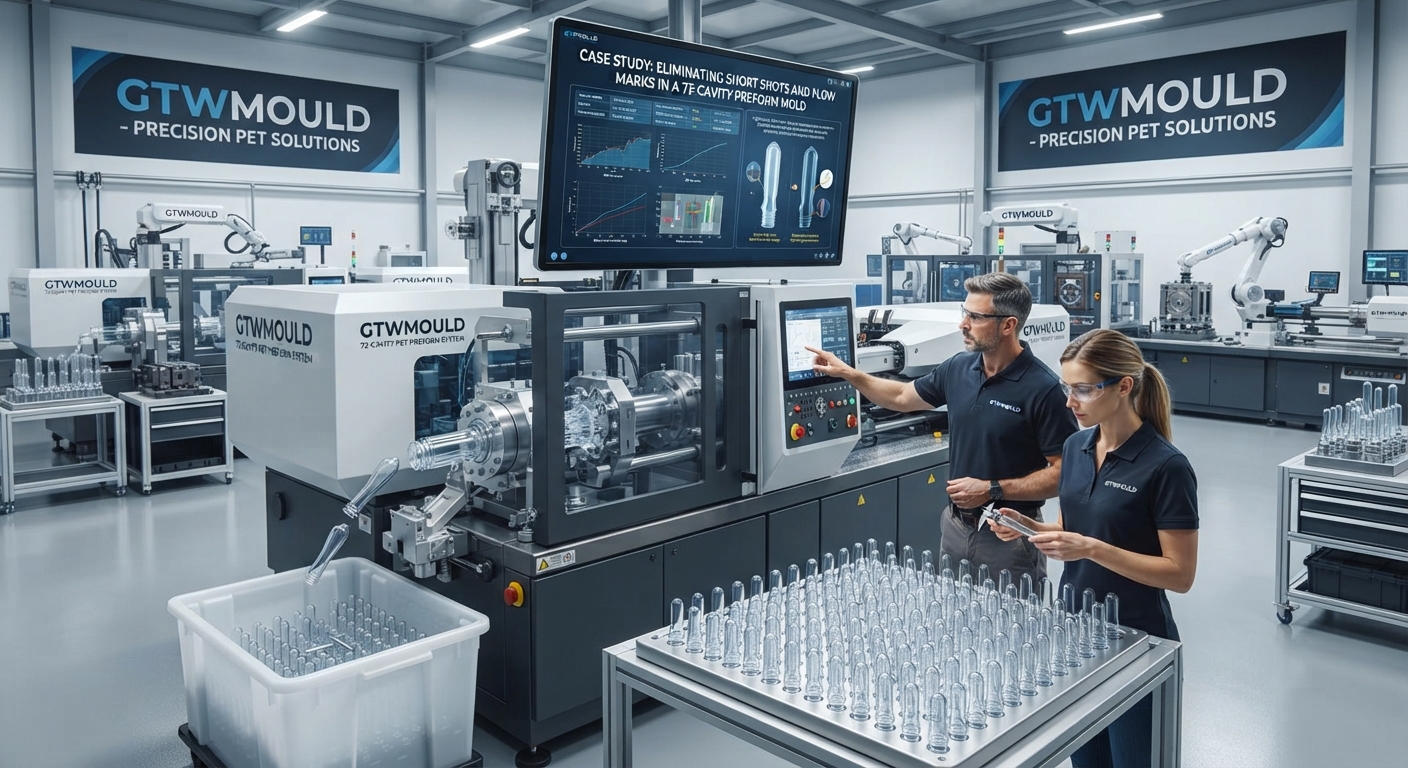
Case Study: Eliminating Short Shots and Flow Marks in a 72-Cavity Preform Mold
A Technical Deep Dive into Rheological Balancing, Micro-Venting, and Multi-Cavity Flow Dynamics by GTWMOULD
Executive Summary: High-Cavitation Molding Challenges
In high-speed, high-cavitation Polyethylene Terephthalate (PET) preform production, maintaining perfect filling balance across all cavity drops is critical. As mold cavitation scales to 72 drops and beyond, minor thermal variations, pressure drops, or air entrapment quickly manifest as operational defects—specifically short shots (incomplete filling) and flow marks (wavy surface freeze lines).
This technical case study examines how GTWMOULD, a premier Chinese engineering manufacturer specializing in high-precision PET preform tooling, analyzed, re-engineered, and resolved severe short shot and flow mark issues in a customer's 72-cavity water preform mold line. Through advanced multi-cavity hot runner rheology, sub-micron venting, and precision thermal management, GTWMOULD delivered a 100% defect-free manufacturing solution.
1. Problem Diagnosis: Analyzing Root Causes in 72-Drop Tooling
A global beverage bottle converter experienced unacceptable scrap rates exceeding 6.5% on a 72-cavity PET preform line producing 18-gram neck-finish preforms. The plant encountered two persistent quality failures:
Key Technical Defects Identified
- Peripheral Cavity Short Shots: Outer edge cavities failed to fill completely, especially during high-speed injection cycles aimed at compressing overall cycle time.
- Visible Flow Marks Near Gate & Body Transition: Preforms exhibited concentric wavy lines along the body transition zone, caused by premature polymer front freezing prior to full mold packing.
- Thermal Degradation & AA Spikes: Raising processing temperatures to force-fill short cavities caused resin degradation, elevated Acetaldehyde (AA) levels ($>3.5 \text{ ppm}$), and gate hazing.
2. Technical Root Cause Analysis
GTWMOULD's engineering team performed complete CAD/CAE simulations and mold flow diagnostics on the competitor's tool, pinpointing three core structural deficiencies:
| Defect Category | Observed Defect & Impact | Identified Root Cause | GTWMOULD Re-Engineering Solution |
|---|---|---|---|
| Short Shots | Outer cavities unfilled; required excessive pressure ($>1450 \text{ bar}$) to fill. | Unbalanced branching in runner channel layout causing uneven melt distribution and pressure drops. | FEA-designed naturally balanced hot runner manifold with identical flow lengths and diameters across all 72 drops. |
| Flow Marks | Wavy surface lines on preform body destroying optical clarity. | Slow melt front velocity combined with localized cavity wall chilling prior to pack phase. | High-velocity spiral cooling loops paired with BeCu inserts to maintain precise, uniform temperature profiles. |
| Air Trap / Diesel Effect | Charred gate spots and incomplete thread filling. | Inadequate cavity parting-line venting, trapping compressed air during fast injection. | Sub-micron micro-venting channels along parting lines and neck splits ($0.012\text{--}0.015 \text{ mm}$). |
3. GTWMOULD Engineering Interventions & Implementation
1. FEA-Optimized Naturally Balanced Hot Runner System
GTWMOULD completely redesigned the 72-cavity hot runner manifold. Utilizing Finite Element Analysis (FEA) polymer melt simulation, the manifold channels were re-routed to ensure that every drop from Cavity 1 to Cavity 72 experiences identical shear rates, residence time, and pressure drop:
$$\Delta P_{\text{cavity}} \approx 0 \text{ bar across all 72 drops}$$
Micro-polished channel interiors further reduced flow resistance, allowing smooth, low-pressure filling ($<950 \text{ bar}$) without requiring elevated melt temperatures.
2. Synchronized Pneumatic Valve Gate Shut-Off
To eliminate stringing, drooling, and flow marks during gate closure, GTWMOULD implemented an individual pneumatic valve gate mechanism featuring hardened, micro-finished shut-off pins. Actuation timing across all 72 drops was synchronized within milliseconds, ensuring identical volumetric dosing.
3. Precision Sub-Micron Micro-Venting Channels
To prevent diesel-effect burning and short shots caused by trapped air, GTWMOULD incorporated specialized ground micro-venting grooves on neck split faces and parting lines. These vents allow trapped gases to escape instantaneously during high-speed injection while holding a tight tolerance to prevent resin flash:
$$\text{Venting Gap Depth: } 0.012 \text{ mm} \le h_{\text{vent}} \le 0.015 \text{ mm}$$
4. Triple-Taper Alignment and Hyper-Conductive Thermal Control
- Triple-Taper Component Alignment: Locks core pins, cavity inserts, and neck rings along three independent mechanical tapers, ensuring concentricity ($\Delta \le 0.015 \text{ mm}$) and preventing uneven wall thickness.
- Beryllium-Copper (BeCu) Gate & Neck Inserts: High thermal conductivity inserts rapidly quench the gate base and thread finish, completely eliminating flow lines and thermal crystallization.
4. Production Results and Quantified Metrics
Following delivery and installation of the GTWMOULD 72-cavity preform tool, the client achieved outstanding manufacturing results during commissioning:
- Zero Short Shots & Flow Marks: 100% uniform filling achieved across all 72 cavities simultaneously at lower injection pressure ($920 \text{ bar}$).
- Scrap Rate Reduction: Production rejection rate dropped from 6.5% down to under 0.15%.
- Cycle Time Acceleration: Overall cycle time compressed from 14.2 seconds to 10.8 seconds (a 24% increase in daily output).
- Acetaldehyde (AA) Control: AA levels remained well below strict still-water industry standards ($<1.8 \text{ ppm}$).
- Tool Durability: Machined from vacuum-hardened Swedish S136 stainless steel ($48\text{--}52 \text{ HRC}$) with DLC-coated slide components, guaranteeing long-term corrosion resistance and maintenance-free operation.
Conclusion: GTWMOULD — High-Cavitation Tooling Engineering Experts
This case study proves that resolving complex defects like short shots and flow marks in high-cavitation molds requires deeply integrated tool engineering rather than trial-and-error processing adjustments. By mastering rheological balancing, micro-venting, sub-micron core concentricity, and thermal quenching, **GTWMOULD** delivers industry-leading PET preform tooling solutions.
Partner with GTWMOULD today to optimize your high-cavitation PET preform manufacturing lines and achieve zero-defect operational performance.