
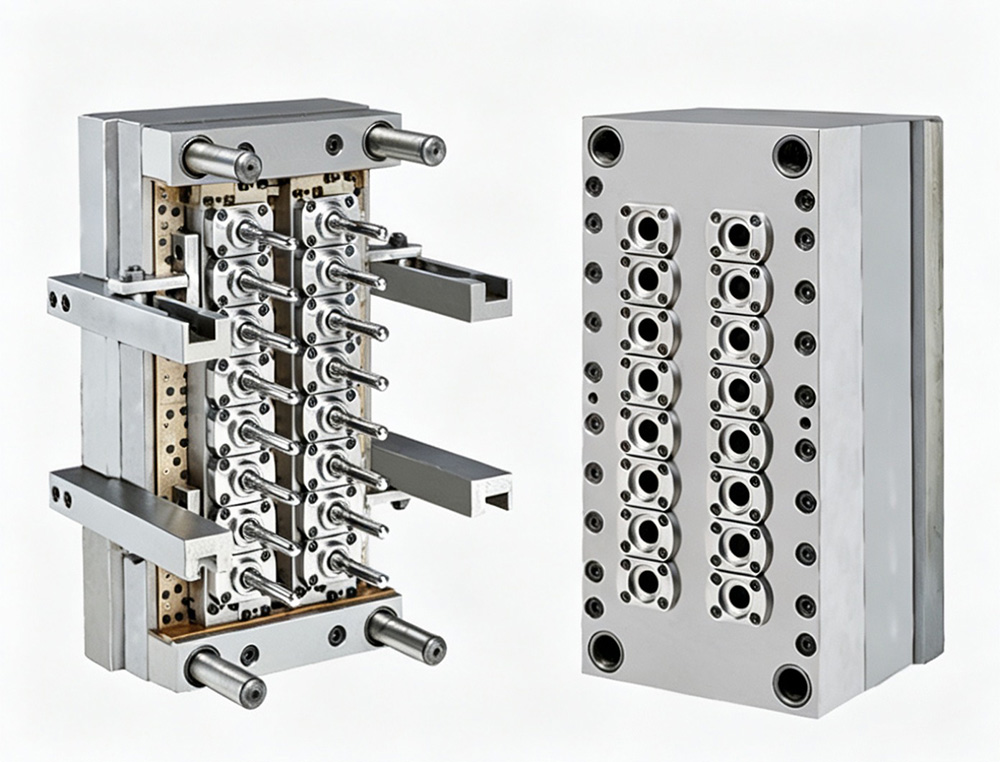
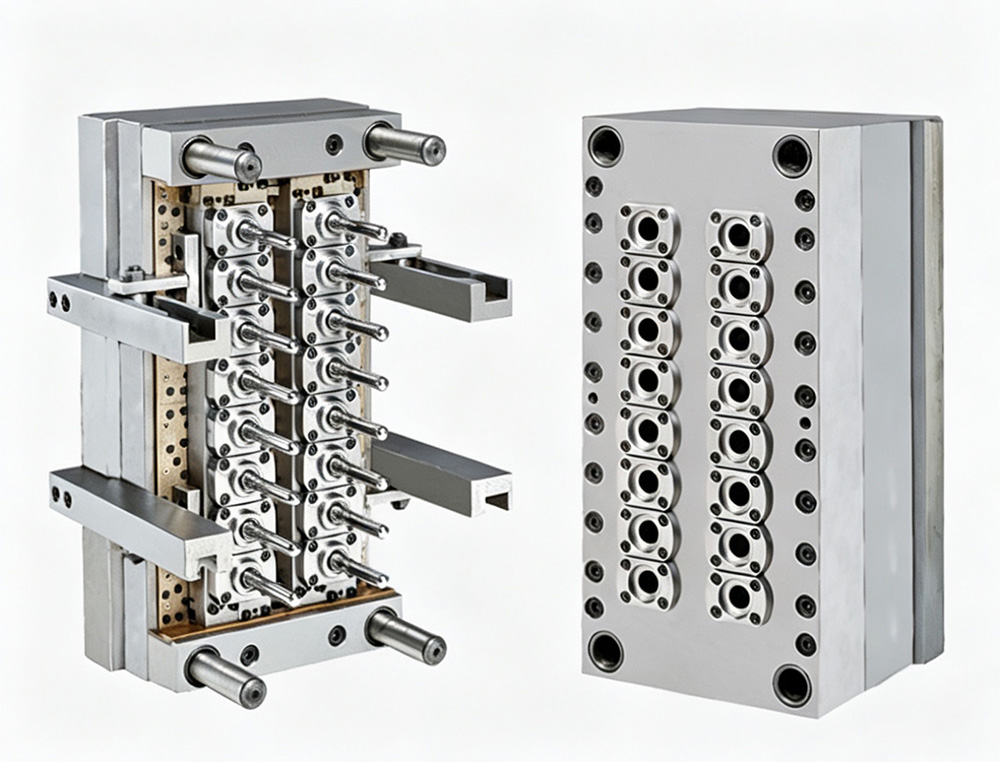
In PET preform injection molding, shrinkage is a fundamental reality. As molten PET cools from approximately 270–290°C to ejection temperature (60–80°C), it contracts. This shrinkage — if not properly controlled and compensated for — leads to dimensional inaccuracies: incorrect neck finish dimensions, inconsistent preform length, and bottles that fail to meet specifications. That is why Gutewei specializes in PET preform mold shrinkage control — providing a dimensional accuracy guide for stable preform geometry that ensures every preform meets your exact specifications.
What Is PET Shrinkage?
Shrinkage is the reduction in volume and dimensions that occurs as PET cools from its molten state to solid state. For PET, this typically ranges from:
| Dimension | Typical Shrinkage | Gutewei Compensation |
|---|---|---|
| Length (axial) | 0.4–0.8% | Mold cavity length increased accordingly |
| Diameter (radial) | 0.3–0.6% | Cavity diameter oversized |
| Neck finish (critical) | 0.2–0.4% | Precision compensated neck rings |
| Wall thickness | 0.5–1.0% | Core/cavity gap adjusted |
Without proper compensation, a 16.0g preform could shrink to 15.8g or less — affecting bottle weight, wall thickness, and blow molding performance.
Factors Affecting PET Shrinkage
| Factor | Impact on Shrinkage | Gutewei Control |
|---|---|---|
| PET material IV (intrinsic viscosity) | Higher IV = lower shrinkage | Material-specific design |
| Melt temperature | Higher temp = higher shrinkage | Consistent temperature control |
| Mold temperature | Higher mold temp = higher shrinkage | Uniform cooling, ±1.5°C |
| Cooling rate | Faster cooling = lower shrinkage | Optimized cooling design |
| Holding pressure | Higher pressure = lower shrinkage | Precision packing control |
| Cavity fill rate | Faster fill = lower shrinkage | Balanced injection |
| Crystallinity | Higher crystallinity = lower shrinkage | Controlled crystallization |
Gutewei Shrinkage Control: Technical Implementation
1. Shrinkage Prediction and Compensation
Before manufacturing any mold, Gutewei engineers calculate expected shrinkage based on:
| Input | How It Affects Shrinkage |
|---|---|
| PET material grade | Specific IV and crystallinity behavior |
| Preform geometry | Wall thickness distribution |
| Cooling system design | Cooling rate and uniformity |
| Process parameters | Temperature, pressure, cycle time |
Gutewei uses: Advanced simulation software (Moldflow) to predict shrinkage before cutting steel.
2. Cavity Dimensional Compensation
| Dimension | Gutewei Compensation Method |
|---|---|
| Cavity length | Oversized by expected axial shrinkage (0.4–0.8%) |
| Cavity diameter | Oversized by expected radial shrinkage (0.3–0.6%) |
| Neck finish dimensions | Precision compensation per standard (PCO, ALCO, custom) |
| Core pin diameter | Undersized by expected wall thickness shrinkage |
| Gate area | Compensated for shrinkage at thickest section |
Result: After cooling, the preform shrinks to exactly your target dimensions.
3. Neck Finish Precision Control
The neck finish is the most critical dimension — it determines capping compatibility and sealing performance.
| Neck Dimension | Gutewei Tolerance | Compensation Method |
|---|---|---|
| Neck outside diameter | ±0.02mm | Neck ring oversized by expected radial shrinkage |
| Thread profile | ±0.02mm | Profile designed with shrinkage compensation |
| Support ring diameter | ±0.02mm | Compensated for axial and radial shrinkage |
| Neck height | ±0.03mm | Compensated for axial shrinkage |
4. Wall Thickness Control
Shrinkage is not uniform — thicker areas shrink more than thinner areas. Gutewei addresses this through:
| Area | Shrinkage Challenge | Gutewei Solution |
|---|---|---|
| Neck (thickest) | Highest shrinkage | Enhanced cooling, precise compensation |
| Shoulder (medium) | Moderate shrinkage | Balanced cooling |
| Body (thinnest) | Lowest shrinkage | Uniform wall thickness design |
| Gate (thickest) | Highest shrinkage | Pin cooling, gate compensation |
5. Cooling Uniformity for Dimensional Stability
Uneven cooling creates differential shrinkage — different parts of the preform shrink at different rates, causing warpage and dimensional inaccuracy.
| Cooling Feature | Gutewei Implementation | Benefit |
|---|---|---|
| Conformal cooling | Follows preform contour | Uniform cooling |
| Multi-zone control | Independent zones | Precise temperature control |
| Balanced circuits | Equal flow to all cavities | Consistent shrinkage across cavities |
| Thermal imaging verification | Pre-shipment test | Confirms cooling uniformity |
Dimensional Accuracy Guide: What to Expect
Preform Length Tolerance
| Preform Length | Gutewei Tolerance | Industry Average |
|---|---|---|
| 20–50mm | ±0.10mm | ±0.25–0.40mm |
| 50–100mm | ±0.15mm | ±0.30–0.50mm |
| 100–150mm | ±0.20mm | ±0.40–0.60mm |
| 150–200mm | ±0.25mm | ±0.50–0.80mm |
Neck Finish Tolerance
| Dimension | Gutewei Tolerance | Industry Average |
|---|---|---|
| Neck OD | ±0.02mm | ±0.05–0.08mm |
| Neck height | ±0.03mm | ±0.08–0.12mm |
| Thread depth | ±0.02mm | ±0.05–0.08mm |
| Support ring diameter | ±0.02mm | ±0.05–0.08mm |
| Ovality | ≤ 0.02mm | 0.05–0.08mm |
Preform Weight Variation
| Cavity Count | Gutewei Weight Variation | Industry Average |
|---|---|---|
| 32 cavities | ≤ 0.25% | 0.6–1.0% |
| 48 cavities | ≤ 0.30% | 0.8–1.2% |
| 72 cavities | ≤ 0.30% | 1.0–1.5% |
| 96 cavities | ≤ 0.35% | 1.2–1.8% |
Stable Preform Geometry: Complete System Features
1. Precision Machined Components
| Component | Gutewei Tolerance | Benefit |
|---|---|---|
| Core pins | ±0.005mm | Consistent wall thickness |
| Cavity blocks | ±0.005mm | Uniform outside diameter |
| Neck rings | ±0.003mm | Precise neck finish |
| Guide components | ±0.005mm | Consistent mold alignment |
2. Material Selection for Dimensional Stability
| Material | Hardness | Shrinkage Stability |
|---|---|---|
| S136 stainless steel | HRC 48–52 | Excellent — minimal thermal distortion |
| 2316 stainless steel | HRC 45–50 | Excellent — good thermal stability |
| Beryllium copper (special) | 120–180 HB | Excellent — fastest heat removal |
3. Process Parameter Recommendations
Gutewei provides recommended process parameters for shrinkage control:
| Parameter | Gutewei Recommendation | Why |
|---|---|---|
| Melt temperature | 275–285°C | Balanced shrinkage |
| Mold temperature | 8–12°C (cooling) | Fast solidification |
| Holding pressure | 600–800 bar | Reduces shrinkage |
| Cooling time | Optimized per preform | Uniform cooling |
| Ejection temperature | 60–70°C | Stable dimensions |
Common Shrinkage Problems and Solutions
| Problem | Symptom | Root Cause | Gutewei Solution |
|---|---|---|---|
| Preform too short | Length below target | Insufficient axial compensation | Increase cavity length |
| Neck OD too small | Capping loose, leakage | Insufficient radial compensation | Increase neck ring diameter |
| Wall thickness variation | Inconsistent blow | Uneven cooling | Improve cooling uniformity |
| Warped preform | Bent or curved | Differential shrinkage | Balance cooling, reduce temperature variation |
| Weight variation | Different cavity weights | Uneven shrinkage across cavities | Improve cavity balance, cooling uniformity |
Real-World Performance: Shrinkage Control in Action
| Parameter | Generic Mold | Gutewei Shrinkage-Controlled Mold |
|---|---|---|
| Preform: 0.5L water (16g) | Same | Same |
| Target length | 100.0mm | 100.0mm |
| Actual length | 99.3–99.7mm | 99.95–100.05mm |
| Length tolerance | ±0.35mm | ±0.05mm |
| Neck OD (target) | 22.00mm | 22.00mm |
| Actual neck OD | 21.88–21.96mm | 21.98–22.02mm |
| Neck OD tolerance | ±0.08mm | ±0.02mm |
| Wall thickness variation | ±0.10mm | ±0.04mm |
| Blow molding reject rate | 2.5% | 0.5% |
Shrinkage Compensation by Preform Type
| Preform Type | Typical Shrinkage | Gutewei Compensation |
|---|---|---|
| Lightweight water (10–16g) | 0.4–0.6% | Standard compensation |
| Standard water (16–24g) | 0.5–0.7% | Increased compensation |
| CSD (20–48g) | 0.5–0.8% | Higher compensation (thicker wall) |
| Edible oil (30–80g) | 0.6–1.0% | Highest compensation (thickest wall) |
| Hot fill (20–40g) | 0.5–0.7% | Heat set compensation |
Why Global Preform Manufacturers Choose Gutewei
| Buyer Requirement | Gutewei Solution |
|---|---|
| Preform meets exact length specification | Shrinkage compensation, ≤ ±0.1mm |
| Neck finish capping compatibility | ±0.02mm neck OD accuracy |
| Consistent wall thickness | Uniform cooling, precise core/cavity |
| Low blow molding reject rate | Stable geometry, ≤ 0.5% reject |
| Export/customer specifications | Verified CMM inspection report |
| Long-term dimensional stability | High quality materials, precision machining |
Quality Verification for Dimensional Accuracy
Every Gutewei mold undergoes dimensional verification before shipping:
| Test | Method | Acceptance |
|---|---|---|
| Preform length | CMM or optical measurement | ±0.1mm of target |
| Neck finish OD | CMM | ±0.02mm of target |
| Neck finish roundness | CMM | ≤ 0.02mm ovality |
| Wall thickness | Ultrasonic measurement | ≤ 0.05mm variation |
| Cavity balance | Weight all cavities | ≤ 0.30% variation |
Ready for Stable Preform Geometry?
If your current preform mold produces preforms with inconsistent dimensions — varying length, neck finish variation, or wall thickness drift — it is time to upgrade to PET preform mold shrinkage control from Gutewei. Our dimensional accuracy guide delivers stable preform geometry that ensures every preform meets your exact specifications.
Contact Gutewei today with your preform specifications — target weight, length, neck finish, material grade, and injection machine model. We will design a mold with precise shrinkage compensation for consistent dimensional accuracy.